












Rational design of ZIF-derived nanocarbon with dual metal active sites via molten salt strategy for advancing oxygen electrocatalysis
文献情報
出版日
2023-10-27
DOI
10.1039/D3QI01700A
インパクトファクター
6.569
著者
Sakshi Bhardwaj, Tribani Boruah, Ramendra Sundar Dey
原文を見る
要旨
Designing competent bifunctional oxygen electrocatalysts is imperative for developing sustainable metal–air batteries and reversible fuel cells. The issue is that efficient oxygen reduction reaction (ORR) catalysts are not necessarily good in oxygen evolution reaction (OER) and vice versa due to the difference in the binding energy of the intermediates of the oxygen reduction and evolution reactions. Thus, materials that can be employed in both are in great demand. Nevertheless, their synthesis is quite challenging due to the agglomeration of metal atoms to form nanoparticles. Therefore, here, we have synthesized Fe in Co-based zeolitic imidazolate frameworks (Fe-ZIF-67) for further formation of a bimetal catalyst comprising Fe–N4 and Co–N4 sites on 2D N-doped carbon (NC) nanosheets with a hierarchically porous structure (Fe,Co-HPNC). It was constructed as the cathode for a flexible zinc–air battery (ZAB) via a one-pot synthesis approach followed by an unusual molten-salt-assisted pyrolysis strategy using eutectic salts, which is responsible for the formation of the bimetal in the nanocarbon sheets with exceptionally high surface area. The as-prepared catalyst exhibits remarkable bifunctional activities with a high half-wave potential of 0.84 V for the ORR, an overpotential of 310 mV at 10 mA cm−2 current density for the OER, and a narrow potential gap (ΔE) between the ORR and OER of 0.70 V in an alkaline medium. The augmented catalytic activity arises from the synergistic effect of the Fe–Co bimetal-sites facilitating intermediate dissociation and the hierarchically porous 2D nanosheet structure promoting the exposure of more active sites and mass transfer during the reaction process. An in situ FTIR experiment was conducted to investigate the intermediates formed within the reactions. The excellent bifunctional activity of Fe,Co-HPNC opens a new route for developing catalysts for ZABs.
関連文献
Methods for the determination of β-agonists in biological matrices. A review
Review Article
DOI: 10.1039/AN996210001R
こちらもおすすめ
化合物よくある質問
2,3-スチオエポキシマドルを取り扱う際の実験室安全事項は何ですか?
取り扱いにはPPE(プロテクティブ・パーソナル・エイド)が必要で、防ぐ手袋と保護眼鏡を着用してください。ドラフトチャンバーの使用を推奨します。漏洩した場合は、適...
4267-80-52,3-Thioepoxy Madol
53981-25-22-Amino-6-fluorophen...
化合物よくある質問
BOC-S-3-アミニ-4-(4-メチオキシベンチル)-ブタン酸の代替品はありますか?
この化合物の代替品としては、BOC保護基を有さないアミノ酸やその他の保護基化合物が考えられます。また、メチオキシ基を有しない他の芳香族アミノ酸も代替品として挙げ...
126800-59-7(3S)-4-(4-Methoxyphe...
化合物よくある質問
Methyl 2-(chloromethyl)-3-nitrobenzoate(1218910-61-2)の代替品はありますか?
Methyl 2-(chloromethyl)-3-nitrobenzoate(1218910-61-2)の代替品としては、化学組成を変えることで効果を達成する...
1218910-61-2Methyl 2-(chlorometh...
化合物よくある質問
(2R)-2-アミノ-N-ベンジル-3-ヒドロキシプロパナミドを含む廃棄物はどのように処理すべきですか?
(2R)-2-アミノ-N-ベンジル-3-ヒドロキシプロパナミドを含む廃棄物は、適切な廃棄物管理ガイドラインに基づき処理する必要があります。まず、廃棄物を適切に収...
175481-39-7(2R)-2-amino-N-benzy...
化合物よくある質問
6,7-二氢-咪唑並[1,2-a]ピリドイン-8(5h)-酮はどのように合成されますか?
6,7-二氢-咪唑並[1,2-a]ピリドイン-8(5h)-酮は、2-ブロモフェニルアセトインとリン酸ハロゲン化物を反応させることで合成できます。この反応は高温で...
457949-09-66,7-Dihydroimidazo[1...
化合物よくある質問
エチル(3R)-3-ピロリジニル酢酸水和塩とは何ですか?
エチル(3R)-3-ピロリジニル酢酸水和塩は、CAS番号1332459-32-1の化合物で、(R)-乙基2-(ピロリジン-3-基)酢酸塩水和塩と呼ばれます。この...
1332459-32-1Ethyl (3R)-3-pyrroli...
化合物よくある質問
(2S)-{[(2-メチルエチルオキシ]カルボニル}アミノ)[2-(トリアフルオロメチルフェニル]エチカシック酸の物理化学的性質は何ですか?
(2S)-{[(2-メチルエチルオキシ]カルボニル}アミノ)[2-(トリアフルオロメチルフェニル]エチカシック酸のCAS番号は1203454-45-8です。この...
1203454-45-8(2S)-({[(2-Methyl-2-...
化合物よくある質問
2-ブロモ-1-(2-メチル-2-プロパニル)-4-ニトロベンゼンはどのように保存すればよいですか?
2-ブロモ-1-(2-メチル-2-プロパニル)-4-ニトロベンゼンは、直射日光を避けて暗所で、室温(約15℃〜25℃)、乾燥した場所に保存する必要があります。ま...
6310-17-42-Bromo-1-(2-methyl-...
化合物よくある質問
1-[(4-硝基フェニル)スルホニル]-1H-1,2,4-三唑の市場動向や研究トレンドはどうですか?
市場動向としては、1-[(4-硝基フェニル)スルホニル]-1H-1,2,4-三唑は主に農業用除草剤や合成化学製品の原料として利用されています。研究トレンドとして...
57777-84-11-[(4-Nitrophenyl)su...
掲載誌
Inorganic Chemistry Frontiers
CiteScore:
10.4
自己引用率:
6.6%
年間論文数:
625
Inorganic Chemistry Frontiers publishes research articles, reviews, notes, comments and methods covering all areas of inorganic chemistry. Emphases are placed on interdisciplinary studies where inorganic chemistry and organometallic chemistry meet related areas, such as catalysis, biochemistry, nanoscience, energy and materials science. For publication in Inorganic Chemistry Frontiers, papers should report high-quality work of exceptional novelty, which will be of significant interest to the wide readership of the journal.
おすすめ化合物
![2-{3-[4-(3-Chlorophenyl)-1-piperazinyl]propyl}[1,2,4]triazolo[4,3-a]pyridin-3(2H)-one hydrochloride (1:1) structure](https://static.chemtradehub.com/structs/253/25332-39-2-496e.webp "2-{3-[4-(3-Chlorophenyl)-1-piperazinyl]propyl}[1,2,4]triazolo[4,3-a]pyridin-3(2H)-one hydrochloride (1:1) structure")


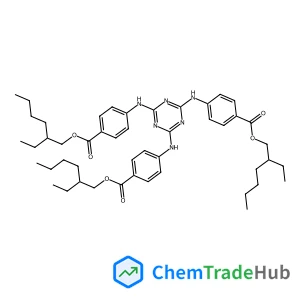
Tris(2-ethylhexyl) 4,4',4''-(1,3,5-triazine-2,4,6-triyltriimino)tribenzoate
CAS番号:
88122-99-0
分子式:
C48H66N6O6
おすすめサプライヤー





免責事項
このページに表示される学術雑誌情報は、参考および研究目的のみを目的としています。当社は雑誌出版社とは提携しておらず、投稿の取り扱いも行っておりません。出版に関するお問い合わせは、各雑誌出版社に直接ご連絡ください。
表示されている情報に誤りがある場合は、support@chemtradehub.com までご連絡ください。迅速に確認し、対応いたします。