












Exploring telogen chemical structure and reactivity when forming highly branched polyesters derived from ethylene glycol dimethacrylate homopolymerisation under transfer-dominated branching radical telomerisation (TBRT) conditions
文献情報
出版日
2023-11-10
DOI
10.1039/D3PY01208E
インパクトファクター
5.582
著者
原文を見る
要旨
Transfer-dominated Branching Radical Telomerisation (TBRT) is a free radical telomerisation reaction that allows the homopolymerisation of multi-vinyl substrates. When applied to dimethacrylates, highly branched polyesters are formed with essentially complete consumption of vinyl functional groups and without gel formation. To date, no reports of TBRT have investigated a diverse series of thiol telogens with considerable variation in chain transfer coefficients (CT) when using the same multi-vinyl taxogen (MVT). Here, the impact of CT on reaction conditions and structural telogen sub-units is studied for the homopolymerisation of ethylene glycol dimethacrylate (EGDMA). Kinetic studies explore the different rates of vinyl group consumption, and model linear telomer studies using a monovinyl taxogen investigate the distribution of sub-units that are formed when using the different telogens. The formation of a library of branched polyesters with varying telogen-derived pendant groups with weight average molecular weights up to 4 930 000 g mol−1 has allowed a detailed comparison of glass transition temperatures and the calculation of Tg∞ values using classical or modified Flory–Fox relationships.
おすすめジャーナル
関連文献
From solvated ions to ion-pairing: a THz study of lanthanum(iii) hydration
Vinay Sharma, Fabian Böhm, Michael Seitz, Gerhard Schwaab, Martina Havenith
2013-04-10
Paper
DOI: 10.1039/C3CP50865J
A variable temperature synchrotron X-ray diffraction study of the ferroelastic double perovskite Ba2GdMoO6
Thomas K. Wallace, Ross H. Colman, Abbie C. Mclaughlin
2013-01-03
Paper
DOI: 10.1039/C2CP43732E
Lone-pair distribution and plumbite network formation in high lead silicate glass, 80PbO·20SiO2
Oliver L. G. Alderman, Alex C. Hannon, Diane Holland, Steve Feller, Gloria Lehr, Adam J. Vitale, Uwe Hoppe, Martin v. Zimmerman, Anke Watenphul
2013-04-29
Paper
DOI: 10.1039/C3CP51348C
Photoinduced electron transfer of platinum(ii) bipyridine diacetylides linked by triphenylamine- and naphthaleneimide-derivatives and their application to photoelectric conversion systems
Yuma Matsumoto, Mai Tsubamoto, Ryoji Sugimura, Masatoshi Kozaki, Kenshi Kimoto, Munetaka Iwamura, Koichi Nozaki, Naoki Senju, Chiasa Uragami, Yohei Muramatsu, Akinori Konno
2013-02-28
Paper
DOI: 10.1039/C3CP50182E
Chronoamperometric study of membrane electrode assembly operation in continuous flow photoelectrochemical water splitting
Jan Rongé, Dorien Nijs, Stef Kerkhofs, Kasper Masschaele, Johan A. Martens
2013-04-11
Paper
DOI: 10.1039/C3CP50890K
Self-assembly of semiconductor/insulator interfaces in one-step spin-coating: a versatile approach for organic field-effect transistors
Chuan Liu, Yun Li, Michael V. Lee, Akichika Kumatani, Kazuhito Tsukagoshi
2013-02-27
Perspective
DOI: 10.1039/C3CP44715D
Powder crystallography of pharmaceutical materials by combined crystal structure prediction and solid-state 1H NMR spectroscopy
Maria Baias, Cory M. Widdifield, Jean-Nicolas Dumez, Hugh P. G. Thompson, Timothy G. Cooper, Elodie Salager, Sirena Bassil, Robin S. Stein, Anne Lesage, Graeme M. Day, Lyndon Emsley
2013-02-19
Paper
DOI: 10.1039/C3CP41095A
Elucidation of structure and nature of the PdO–Pd transformation using in situ PDF and XAS techniques
Jonathan Keating, Gopinathan Sankar, Timothy I. Hyde, Shinji Kohara, Koji Ohara
2013-04-26
Paper
DOI: 10.1039/C3CP50600B
Influence of adsorption thermodynamics on guest diffusivities in nanoporous crystalline materials
Rajamani Krishna, Jasper M. van Baten
2013-03-26
Perspective
DOI: 10.1039/C3CP50449B
The fast Z-scan method for studying working catalytic reactors with high energy X-ray diffraction: ZSM-5 in the methanol to gasoline process
David S. Wragg, Francesca L. Bleken, Matthew G. O'Brien, Marco Di Michiel, Helmer Fjellvåg, Unni Olsbye
2013-03-18
Paper
DOI: 10.1039/C3CP44343D
こちらもおすすめ
化合物よくある質問
3-イチチルビフェニルはどのように合成されますか?
3-イチチルビフェニルは、ビフェニルとイチプロピオニトリルを回収率約90%で反応させて合成されます。触媒は通常、亜リチウムホウ素を用います。
5668-93-93-Ethylbiphenyl
化合物よくある質問
8-溴-5-三氟甲基喹啉はどのように合成されますか?
8-溴-5-三氟甲基喹啉は、5-トリフルオロメチル-2-メチル-1,3-ベンゼンジオールをブロモエタノールと反応させて生成します。この反応は塩基性条件下で行われ...
917251-92-48-Bromo-5-(trifluoro...
化合物よくある質問
ジメチル4-(4,4,5,5-テトラメチル-1,3,2-ドioxaborolan-2-基)-2,6-ピリジンジカルボイル酸フェニルアミニドの代替品はありますか?
ジメチル4-(4,4,5,5-テトラメチル-1,3,2-ドioxaborolan-2-基)-2,6-ピリジンジカルボイル酸フェニルアミニドの代替品としては、4-...
741709-66-0Dimethyl 4-(4,4,5,5-...
化合物よくある質問
N-(3,5-ヘキサクロロ-4-ピリドインイル)-8-メチオキシ-5-キノリンカーボン酸の市場動向や研究トレンドはどのようなものでしょうか?
N-(3,5-ヘキサクロロ-4-ピリドインイル)-8-メチオキシ-5-キノリンカーボン酸の市場動向は、主に産業用途での需要により影響を受けます。研究トレンドとし...
199871-63-1N-(3,5-Dichloro-4-py...
化合物よくある質問
イソステアロイルグリセリルは安全ですか?
イソステアロイルグリセリルは一般的に安全性が高いとされていますが、過度な使用や個人差により皮�owsん炎などの反応が起こる可能性があります。使用前に医師に相談す...
222723-55-92-[(5Z,8Z,11Z,14Z)-5...
化合物よくある質問
1-(二苯甲基)-3,3-二氟-氮杂环丁烷の市場動向や研究トレンドはどうですか?
1-(二苯甲基)-3,3-二氟-氮杂环丁烷の市場動向は、医薬品や合成化学の研究分野で注目を集めています。新興研究は、該当化合物の合成改良と生体内での作用メカニズ...
288315-02-61-Benzhydryl-3,3-dif...
化合物よくある質問
3-チオフェンスチオールの物理化学的性質は何ですか?
3-チオフェンスチオールのCAS番号は7774-73-4です。結晶性の白色粉末で、分子量は122.17です。この化合物は水に微溶解し、エタノールやジクロロメタン...
7774-73-43-Thiophenethiol
化合物よくある質問
2-Methyl-2-propanyl (2S)-2-(aminomethyl)-1-piperidinecarboxylateは安全ですか?
2-Methyl-2-propanyl (2S)-2-(aminomethyl)-1-piperidinecarboxylateは一定の安全性基準を満たしていま...
475105-35-22-Methyl-2-propanyl ...
化合物よくある質問
CAS番号1316822-90-8の化合物は安全ですか?
CAS番号1316822-90-8の化合物は安全性に関しては評価が不足していますが、一般的には生物学的に活性な物質であり、取り扱いには適切な安全防護措置が必要で...
1316822-90-8Gal beta(1-3)[Neu5Ac...
化合物よくある質問
Tert-butyl 2-(2-羟基乙基)哌嗪-1-羧酸はどのように保存すればよいですか?
Tert-butyl 2-(2-羟基乙基)哌嗪-1-羧酸は、冷暗所で保存し、直射日光から遠ざけてください。容器は密閉し、高湿度や高温を避けて保管してください。
517866-79-4Tert-butyl 2-(2-hydr...
掲載誌
Polymer Chemistry

CiteScore:
8.6
自己引用率:
7.3%
年間論文数:
457
Polymer Chemistry welcomes submissions in all areas of polymer science that have a strong focus on macromolecular chemistry. Manuscripts may cover a broad range of fields, yet no direct application focus is required.
おすすめ化合物
![(2R,6S)-6-[(Benzyloxy)methyl]-4-{[(2-methyl-2-propanyl)oxy]carbonyl}-2-morpholinecarboxylic acid structure](https://static.chemtradehub.com/structs/109/1093085-91-6-3382.webp "(2R,6S)-6-[(Benzyloxy)methyl]-4-{[(2-methyl-2-propanyl)oxy]carbonyl}-2-morpholinecarboxylic acid structure")
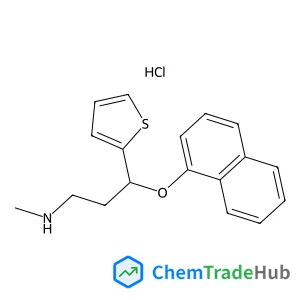
N-Methyl-3-(1-naphthyloxy)-3-(2-thienyl)-1-propanamine hydrochloride (1:1)
CAS番号:
1188266-11-6
分子式:
C18H20ClNOS
おすすめサプライヤー





免責事項
このページに表示される学術雑誌情報は、参考および研究目的のみを目的としています。当社は雑誌出版社とは提携しておらず、投稿の取り扱いも行っておりません。出版に関するお問い合わせは、各雑誌出版社に直接ご連絡ください。
表示されている情報に誤りがある場合は、support@chemtradehub.com までご連絡ください。迅速に確認し、対応いたします。