












Selective and controllable amination and defluoroamidation of α-trifluoromethylstyrene
文献情報
出版日
2023-10-21
DOI
10.1039/D3OB01595E
インパクトファクター
3.876
著者
Shuang-Lian He, Yong-Sheng Bao, Juan Hu, Chaolumen Bai, Dan Liu
原文を見る
要旨
We present a blueprint for the amination and defluoroamidation of α-trifluoromethylstyrene. This practical protocol presents a general method for the diversity-oriented synthesis of vicinal trifluoromethyl amines and gem-difluoro alkenes from α-trifluoromethylstyrene maintaining excellent chemoselectivity. The synthetic strategy features outstanding atom economy and wide functional group tolerance under mild reaction conditions.
関連文献
Molecular charge transfer by adsorbing TCNQ/TTF molecules via π–π interaction: a simple and effective strategy to modulate the electronic and magnetic behaviors of zigzag SiC nanoribbons
Dan Liu, Guangtao Yu, Yuanhui Sun, Xuri Huang, Jia Guan, Hui Zhang, Hui Li, Wei Chen
2014-11-05
Paper
DOI: 10.1039/C4CP03690E
Nano-design of quantum dot-based photocatalysts for hydrogen generation using advanced surface molecular chemistry
Dalal Noureldine, Tayirjan Isimjan, Bin Lin, Silvano Del Gobbo, Mutalifu Abulikemu, Mohamed Nejib Hedhili, Dalaver H. Anjum, Kazuhiro Takanabe
2014-11-12
Paper
DOI: 10.1039/C4CP04365K
Oxygen vacancy and hole conduction in amorphous TiO2
Hieu H. Pham, Lin-Wang Wang
2014-11-05
Paper
DOI: 10.1039/C4CP04209C
Near field plasmonic gradient effects on high vacuum tip-enhanced Raman spectroscopy
Mengtao Sun
2014-11-07
Perspective
DOI: 10.1039/C4CP03871A
Using beryllium bonds to change halogen bonds from traditional to chlorine-shared to ion-pair bonds
Ibon Alkorta, José Elguero, Otilia Mó, Manuel Yáñez, Janet E. Del Bene
2014-11-28
Paper
DOI: 10.1039/C4CP04574B
A novel two-dimensional MgB6 crystal: metal-layer stabilized boron kagome lattice
Sheng-Yi Xie, Xian-Bin Li, Nian-Ke Chen, Yeliang Wang, Shengbai Zhang, Hong-Bo Sun
2014-11-07
Paper
DOI: 10.1039/C4CP03728F
Ligand(s)-to-metal charge transfer as a factor controlling the equilibrium constants of late first-row transition metal complexes: revealing the Irving–Williams thermodynamical series
Pradeep R. Varadwaj, Arpita Varadwaj, Bih-Yaw Jin
2014-10-27
Communication
DOI: 10.1039/C4CP03953J
Electronic structure aspects of the complete O2 transfer reaction between Ni(ii) and Mn(ii) complexes with cyclam ligands
Jhon Zapata-Rivera, Rosa Caballol, Carmen J. Calzado
2014-12-05
Paper
DOI: 10.1039/C4CP05127K
A class of polysulfide catholytes for lithium–sulfur batteries: energy density, cyclability, and voltage enhancement
Xingwen Yu, Arumugam Manthiram
2014-11-28
Paper
DOI: 10.1039/C4CP04895D
こちらもおすすめ
化合物よくある質問
1-{3-[5-(エチルカルボンイル)-2,4-ジメチル-1H-ピロロール-3-基]プロパニル}ピペリジン-4-カルボン酸について、適用される法規ガイドラインは何ですか?
この化合物はCAS番号1142209-81-1であり、GHS分類では corrosive (腐食性物質) と classified (分類物質) として指定され...
1142209-81-11-{3-[5-(Ethoxycarbo...
化合物よくある質問
2,2-二氟-1,3-ベンゾジオキサン-5-カルボキシlic酸とは何ですか?
2,2-二氟-1,3-ベンゾジオキサン-5-カルボキシlic酸は、CAS番号656-46-2の化合物で、化学式はC8H4F2O4です。この化合物は白色の結晶性粉...
656-46-22,2-Difluoro-1,3-ben...
化合物よくある質問
8-氯-4-色原酮の代替品はありますか?
8-氯-4-色原酮(CAS番号: 49701-11-3)の代替品には、他の色原酮類似物や、構造が似ている化合物があります。例えば、8-メチル-4-色原酮や、他の...
49701-11-38-Chloro-2,3-dihydro...
化合物よくある質問
エチル6,6-ジメチル-4,5,6,7-テトラヒドロ-1H-インドアゼー-3-カルボキシレートとは何ですか?
エチル6,6-ジメチル-4,5,6,7-テトラヒドロ-1H-インドアゼー-3-カルボキシレートは、CAS番号1233243-56-5を有する化合物です。これは有...
1233243-56-5Ethyl 6,6-dimethyl-4...
化合物よくある質問
4-叔丁基-6-氯-嘧啶に適用される法規ガイドラインは何ですか?
4-叔丁基-6-氯-嘧啶はCAS番号3435-24-3で、GHS分類では毒性物質とみなし、GHSの危険性分類が適用されます。REACH規則では登録が必要で、Eu...
3435-24-34-Tert-butyl-6-chlor...
化合物よくある質問
維库溴铵杂质Bはどのように合成されますか?
維库溴铵杂质Bは、アンドロステンデンから始まり、一連の合成反応、包括的な選択性と高い収率で合成されます。具体的には、ブロミド化、酸化、ジマーゼ反応、アミド化など...
50587-95-6(2beta,3alpha,5alpha...
化合物よくある質問
2-(4-氟苄基)-吡咯烷の物理化学的性質は何ですか?
CAS番号350017-04-8の2-(4-氟苄基)-吡咯烷は、結晶性の白色粉末です。分子量は199.17 g/molで、水に溶けにくいです。化学反応では比較的...
350017-04-82-(4-Fluorobenzyl)py...
化合物よくある質問
3-喹啉甲醛(2-チロール-8-エチル)は安全ですか?
3-喹啉甲醛(2-チロール-8-エチル)は一定の毒性を持つため、取扱には注意が必要です。使用する際は適切な防護具を着用し、密閉容器で保管・搬送し、直接的な接触を...
335196-05-92-Chloro-8-ethyl-3-q...
化合物よくある質問
エチル3-(ヒドロキシメチル)-1H-ピロール-2-カルボキシレートはどのように保存すればよいですか?
エチル3-(ヒドロキシメチル)-1H-ピロール-2-カルボキシレートは、室温(25℃)以下で保存し、直射日光を避け、乾燥した環境で保管することが推奨されます。ま...
75448-69-0Ethyl 3-(hydroxymeth...
119410-05-88-Chloro-11-(4-piper...
掲載誌
Organic & Biomolecular Chemistry

CiteScore:
3.4
自己引用率:
10.3%
年間論文数:
1041
Organic & Biomolecular Chemistry (OBC) publishes original and high impact research and reviews in organic chemistry. We welcome research that shows new or significantly improved protocols or methodologies in total synthesis, synthetic methodology or physical and theoretical organic chemistry as well as research that shows a significant advance in the organic chemistry or molecular design aspects of chemical biology, catalysis, supramolecular and macromolecular chemistry, theoretical chemistry, mechanism-oriented physical organic chemistry, medicinal chemistry or natural products. Articles published in the journal should report new work which makes a highly-significant impact in the field. Routine and incremental work is generally not suitable for publication in the journal. More details about key areas of our scope are below. In all cases authors should include in their article clear rationale for why their research has been carried out.
おすすめ化合物
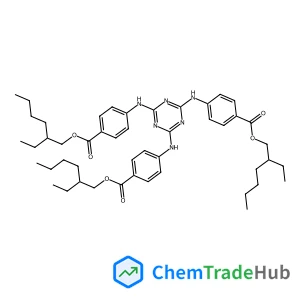
Tris(2-ethylhexyl) 4,4',4''-(1,3,5-triazine-2,4,6-triyltriimino)tribenzoate
CAS番号:
88122-99-0
分子式:
C48H66N6O6

![3-[(4-Nitrobenzyl)oxy]-3-oxopropanoic Acid structure](https://static.chemtradehub.com/structs/773/77359-11-6-0d04.webp "3-[(4-Nitrobenzyl)oxy]-3-oxopropanoic Acid structure")
おすすめサプライヤー




免責事項
このページに表示される学術雑誌情報は、参考および研究目的のみを目的としています。当社は雑誌出版社とは提携しておらず、投稿の取り扱いも行っておりません。出版に関するお問い合わせは、各雑誌出版社に直接ご連絡ください。
表示されている情報に誤りがある場合は、support@chemtradehub.com までご連絡ください。迅速に確認し、対応いたします。