












Construction of porphyrin-based photocatalyst comprising pyridinium ionic liquid moiety for the metal-free visible light-assisted N-arylation of amines: facile approach to afford drug intermediates
文献情報
出版日
2023-11-02
DOI
10.1039/D3NJ04295B
インパクトファクター
3.591
著者
Bhairav Chandroday Mataghare
原文を見る
要旨
Herein, a pyridinium-based ionic liquid-functionalized porphyrin (PBILFPc) photocatalyst was successfully synthesized and characterized using various techniques, such as 1H NMR, HR-MS, FT-IR, SEM, and XPS. The surface area of the photocatalyst was calculated using the BET method and found to be 125.882 m2 g−1. The successful formation of the porphyrin was supported by the extremely shielded inner NH-protons at −2.61 δ ppm. The energy band gap and Hammett acidity were determined to be 1.42 eV and 0.64, respectively, using UV-Vis spectroscopy. Subsequently, PBILFPc was employed as a proficient photocatalyst for the arylation of various N-heterocycles with inactivated/activated aryl halides. The photocatalytic cross-coupling was achieved under metal/base/ligand-free conditions in a laboratory-made photoreactor under the exposure of 5 W white LED light and ambient conditions. Similarly, this protocol was also appropriate for a variety of N-heterocycles, offering N-substituted aryl/alkyl derivatives in appreciable yields (71% to 91%). The photocatalytic activity of PBILFPc was supported by its low energy band gap, promoting the absorption of radiation in the visible region and leading to the formation of excitons (holes and electrons). Moreover, the presence of Brønsted acidic groups together with excitons enhanced its photocatalytic activity at room temperature. This protocol afforded the synthesis of moieties analogous to clotrimazole using the optimized parameters. Furthermore, after the reaction, the reused PBILFPc photocatalyst was found to be active and afforded a reasonable yield (82%) even after six runs. Thus, this sustainable metal/base/ligand-free PBILFPc photocatalytic route in a homemade photoreactor under visible light will motivate investigators to study the synthesis of medicinally vital scaffolds and other intermediates.
関連文献
Mass spectrometric analysis of PTM dynamics using stable isotope labeled metabolic precursors in cell culture
Alienke van Pijkeren, Rainer Bischoff
2019-10-25
Critical Review
DOI: 10.1039/C9AN01258C
pulSED: pulsed sonoelectrodeposition of fractal nanoplatinum for enhancing amperometric biosensor performance
M. Taguchi, N. Schwalb, Y. Rong, N. Garland, M. Tan, H. Yamaguchi, J. C. Claussen, E. S. McLamore
2016-04-20
Paper
DOI: 10.1039/C6AN00069J
Correction: Shell-isolated nanoparticle-enhanced Raman spectroscopy study of the adsorption behaviour of DNA bases on Au(111) electrode surfaces
Bao-Ying Wen, Xi Jin, Yue Li, Ya-Hao Wang, Chao-Yu Li, Miao-Miao Liang, Rajapandiyan Panneerselvam, Qing-Chi Xu, De-Yin Wu, Zhi-Lin Yang, Jian-Feng Li, Zhong-Qun Tian
2016-04-15
Correction
DOI: 10.1039/C6AN90033J
Tunicamycin induced endoplasmic reticulum changes in endothelial cells investigated in vitro by confocal Raman imaging
Nikola Mielniczek, Magdalena Jarosz, Joanna Denbigh, Renata Budzynska
2019-08-27
Paper
DOI: 10.1039/C9AN01456J
Correction: Micropatterning neuronal networks
Heike Hardelauf‡, Sarah Waide‡, Julia Sisnaiske, Peter Jacob, Vanessa Hausherr, Nicole Schöbel, Dirk Janasek, Christoph van Thriel
2016-05-04
Correction
DOI: 10.1039/C6AN90037B
Smartphone spectrometer for colorimetric biosensing
Xiaohu Liu, Peng Chen, Nhung Thi Tran, Jinling Zhang, Wei Sheng Chia, Bo Liedberg
2016-04-29
Communication
DOI: 10.1039/C5AN02508G
Spectrochemical analysis of sycamore (Acer pseudoplatanus) leaves for environmental health monitoring
Holly J. Butler, Martin R. McAinsh
2016-04-06
Paper
DOI: 10.1039/C6AN00392C
Ultrasensitive enrichment of phosphopeptides with Ti4+ immobilized SiO2 graphene-like multilayer nanosheets
Dongpo Xu, Mingxia Gao, Chunhui Deng, Xiangmin Zhang
2016-04-18
Paper
DOI: 10.1039/C6AN00361C
Enantioseparation of amino alcohol drugs by nonaqueous capillary electrophoresis with a maltobionic acid-based ionic liquid as the chiral selector
2019-10-19
Paper
DOI: 10.1039/C9AN01162E
こちらもおすすめ
化合物よくある質問
2-ブロモ-9,9-ジフェニル-9H-フルオレンの主な用途は何ですか?
2-溴-9,9-二苯基芴は、医薬品、工業材料、有機合成の研究分野で応用されます。特に、レーザー材料や機能性ポリマーの合成に使用されることがあります。また、蛍光色...
474918-32-62-Bromo-9,9-diphenyl...
化合物よくある質問
四氯化铱の市場動向や研究トレンドはどうですか?
四氯化铱の市場は研究開発分野で注目されており、特にナノ技術や金属有機框架(MOFs)の分野での需要が増加傾向にあります。価格は安定しており、中国や韓国での生産が...
207399-11-9Tetrachloroiridium h...
882-06-44-Nitrocinnamic acid
化合物よくある質問
1-(4-溴-3-氟苯基)-2-氯乙酮を含む廃棄物はどのように処理すべきですか?
1-(4-溴-3-氟苯基)-2-氯乙酮 (CAS番号: 1260857-14-4) の廃棄物は専門的な廃棄処理が必要です。まず、廃棄物は密閉された容器に収集し、...
1260857-14-41-(4-Bromo-3-fluorop...
化合物よくある質問
苦参酚Kとは何ですか?
苦参酚Kは、CAS番号101236-49-1を持つ化合物で、主に天然由来の生薬から抽出されます。この化合物は、抗炎症作用や抗癌作用を持つことが報告されています。
101236-49-1Kushenol K
化合物よくある質問
POTASSIUM (1-(TERTBUTOXYCARBONYL)AZETIDIN-3-YL)TRIFLUOROBORATE を含む廃棄物はどのように処理すべきですか?
POTASSIUM (1-(TERTBUTOXYCARBONYL)AZETIDIN-3-YL)TRIFLUOROBORATE を含む廃棄物は、まず安全なエント...
1430219-73-0Potassium (1-(tert-b...
化合物よくある質問
4-庚基-4’-联苯羧酸の市場動向や研究トレンドはどうですか?
4-庚基-4’-聯苯羧酸は、特殊化学品や合成化学の分野で用いられる化学物質ですが、市場動向としては、研究開発の進展とともに需要が増加しています。また、環境配慮型...
58573-94-74'-Heptyl-4-biphenyl...
化合物よくある質問
6-ブロモ-3-メトキシ-1-フェニル-1H-インドゾールを含む廃棄物はどのように処理すべきですか?
6-ブロモ-3-メトキシ-1-フェニル-1H-インドゾールを含む廃棄物は、適切な化学廃棄処理が必要です。通常、廃棄物は密閉容器に収集され、専門の廃棄処理業者に引...
1332527-03-36-Bromo-3-methoxy-1-...
化合物よくある質問
4,4-二甲基-2-吡咯烷酮はどの業界で使用されていますか?
4,4-二甲基-2-吡咯烷酮は医薬、ポリマー、センサー、半導体などの業界で広く使用されています。特に溶媒としての性能が高く評価されています。
66899-02-34,4-dimethylpyrrolid...
51312-42-6Sodium Phosphotungst...
掲載誌
New Journal of Chemistry

CiteScore:
5.3
自己引用率:
3.7%
年間論文数:
2153
NJC (New Journal of Chemistry) is a broad-based primary journal encompassing all branches of chemistry and its sub-disciplines. It contains full research articles, communications, perspectives and focus articles. This well-established journal, owned by the Centre National de la Recherche Scientifique (CNRS) of France, has been co-published with the Royal Society of Chemistry since January 1998. NJC is the forum for the publication of high-quality, original and significant work that opens new directions in chemistry or other scientific disciplines. In addition to having a significant chemical component, work published in NJC must demonstrate that it will have an impact on areas of research other than that of the reported work.
おすすめ化合物
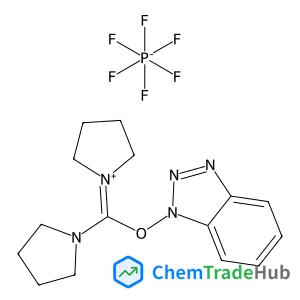
(1H-Benzotriazol-1-yloxy)(di-1-pyrrolidinyl)methylium hexafluorophosphate
CAS番号:
105379-24-6
分子式:
C15H21F6N5OP

おすすめサプライヤー





免責事項
このページに表示される学術雑誌情報は、参考および研究目的のみを目的としています。当社は雑誌出版社とは提携しておらず、投稿の取り扱いも行っておりません。出版に関するお問い合わせは、各雑誌出版社に直接ご連絡ください。
表示されている情報に誤りがある場合は、support@chemtradehub.com までご連絡ください。迅速に確認し、対応いたします。