












High dehydrogenation of ammonia borane by core–shell heterostructure catalysts formed by carbon template-assisted synthesis
文献情報
出版日
2023-11-15
DOI
10.1039/D3NJ03802E
インパクトファクター
3.591
著者
Hui-Ling Zheng, Zi-Hao Zhang, Chen-Gang Feng, Hong-Lin Zhu, Yue-Qing Zheng
原文を見る
要旨
The development of non-noble metal catalysts that exhibit high performance in the dehydrogenation of ammonia borane has been considered a safe and efficient method for hydrogen generation. In this study, a series of CuxCoy alloy nanoparticles with different ratios were highly dispersed on a core–shell microsphere carrier, and the carrier was prepared using carbon spheres as a template. The catalytic activity for H2 from ammonia borane (NH3BH3, AB) hydrolysis was investigated by adjusting the ratio of Cu2+ to Co2+ doping in the catalyst. The Co1Cu1/C@Cu0.76Co2.24O4 core–shell heterostructure catalyst shows excellent catalytic activity with a high turnover frequency (TOF) value of 82.58 molH2 molcat−1 min−1 and a low activation energy (Ea) of 16.06 kJ mol−1. Detailed analysis indicates that the outstanding activity of AB for hydrolytic dehydrogenation could be attributed to the unique core–shell hetero-structures and high dispersion of the CuCo alloy nanoparticles.
関連文献
An in vivo quantitative Raman-pH sensor of arterial blood based on laser trapping of erythrocytes
Manman Lin, Bin Xu, Huilu Yao, Aiguo Shen, Jiming Hu
2016-03-23
Paper
DOI: 10.1039/C5AN02315G
SERS monitoring the dynamics of local pH in lysosome of living cells during photothermal therapy
Rongxing Luo, Yinhui Li, Qifeng Zhou, Jing Zheng, Dandan Ma, Pinting Tang, Sheng Yang, Zhihe Qing
2016-04-19
Communication
DOI: 10.1039/C6AN00467A
High-throughput endogenous measurement of S-nitrosylation in Alzheimer's disease using oxidized cysteine-selective cPILOT
Liqing Gu, Renã A. S. Robinson
2016-05-06
Paper
DOI: 10.1039/C6AN00417B
Feature engineering applied to intraoperative in vivo Raman spectroscopy sheds light on molecular processes in brain cancer: a retrospective study of 65 patients
Rajeev Yadav, Rajeev Agarwal, Samuel Kadoury, Dominique Trudel, Marie-Christine Guiot, Kevin Petrecca
2019-10-15
Communication
DOI: 10.1039/C9AN01144G
A novel platform self-assembled from squaraine-embedded Zn(ii) complexes for selective monitoring of ATP and its level fluctuation in mitotic cells
Ruizhi Feng, Yongqian Xu, Hongwei Zhao, Xuemei Duan, Shiguo Sun
2016-04-26
Communication
DOI: 10.1039/C6AN00646A
Functionalization of metal nanoclusters for biomedical applications
Nirmal Goswami, Huang-Hao Yang, Jianping Xie
2016-04-21
Critical Review
DOI: 10.1039/C6AN00773B
Expression pattern of androgen receptors, AR-V7 and AR-567es, in circulating tumor cells and paired plasma-derived extracellular vesicles in metastatic castration resistant prostate cancer
Areti Strati, Martha Zavridou, Evangelos Bournakis, Sophia Mastoraki, Evi Lianidou
2019-10-09
Paper
DOI: 10.1039/C9AN00999J
Tunicamycin induced endoplasmic reticulum changes in endothelial cells investigated in vitro by confocal Raman imaging
Nikola Mielniczek, Magdalena Jarosz, Joanna Denbigh, Renata Budzynska
2019-08-27
Paper
DOI: 10.1039/C9AN01456J
A wavelength-resolved electrochemiluminescence resonance energy transfer ratiometric immunosensor for detection of cardiac troponin I
Liping Zhu, Jing Ye, Qiuju Zhu
2019-09-17
Paper
DOI: 10.1039/C9AN01445D
こちらもおすすめ
化合物よくある質問
2-ブロモ-9,9-ジフェニル-9H-フルオレンの主な用途は何ですか?
2-溴-9,9-二苯基芴は、医薬品、工業材料、有機合成の研究分野で応用されます。特に、レーザー材料や機能性ポリマーの合成に使用されることがあります。また、蛍光色...
474918-32-62-Bromo-9,9-diphenyl...
化合物よくある質問
四氯化铱の市場動向や研究トレンドはどうですか?
四氯化铱の市場は研究開発分野で注目されており、特にナノ技術や金属有機框架(MOFs)の分野での需要が増加傾向にあります。価格は安定しており、中国や韓国での生産が...
207399-11-9Tetrachloroiridium h...
882-06-44-Nitrocinnamic acid
化合物よくある質問
1-(4-溴-3-氟苯基)-2-氯乙酮を含む廃棄物はどのように処理すべきですか?
1-(4-溴-3-氟苯基)-2-氯乙酮 (CAS番号: 1260857-14-4) の廃棄物は専門的な廃棄処理が必要です。まず、廃棄物は密閉された容器に収集し、...
1260857-14-41-(4-Bromo-3-fluorop...
化合物よくある質問
苦参酚Kとは何ですか?
苦参酚Kは、CAS番号101236-49-1を持つ化合物で、主に天然由来の生薬から抽出されます。この化合物は、抗炎症作用や抗癌作用を持つことが報告されています。
101236-49-1Kushenol K
化合物よくある質問
POTASSIUM (1-(TERTBUTOXYCARBONYL)AZETIDIN-3-YL)TRIFLUOROBORATE を含む廃棄物はどのように処理すべきですか?
POTASSIUM (1-(TERTBUTOXYCARBONYL)AZETIDIN-3-YL)TRIFLUOROBORATE を含む廃棄物は、まず安全なエント...
1430219-73-0Potassium (1-(tert-b...
化合物よくある質問
4-庚基-4’-联苯羧酸の市場動向や研究トレンドはどうですか?
4-庚基-4’-聯苯羧酸は、特殊化学品や合成化学の分野で用いられる化学物質ですが、市場動向としては、研究開発の進展とともに需要が増加しています。また、環境配慮型...
58573-94-74'-Heptyl-4-biphenyl...
化合物よくある質問
6-ブロモ-3-メトキシ-1-フェニル-1H-インドゾールを含む廃棄物はどのように処理すべきですか?
6-ブロモ-3-メトキシ-1-フェニル-1H-インドゾールを含む廃棄物は、適切な化学廃棄処理が必要です。通常、廃棄物は密閉容器に収集され、専門の廃棄処理業者に引...
1332527-03-36-Bromo-3-methoxy-1-...
化合物よくある質問
4,4-二甲基-2-吡咯烷酮はどの業界で使用されていますか?
4,4-二甲基-2-吡咯烷酮は医薬、ポリマー、センサー、半導体などの業界で広く使用されています。特に溶媒としての性能が高く評価されています。
66899-02-34,4-dimethylpyrrolid...
51312-42-6Sodium Phosphotungst...
掲載誌
New Journal of Chemistry

CiteScore:
5.3
自己引用率:
3.7%
年間論文数:
2153
NJC (New Journal of Chemistry) is a broad-based primary journal encompassing all branches of chemistry and its sub-disciplines. It contains full research articles, communications, perspectives and focus articles. This well-established journal, owned by the Centre National de la Recherche Scientifique (CNRS) of France, has been co-published with the Royal Society of Chemistry since January 1998. NJC is the forum for the publication of high-quality, original and significant work that opens new directions in chemistry or other scientific disciplines. In addition to having a significant chemical component, work published in NJC must demonstrate that it will have an impact on areas of research other than that of the reported work.
おすすめ化合物
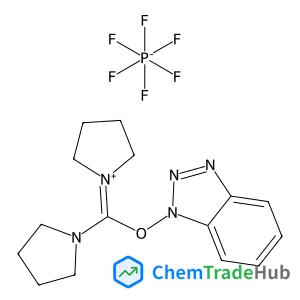
(1H-Benzotriazol-1-yloxy)(di-1-pyrrolidinyl)methylium hexafluorophosphate
CAS番号:
105379-24-6
分子式:
C15H21F6N5OP

おすすめサプライヤー



免責事項
このページに表示される学術雑誌情報は、参考および研究目的のみを目的としています。当社は雑誌出版社とは提携しておらず、投稿の取り扱いも行っておりません。出版に関するお問い合わせは、各雑誌出版社に直接ご連絡ください。
表示されている情報に誤りがある場合は、support@chemtradehub.com までご連絡ください。迅速に確認し、対応いたします。