












Multi-doped ceria-based composite as a promising low-temperature electrolyte with enhanced ionic conductivity for steam electrolysis
文献情報
出版日
2023-04-28
DOI
10.1039/D3ME00011G
インパクトファクター
4.935
著者
Yuheng Liu, Ming Xu, Yunlong Zhao, Bahman Amini Horri
原文を見る
要旨
Steam electrolysis is one of the most efficient approaches for producing green hydrogen. This method is based on the application of solid oxide electrolysis cells (SOECs) fabricated from functional ceramic composites for water splitting at high temperatures. Gadolinium doped ceria (GDC) is a promising electrolyte material for the fabrication of SOECs. However, the effective sintering temperature for GDC composites is usually above 1250 °C, which makes it impossible to use conventional supporting materials like ferritic steel for stack fabrication. In this work, for the first time, we have developed a lithium–bismuth–copper co-doped GDC composite capable of sintering at ∼750 °C. The physicochemical and electrochemical characteristics of the co-doped GDC electrolyte were systematically analysed using thermogravimetric analysis (TG/DTA), Raman spectroscopy, SEM/EDX, XRD, EIS, XPS and dilatometry analysis. The fabricated electrolyte pellets sintered at 750 °C for 6 hours in an inert atmosphere (argon) showed high densification, obtaining 96.70% relative density. Also, the electrical conductivity obtained for the synthesised composite Ce0.712Gd0.178Li0.05Bi0.05Cu0.01O1.801 (sintered at 950 °C for 6 h) was 29.6 mS cm−1 at 750 °C with activation energy as low as 0.13 eV. The result of this study helps to understand better the properties of co-doped electrolyte materials for the fabrication of more efficient steam electrolysers for environmentally-friendly hydrogen generation.
関連文献
Doping effect on the local structure of metamagnetic Co doped Ni/NiO:GO core–shell nanoparticles using X-ray absorption spectroscopy and the pair distribution function
U. P. Gawai, D. K. Gaikwad, M. R. Bodke, H. A. Khawal, K. K. Pandey, A. K. Yadav, S. N. Jha, D. Bhattacharyya, B. N. Dole
2018-12-05
Paper
DOI: 10.1039/C8CP05267K
The oxygen reduction reaction on [NiFe] hydrogenases
Seth Olsen
2018-08-24
Paper
DOI: 10.1039/C8CP04160A
Unravelling the solvent polarity effect on the excited state intramolecular proton transfer mechanism of the 1- and 2-salicylideneanthrylamine. A TD-DFT case study
Wilver A. Muriel, Rodrigo Morales-Cueto, William Rodríguez-Córdoba
2018-12-10
Paper
DOI: 10.1039/C8CP06298F
Electron transfer mediates vibrational relaxation of CO in collisions with Ag(111)
Mareike Wallrabe
2018-11-09
Paper
DOI: 10.1039/C8CP06041J
Revealing the role of phosphoric acid in all-vanadium redox flow batteries with DFT calculations and in situ analysis
Fabio Jonas Oldenburg, Marta Bon, Daniele Perego, Daniela Polino, Teodoro Laino, Lorenz Gubler
2018-08-31
Paper
DOI: 10.1039/C8CP04517H
Metalation and coordination reactions of 2H-meso-trans-di(p-cyanophenyl)porphyrin on Ag(111) with coadsorbed cobalt atoms
2018-09-14
Paper
DOI: 10.1039/C8CP05255G
Theoretical study of the bandgap regulation of a two-dimensional GeSn alloy under biaxial strain and uniaxial strain along the armchair direction
Wenqi Huang, Hong Yang, Buwen Cheng, Chunlai Xue
2018-08-20
Paper
DOI: 10.1039/C8CP03570A
Polymerization-induced polymer aggregation or polymer aggregation-enhanced polymerization? A computer simulation study
Si-Min Kong, Yao-Hong Xue, Xiao-Li Liu, Xiao-Xi Jia, Feng-Chao Cui
2018-09-10
Paper
DOI: 10.1039/C8CP03069C
Nucleation of pseudo hard-spheres and dumbbells at moderate metastability: appearance of A15 Frank–Kasper phase at intermediate elongations
Itziar Zubieta, Pablo Llombart, Carlos Vega, Eva G. Noya
2018-10-12
Paper
DOI: 10.1039/C8CP04964E
こちらもおすすめ
化合物よくある質問
6- bromo-1-cyclopropyl-1H-benzimidazoleの市場動向や研究トレンドはどうですか?
6- bromo-1-cyclopropyl-1H-benzimidazoleは、抗炎症、抗ウイルス作用を持つことが報告されており、新薬開発の研究対象として注目...
1416713-53-56-Bromo-1-cyclopropy...
化合物よくある質問
環氧プロpanol-d5を取り扱う際の実験室安全事項は何ですか?
取り扱う際には、防護眼鏡と手袋を使用し、ドラフトチャンバー内で操作することを推奨します。漏洩時には適切な手順で処理し、安全データシートを常に参照してください。
1246819-20-4Glycidol-d5
化合物よくある質問
2,2’-ジメチル-3,3’-ビピリジンはどのように合成されますか?
2,2’-ジメチル-3,3’-ビピリジンは、ピリジンと2-メチルアクリルアミドを有機合成反応で合成します。この反応では、ピリジンと2-メチルアクリルアミドを含有...
86156-55-02,2’-Dimethyl-3,3’-b...
化合物よくある質問
6-甲基ピリジン-2-ボリック酸の主な用途は何ですか?
6-甲基ピリジン-2-ボリック酸は、合成化学、医薬品合成、以及研究用途などに広く使用され、特に組換えDNA技術や分子生物学の研究において重要な役割を果たします。
372963-50-3(6-Methyl-2-pyridiny...
化合物よくある質問
(R)-3-(1-甲基-2-氧環己基)プロpano酸メチルは安全ですか?
(R)-3-(1-甲基-2-氧環己基)プロpano酸メチルは一定の安全性がありますが、直接的な皮膚接触や吸入は避けるべきです。使用する際は適切な個々の安全データ...
94089-47-1methyl 3-[(1R)-1-met...
化合物よくある質問
ketorolacはどのように保存すればよいですか?
ketorolacは、密封して遮光容器に保管し、直射日光や高温を避けて保存してください。温度は常温で保存し、湿度をなるべく低く保つことが推奨されます。
74103-06-3rac Ketorolac
化合物よくある質問
L-2,3-二氨基丙酸二盐酸盐を取り扱う際の実験室安全事項は何ですか?
L-2,3-二氨基丙酸二盐酸盐は腐食性が強く、皮膚や粘膜に刺激を与える可能性があります。取り扱う際は、防塵マスク、ゴーグル、手袋を使用し、適切な排気設備を使用し...
19777-68-5(S)-2,3-Diaminopropa...
化合物よくある質問
2-(4-溴ピリジン-2-基)乙腈の物理化学的性質は何ですか?
2-(4-溴ピリジン-2-基)乙腈のCAS番号は312325-73-8です。主に結晶形態で存在し、分子量は159.01 g/molです。この化合物は水に溶けやす...
312325-73-8(4-Bromo-2-pyridinyl...
化合物よくある質問
3-フローロ-[1,1-ベンジレン]-3,4-ジカルボン酸を取り扱う際の実験室安全事項は何ですか?
この化合物は毒性は低いですが、直接的な接触や吸入に注意が必要です。PPE(個人防護具)を着用し、ドラフトチャンバーを使用して操作することを推奨します。また、漏洩...
1261915-32-53'-Fluoro-[1,1'-biph...
化合物よくある質問
3-(1-氧代-1,3-二氢-2H-2-异吲哚)丙酸の主な用途は何ですか?
3-(1-氧代-1,3-二氢-2H-2-异吲哚)丙酸は、薬理学研究や医薬品製造において広く用いられる化合物です。また、工業的な用途でも一部の化学反応の触媒や助剤...
83747-30-23-(1-Oxo-1,3-dihydro...
掲載誌
おすすめ化合物
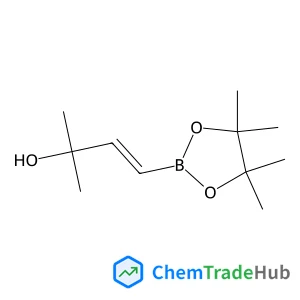
(E)-2-methyl-4-(4,4,5,5-tetramethyl-1,3,2-dioxaborolan-2-yl)but-3-en-2-ol
CAS番号:
581802-26-8
分子式:
C11H21BO3
おすすめサプライヤー





免責事項
このページに表示される学術雑誌情報は、参考および研究目的のみを目的としています。当社は雑誌出版社とは提携しておらず、投稿の取り扱いも行っておりません。出版に関するお問い合わせは、各雑誌出版社に直接ご連絡ください。
表示されている情報に誤りがある場合は、support@chemtradehub.com までご連絡ください。迅速に確認し、対応いたします。