












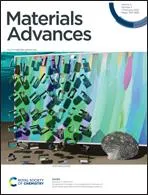
Enhancing the conductivity of plasma polymer functionalized electrodes using gold nanoparticles
文献情報
出版日
2023-11-20
DOI
10.1039/D3MA00641G
インパクトファクター
0
著者
Alex Gheorghiu, Daisy Yang, Tiexin Li, Essam M. Dief, Nadim Darwish, Melanie MacGregor
原文を見る
要旨
Plasma deposited polyoxazoline thin films (POx) are a promising solution for the rapid, scalable, and substrate-independent immuno-functionalization of electrochemical biosensors. However, a major challenge in using POx thin films in electrochemical sensing is their inherently insulating nature. This work reports the incorporation of gold nanoparticles (AuNPs) between two layers of POx which enhances the conductivity of the films. The size of the AuNPs, their binding density on the POx underlayer, and the POx films’ intrinsic electrical resistance were all factors in improving the overall electrochemical response of the layered construction. Surface bound electrochemical measurements and conductive atomic force microscopy were conducted to uncover a possible mechanism for the observed nanoparticle-mediated electron transport through the insulating matrix. The primary contributor to increasing conductivity in layered constructions is maximising the surface coverage of AuNPs on the surface to provide pathways for current to flow through the insulating matrix. As a proof of concept, POx layered constructions were then used to detect the binding of exosomes to the surface, indicating that these electrodes promise to provide low limits of detection when functionalised with a suitable recognition element.
関連文献
Hydrogen bond-dominated polybenzimidazole semi-interpenetrating network membranes for alkaline water electrolysis
Lihua Wang, Min He, Pingxia Zhang, Hao Li, Yanbin Yun, Tong Zhao
2023-11-03
Paper
DOI: 10.1039/D3TA05159E
Py-2NO ligand enabled Ni(ii)-catalyzed asymmetric Michael addition reaction of indoles with β,γ-unsaturated α-keto esters
Xi-Rui Wang, Ke-Lan Xu, Pan Hu, You-Ping Tian, Hui-Juan Wang, Ying Zhou
2024-01-04
Paper
DOI: 10.1039/D3NJ05076A
Halogen substitution effects on crystal structures and magnetic properties in nickel dithiolate molecular crystals
Xiao-Yu Chen, Yi-Ting Wei, Yan-She Yu, Jing-Wen Xu, Jia Lai
2023-12-14
Paper
DOI: 10.1039/D3NJ02943C
Molecular dynamics studies of disulfide bonds for enhancing the stability of serine protease PB92
2023-12-22
Paper
DOI: 10.1039/D3NJ04676A
Facile preparation of physically crosslinked hydrogel based on the glassy state with high strength
Qiurui Lin, Tao Rao, Xinyu Ma, Pan Du, Yuhan Liu, Die Luo, Xianru He
2024-01-04
Paper
DOI: 10.1039/D3NJ05118H
One-pot preparation of long-wavelength carbon dots with targeting ability toward different organelles
Xiao-Li Tian, Xi He, Ping Chen, Lan Zhang, Meng-Wei Hei, Xiao-Qi Yu, Ji Zhang
2023-11-03
Communication
DOI: 10.1039/D3NJ03235C
Mn-doped FeOOH modified g-C3N4 as a 3D tubular heterogeneous catalyst for photo-Fenton removal of organic pollutants
Liumi Deng, Meng Liao, Xuejing Wei, Zixuan Zou, Shaohua Chen, Hua Wang, Jiayue Chen
2023-12-19
Paper
DOI: 10.1039/D3NJ05134J
A light-sensitive protein-based wearable pH biometer
Siyuan Chen, Shiwang Xie, Zhou Li, Yujia Lv, Dan Luo
2024-01-15
Paper
DOI: 10.1039/D3TB02466K
こちらもおすすめ
化合物よくある質問
N-乙酰基-L-精氨酸はどのように合成されますか?
N-乙酰基-L-精氨酸は、L-精氨酸をエタノールと酸化アクリル酸で反応させて得られます。この合成過程では、酸化アクリル酸がL-精氨酸のN-アミノグループに結合す...
155-84-0N~2~-Acetyl-L-argini...
化合物よくある質問
カウウェルパリミタートを含む廃棄物はどのように処理すべきですか?
カウウェルパリミタートの廃棄物は、化学廃棄物として適切に収集し、専門的な廃棄処理業者に委託します。処理には、有害物質の除去と環境への影響最小化が重要です。温度は...
81760-45-4Kahweol palmitate
化合物よくある質問
タテライル1,4,8,11-テトラエチルアセートの代替品はありますか?
タテライル1,4,8,11-テトラエチルアセートの代替品として、他のエチルエステル化合物や、有機窒素化合物が考えられます。ただし、代替品の選択は目的や使用条件に...
126320-57-8Tetraethyl 1,4,8,11-...
化合物よくある質問
異丁卡因を取り扱う際の実験室安全事項は何ですか?
異丁卡因は毒性があり、皮膚や目を刺激する可能性があります。作業中は保護目鏡、防護手袋、防護マスクを使用し、ドラフトチャンバーで扱うべきです。漏えいした場合、その...
94-14-4Isobutamben
化合物よくある質問
4-氯-2-丙基吡啶を取り扱う際の実験室安全事項は何ですか?
4-氯-2-丙基吡啶は有毒で、吸入や皮膚接触を避けることが重要です。PPEとしてゴーグル、マスク、長袖のガウン、手袋を使用し、ドラフトチャンバーを用いて操作しま...
93856-98-54-Chloro-2-propylpyr...
化合物よくある質問
9,10-脱水阿霉素について適用される法規ガイドラインは何ですか?
CAS番号80996-23-2の9,10-脱水阿霉素は、GHS分類においては第3類毒性物質に分類され、REACH規則においてはカテゴリー1の急性毒性物質とされて...
80996-23-29,10-Anhydroadriamyc...
化合物よくある質問
4-(3-溴苯基)噻唑-2-甲酸の物理化学的性質は何ですか?
4-(3-溴苯基)噻唑-2-甲酸の分子量は265.01です。この化合物は水に微溶です。反応性は中程度で、酸性やアルカリ性の条件下で分解する可能性があります。
808128-00-94-(3-Bromophenyl)-1,...
化合物よくある質問
3-(4-塩素フェニル)-3-オキセタニアミン塩酸塩はどの業界で使用されていますか?
3-(4-塩素フェニル)-3-オキセタニアミン塩酸塩は、医薬業界、ポリマー業界、センサー業界、半導体業界などで使用されています。この化合物は薬物開発の一部として...
1245782-61-93-(4-Chlorophenyl)-3...
化合物よくある質問
氮卓斯汀杂质Eを取り扱う際の実験室安全事項は何ですか?
氮卓斯汀杂质E(CAS番号: 20526-97-0)を扱う際は、ゴーグルとシールド付きの手袋を使用し、漏洩がある場合はドラフトチャンバーを使用して処理することを...
20526-97-03-(4-chlorobenzylide...
化合物よくある質問
デシシボチル-n-ブチルボルテゾミブはどのように保存すればよいですか?
デシシボチル-n-ブチルボルテゾミブは室温で保管し、直日光から遠ざけて密栓容器に保管することが推奨されます。
1104011-35-9Desisobutyl-n-butyl ...
掲載誌
おすすめ化合物
![(3aR,7R,7aR)-2,2-Diethyl-3a,6,7,7a-tetrahydro-7-[(methylsulfonyl)oxy]-1,3-benzodioxole-5-carboxylic Acid Ethyl Ester structure](https://static.chemtradehub.com/structs/204/204254-90-0-7172.webp "(3aR,7R,7aR)-2,2-Diethyl-3a,6,7,7a-tetrahydro-7-[(methylsulfonyl)oxy]-1,3-benzodioxole-5-carboxylic Acid Ethyl Ester structure")
おすすめサプライヤー






免責事項
このページに表示される学術雑誌情報は、参考および研究目的のみを目的としています。当社は雑誌出版社とは提携しておらず、投稿の取り扱いも行っておりません。出版に関するお問い合わせは、各雑誌出版社に直接ご連絡ください。
表示されている情報に誤りがある場合は、support@chemtradehub.com までご連絡ください。迅速に確認し、対応いたします。