












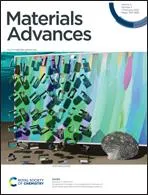
Computational study of the physical characteristics of Si-based oxide perovskites for energy generation using DFT
文献情報
出版日
2023-11-24
DOI
10.1039/D3MA00537B
インパクトファクター
0
著者
Amjad Ali Pasha, Hukam Khan, Mohammad Sohail, Nasir Rahman, Rajwali Khan, Omar H. Alsalmi, Dilsora Abduvalieva, Khamael M. Abualnaja, Atef El Jery, Mouataz Adrdery
原文を見る
要旨
SiMO3 (M = Sn, Ge) silicon-based oxide perovskite compounds are studied using density functional theory (DFT) and Wien2k software to examine their structural, elastic, optical, and electronic properties. The Birch–Murnaghan equation is used to optimize SiSnO3 and SiGeO3 compounds and deliver structural stability, whereas the IRelast program is used to find elastic constants to confirm the flexible stability as well as the elastic behavior of the presented compounds. These compounds resist plastic strain and are ductile, scratch resistant, anisotropic, and mechanically stable. The Trans-Blaha modified Becke–Johnson potential approximation calculations demonstrate that the band structure of SiSnO3 is intermetallic, whereas the second compound, SiGeO3, is a semiconductor. The evidence obtained from the band structure and density of states of the these compounds demonstrates that SiSnO3 has an indirect band gap, and the minima of the conduction band are at evenness point X, whereas the maxima of the valence band are at symmetry points M, resulting in an indirect band gap (X–M). Meanwhile, SiGeO3 has a direct band gap, and the minima of the valence band and maxima of the conduction band occur at symmetry points X. These crystals have low-energy absorption. If we examine the reflectance of ternary molecules SiGeO3 has a low absorption of up to 2 eV with fluctuations and the absorption increases to a maximum value of 40.0 at 6.50 eV. In contrast, SiSnO3 exhibits a different increase, and the absorption coefficient decreases to the lowest value of 12.4 eV. Our optical property analysis showed that SiSnO3 and SiGeO3 can be used in high-frequency ultraviolet devices. To the best of our knowledge, this is the first DFT-based examination of the characteristics of these crystals.
関連文献
Ultra-high dispersion of Ni-based OER catalysts on graphene 3D networks enhances the in situ Fe3+ catalytic activation
María González-Ingelmo, Miriam López García, Freddy E. Oropeza, Patricia Álvarez, Clara Blanco, Ricardo Santamaría, Victoria G. Rocha
2023-10-25
Paper
DOI: 10.1039/D3TA04481E
Silver-integrated cobalt hydroxide hybrid nanostructured materials for improved electrocatalytic oxygen evolution reaction
Gunasekaran Arunkumar, Pandi Muthukumar, Govindan Deviga, Mariappan Mariappan, Savarimuthu Philip Anthony
2023-12-21
Paper
DOI: 10.1039/D3NJ05268K
Preparation and optical properties of Eu2+–Pr3+/Nd3+ co-doped CaAl2O4 long afterglow luminescent materials
Ning Zhang, Qingling Zeng, Chunhua Yin
2023-12-06
Paper
DOI: 10.1039/D3NJ05121H
3D stem cell spheroids with urchin-like hydroxyapatite microparticles enhance osteogenesis of stem cells
Hongmei Liu, Jianxin Ye, Hui Hu, Yuheng Song, Huijun Qiang, Junjun Wang, Lei Zhou, Xuefen Wang, Meifang Zhu
2023-12-19
Paper
DOI: 10.1039/D3TB02453A
A light-sensitive protein-based wearable pH biometer
Siyuan Chen, Shiwang Xie, Zhou Li, Yujia Lv, Dan Luo
2024-01-15
Paper
DOI: 10.1039/D3TB02466K
Catalytic investigation of hyaluronic acid-stabilized Ag nanoparticles as non-toxic nanocatalysts in the oxidation of morin
2024-01-03
Paper
DOI: 10.1039/D3NJ05411J
A review of nanomaterials for biosensing applications
Lei Li, Tianshu Wang, Yuting Zhong, Ruyi Li, Wei Deng, Xuanyu Xiao, Yuanyuan Xu, Jieyu Zhang, Xuefeng Hu, Yunbing Wang
2023-12-21
Review Article
DOI: 10.1039/D3TB02648E
Distinguishing anti-PEG antibodies by specificity for the PEG terminus using nanoarchitectonics-based antibiofouling cello-oligosaccharide platforms
Kai Sugiura, Toshiki Sawada, Yuuki Hata, Hiroshi Tanaka, Takeshi Serizawa
2023-12-03
Paper
DOI: 10.1039/D3TB01723K
Electrogelated drug-embedded silk/gelatin/rGO degradable electrode for anti-inflammatory applications in brain-implant systems
Zhen-Kai Lin, Jing-Syu Lin, Zih-Huei Chen, Hung-Wei Cheng, Wei-Chen Huang
2024-01-02
Paper
DOI: 10.1039/D3TB02715E
こちらもおすすめ
化合物よくある質問
N-乙酰基-L-精氨酸はどのように合成されますか?
N-乙酰基-L-精氨酸は、L-精氨酸をエタノールと酸化アクリル酸で反応させて得られます。この合成過程では、酸化アクリル酸がL-精氨酸のN-アミノグループに結合す...
155-84-0N~2~-Acetyl-L-argini...
化合物よくある質問
カウウェルパリミタートを含む廃棄物はどのように処理すべきですか?
カウウェルパリミタートの廃棄物は、化学廃棄物として適切に収集し、専門的な廃棄処理業者に委託します。処理には、有害物質の除去と環境への影響最小化が重要です。温度は...
81760-45-4Kahweol palmitate
化合物よくある質問
タテライル1,4,8,11-テトラエチルアセートの代替品はありますか?
タテライル1,4,8,11-テトラエチルアセートの代替品として、他のエチルエステル化合物や、有機窒素化合物が考えられます。ただし、代替品の選択は目的や使用条件に...
126320-57-8Tetraethyl 1,4,8,11-...
化合物よくある質問
異丁卡因を取り扱う際の実験室安全事項は何ですか?
異丁卡因は毒性があり、皮膚や目を刺激する可能性があります。作業中は保護目鏡、防護手袋、防護マスクを使用し、ドラフトチャンバーで扱うべきです。漏えいした場合、その...
94-14-4Isobutamben
化合物よくある質問
4-氯-2-丙基吡啶を取り扱う際の実験室安全事項は何ですか?
4-氯-2-丙基吡啶は有毒で、吸入や皮膚接触を避けることが重要です。PPEとしてゴーグル、マスク、長袖のガウン、手袋を使用し、ドラフトチャンバーを用いて操作しま...
93856-98-54-Chloro-2-propylpyr...
化合物よくある質問
9,10-脱水阿霉素について適用される法規ガイドラインは何ですか?
CAS番号80996-23-2の9,10-脱水阿霉素は、GHS分類においては第3類毒性物質に分類され、REACH規則においてはカテゴリー1の急性毒性物質とされて...
80996-23-29,10-Anhydroadriamyc...
化合物よくある質問
4-(3-溴苯基)噻唑-2-甲酸の物理化学的性質は何ですか?
4-(3-溴苯基)噻唑-2-甲酸の分子量は265.01です。この化合物は水に微溶です。反応性は中程度で、酸性やアルカリ性の条件下で分解する可能性があります。
808128-00-94-(3-Bromophenyl)-1,...
化合物よくある質問
3-(4-塩素フェニル)-3-オキセタニアミン塩酸塩はどの業界で使用されていますか?
3-(4-塩素フェニル)-3-オキセタニアミン塩酸塩は、医薬業界、ポリマー業界、センサー業界、半導体業界などで使用されています。この化合物は薬物開発の一部として...
1245782-61-93-(4-Chlorophenyl)-3...
化合物よくある質問
氮卓斯汀杂质Eを取り扱う際の実験室安全事項は何ですか?
氮卓斯汀杂质E(CAS番号: 20526-97-0)を扱う際は、ゴーグルとシールド付きの手袋を使用し、漏洩がある場合はドラフトチャンバーを使用して処理することを...
20526-97-03-(4-chlorobenzylide...
化合物よくある質問
デシシボチル-n-ブチルボルテゾミブはどのように保存すればよいですか?
デシシボチル-n-ブチルボルテゾミブは室温で保管し、直日光から遠ざけて密栓容器に保管することが推奨されます。
1104011-35-9Desisobutyl-n-butyl ...
掲載誌
おすすめ化合物
![6-[2-(Trifluoromethoxy)phenyl]-2-pyridinecarboxylic acid structure](https://static.chemtradehub.com/structs/887/887983-48-4-f6ac.webp "6-[2-(Trifluoromethoxy)phenyl]-2-pyridinecarboxylic acid structure")
![(3aR,7R,7aR)-2,2-Diethyl-3a,6,7,7a-tetrahydro-7-[(methylsulfonyl)oxy]-1,3-benzodioxole-5-carboxylic Acid Ethyl Ester structure](https://static.chemtradehub.com/structs/204/204254-90-0-7172.webp "(3aR,7R,7aR)-2,2-Diethyl-3a,6,7,7a-tetrahydro-7-[(methylsulfonyl)oxy]-1,3-benzodioxole-5-carboxylic Acid Ethyl Ester structure")
おすすめサプライヤー







免責事項
このページに表示される学術雑誌情報は、参考および研究目的のみを目的としています。当社は雑誌出版社とは提携しておらず、投稿の取り扱いも行っておりません。出版に関するお問い合わせは、各雑誌出版社に直接ご連絡ください。
表示されている情報に誤りがある場合は、support@chemtradehub.com までご連絡ください。迅速に確認し、対応いたします。