












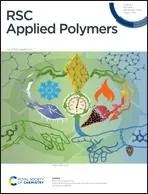
Dynamic polymer nanocomposites towards strain sensors and customizable resistors
文献情報
出版日
2023-07-20
DOI
10.1039/D3LP00012E
インパクトファクター
0
著者
Obed J. Dodo, Ibrahim O. Raji, Ian J. Arny, Camryn P. Myers, Leilah Petit, Kumari Walpita, Derrick Dunn, Carl J. Thrasher, Dominik Konkolewicz
原文を見る
要旨
In the future, well-engineered and optimized flexible electronic devices will be woven into everyday accessories such as clothes, furniture, and healthcare monitoring devices. Herein, a series of multifunctional, flexible, conductive, and self-healing polymer nanocomposites that contribute to multiple electronic applications are reported. RAFT polymerization is employed in a modular approach to synthesize dynamic polymer nanocomposites (DPNs) using different architectures including interpenetrating (IPN) and block copolymer (BCN) networks through dynamic Diels–Alder and hydrogen bond cross-links. Structure–property relationships highlighting the impact of network architecture, chain-length, cross-link density, and carbon nanotubes loading are explored. Controlled addition of multiwalled carbon nanotubes (CNTs) as nano-reinforcements produces electrically conductive and mechanically enhanced DPNs with demonstrated application in the regulation of current flow towards a dimmable light emitting diode (LED). Further application of DPNs as strain sensors and customizable/tunable electrical resistors is demonstrated. Overall, this report furnishes new insights into designing next-generation custom resistors and materials for smart LED lighting.
関連文献
New insight into selective catalytic reduction of nitrogen oxides by ammonia over H-form zeolites: a theoretical study
Jun Li, Shuhua Li
2007-05-18
Paper
DOI: 10.1039/B700161D
Comparison of the modified Poisson–Boltzmann theory with recent density functional theory and simulation results in the planar electric double layer
Christopher W. Outhwaite
2004-04-26
Paper
DOI: 10.1039/B316098J
Ab initio studies on the photophysics of the guanine–cytosine base pair
Andrzej L. Sobolewski, Wolfgang Domcke
2004-01-28
Paper
DOI: 10.1039/B314419D
Adding water to sugar: A spectroscopic and computational study of α- and β-phenylxyloside in the gas phase
Isabel Hünig, Alexander J. Painter, Rebecca A. Jockusch, Pierre Çarçabal, Elaine M. Marzluff, Lavina C. Snoek, David P. Gamblin, Benjamin G. Davis, John P. Simons
2005-05-17
Paper
DOI: 10.1039/B504230E
Static and dynamic light scattering measurements near the critical solution point of a ternary liquid mixture
D. A. Ivanov, J. Winkelmann
2004-05-04
Paper
DOI: 10.1039/B402165G
Reactions of platinum clusters 195Ptn±, n = 1–24, with N2O studied with isotopically enriched platinum
Iulia Balteanu, O. Petru Balaj, Martin K. Beyer, Vladimir E. Bondybey
2004-05-04
Communication
DOI: 10.1039/B405211K
Quantum free energies of the conformers of glycine on an ab initio potential energy surface
Thomas F. Miller, III, David C. Clary
2004-03-04
Paper
DOI: 10.1039/B314644H
こちらもおすすめ
化合物よくある質問
3-(5-フェニル-2-ファイル)-プロパン酸の市場動向や研究トレンドはどうですか?
この化合物の市場動向は不明ですが、類似化合物の需要は化学繊維、医薬品、農薬分野で安定しています。研究トレンドとしては、該当化合物の生物学的活性の評価や、その他の...
3465-61-03-(5-Phenyl-2-furyl)...
化合物よくある質問
3- Chloro-1H-indazol-5-olはどのように保存すればよいですか?
3- チロロ-1H-吲唑-5-醇は遮光し、直射日光を避けて、温度は室温を推奨し、密閉容器に保存してください。
885519-34-63-Chloro-1H-indazol-...
849924-76-11,2,3,4,5-Cyclopenta...
化合物よくある質問
L-(1-~13~C)メチオニンの市場動向や研究トレンドはどうですか?
L-(1-~13~C)メチオニンは、医薬品やバイオテクノロジー分野での研究が増加しており、その価格は安定しています。新興研究分野では、代謝解析や遺伝子機能解析で...
81202-04-2L-(1-~13~C)Methionin...
化合物よくある質問
1,3-フェニレンビスメチレンビスアクリレートは安全ですか?
1,3-フェニレンビスメチレンビスアクリレートは一般的に安全ですが、直接皮膚に触れる場合は保護用具を使用することを推奨します。高濃度の蒸気が吸入された場合は呼吸...
22757-16-01,3-Phenylenebis(met...
化合物よくある質問
丹参醇Aはどのように保存すればよいですか?
丹参醇Aは、直射日光を避けて室温で保存し、密栓容器に入れることをお勧めします。適切な保存条件は、安定性を保ち、安全性を確保する上で重要です。
189308-08-5Danshenol A
化合物よくある質問
4-メチル-2-(1,1,1-三フロロ-2-メチルプロパニル)ピリドインとは何ですか?
CAS番号1378865-93-0の4-メチル-2-(1,1,1-三フロロ-2-メチルプロパニル)ピリドインは、合成化学分野で用いられる有機化合物の一種です。こ...
1378865-93-04-Methyl-2-(1,1,1-tr...
化合物よくある質問
N-フェニルベンジル-2-クロロ酢氨を取り扱う際の実験室安全事項は何ですか?
N-フェニルベンジル-2-クロロ酢氨は毒性があり、皮膚や粘膜に刺激を与えます。取り扱う際には、保護眼鏡、手袋、ゴーグルを着用することを強く推奨します。ドラフトチ...
2653-14-7N-benzyl-2-chloro-N-...
化合物よくある質問
UCN-02を取り扱う際の実験室安全事項は何ですか?
UCN-02は毒性は低いですが、人体への直接的な接触は避けるべきです。PPE要件はグローブと顔面保護具を着用することです。ドラフトチャンバーを使用して漏洩を処理...
121569-61-7UCN-02
化合物よくある質問
N-[3-[2-(二甲基氨基)乙氧基]-4-甲氧基苯基]-2'-甲基-4'-(5-甲基-1,2,4-恶二唑-3-基)-[1,1'-联苯]-4-甲酰胺を取り扱う際の実験室安全事項は何ですか?
手袋と保護眼鏡を着用し、漏洩時には吸気防止装置を使用してください。室温、乾燥した場所に保管し、直日光から隔離してください。SDS(安全データシート)を参照してく...
170230-39-4N-{3-[2-(Dimethylami...
掲載誌
おすすめ化合物


おすすめサプライヤー





免責事項
このページに表示される学術雑誌情報は、参考および研究目的のみを目的としています。当社は雑誌出版社とは提携しておらず、投稿の取り扱いも行っておりません。出版に関するお問い合わせは、各雑誌出版社に直接ご連絡ください。
表示されている情報に誤りがある場合は、support@chemtradehub.com までご連絡ください。迅速に確認し、対応いたします。