


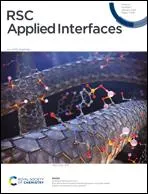
Developing 3D computational models to capture the spatial, temporal and thermal behavior as laser beams propagate through photo-thermally responsive gels
文献情報
出版日
2023-11-16
DOI
10.1039/D3LF00156C
インパクトファクター
0
著者
Victor V. Yashin, Fariha Mahmood, Kalaichelvi Saravanamuttu, Anna C. Balazs
原文を見る
要旨
By developing a new 3D computational model for laser beams propagating through photo-thermally responsive hydrogels, we investigate the complex feedback that occurs as the propagating beam forms a waveguide, which in turn affects the passage of light through the sample. As the beam passes through a poly-(N-isopropylacrylamide) (pNIPAAm) hydrogel, the pendent spiropyran (SP) chromophores isomerize to a hydrophobic state. In water, the resultant localized collapse of the hydrogel leads to a local increase the refractive index, which alters the spatial distribution of light in the sample and leads to the formation of the waveguide. The system displays self-trapping as the light is confined to propagate within the generated waveguide. Our 3D model captures the cooperative interactions among the light propagation, photochemical reaction, hydrogel dynamics, and local heating due to the absorption of light and thereby allows us to characterize the spatial, temporal and thermal variations in the system as the beam traverses the gels. Consequently, the simulations reveal the spatiotemporal behavior as heating due to absorption of light promotes the waveguide formation and leads to a strong attractive interaction between two beams. The strength of interaction between two beams can be tuned by varying the beam intensity, ambient temperature and inter-beam distance. Our results show that two Gaussian beams can cross each other if the interaction is sufficiently strong. The simulations also reveal the long-time dynamics and further elucidate the evolution of the cooperative behavior that leads to this non-linear optical phenomenon.
おすすめジャーナル

Journal of Chemical Sciences

Bioorganic & Medicinal Chemistry Letters

Bioorganic & Medicinal Chemistry

Polycyclic Aromatic Compounds

Critical Reviews in Solid State and Materials Sciences

Journal of Asian Natural Products Research

Heteroatom Chemistry

Biocatalysis and Biotransformation

Electroanalysis

Colloid Journal
関連文献
Photon-driven nanomechanical cyclic motion
Hai-Feng Ji, Yu Feng, Xiaohe Xu, Vemana Purushotham, Thomas Thundat, Gilbert M. Brown
2004-09-28
Communication
DOI: 10.1039/B408997A
Palladium catalysed cyclisation–carbonylation of enynes to give cyclic γ,δ-unsaturated acids
Varinder K. Aggarwal, Mike Butters, Paul W. Davies
2003-04-02
Communication
DOI: 10.1039/B300719G
Biotinylated poly(p-phenylene ethynylene): unexpected energy transfer results in the detection of biological analytes
Juan Zheng, Timothy M. Swager
2004-11-04
Communication
DOI: 10.1039/B408478K
Ensemble hybridisation – a new method for exploring sequence dependent fluorescence of dye–nucleic acid conjugates
Olaf Köhler, Dilip Venkatrao Jarikote, Oliver Seitz
2004-10-14
Communication
DOI: 10.1039/B411877D
Synthesis of monodisperse chromium nanoparticles from the thermolysis of a Fischer carbene complex
Seung Uk Son, Youngjin Jang, Ki Youl Yoon, Changhua An, Yosun Hwang, Je-Geun Park, Han-Jin Noh, Jae-Young Kim, Jae-Hoon Park, Taeghwan Hyeon
2004-11-26
Communication
DOI: 10.1039/B411656A
Silica coated fullerenols: seeded growth of silica spheres under acidic conditions
Elizabeth A. Whitsitt, Andrew R. Barron
2003-04-04
Communication
DOI: 10.1039/B212808J
Sextuplet phenyl embrace in a metal–organic Kagomé lattice
John J. Perry, Gregory J. McManus, Michael J. Zaworotko
2004-09-29
Communication
DOI: 10.1039/B408973A
Cyclodehydrogenation of di- and tetra(benzimidazol-2-yl)benzenes to give model heteroaromatic discotic systems
Weicheng Wu, Andrew. C. Grimsdale, Klaus Müllen
2003-04-07
Communication
DOI: 10.1039/B301512M
Bioinspired synthesis of new silica structures
Siddharth V. Patwardhan, Niloy Mukherjee, Miriam Steinitz-Kannan, Stephen J. Clarson
2003-04-23
Communication
DOI: 10.1039/B302056H
Dispersing palladium nanoparticles using a water-in-oil microemulsion—homogenization of heterogeneous catalysis
Byunghoon Yoon, Hakwon Kim, Chien M. Wai
2003-04-02
Communication
DOI: 10.1039/B211836J
こちらもおすすめ
化合物よくある質問
環戊烷-1,3-二甲酸甲酯はどのように合成されますか?
環戊烷-1,3-二甲酸甲酯は、環戊烷と塩酸によるヒンデンブルク反応を経由して合成されます。この反応では、環戊烷が塩酸と作用し、1,3-ジカルボキシ基が導入されま...
2435-36-1Dimethyl 1,3-cyclope...
化合物よくある質問
4-メトキシ-1,2,3-スチアゼ-3,5-ジオンとは何ですか?
4-メトキシ-1,2,3-スチアゼ-3,5-ジオンは、CAS番号107843-77-6の化合物で、(E)-ベンジル3-(3,4-ジヒドロキシフェニル) acry...
107843-77-6(E)-Benzyl 3-(3,4-di...
化合物よくある質問
プロスタグランジンA2について「に適用される法規ガイドラインは何ですか?'
プロスタグランジンA2 (CAS番号: 41691-92-3) は、化学物質の安全管理に関する規制として、GHS (危険物質の国際的ハザード分類・ラベル付けシス...
41691-92-316,16-DIMETHYL PROST...
化合物よくある質問
4-アミノ-1-ナフタレン sulfonic 酸についての物理化学的性質は何ですか?
4-アミノ-1-ナフタレン sulfonic 酸のCAS番号は84-86-6です。この化合物は結晶性で、分子量は212.15 g/molです。アルコールや水など...
84-86-64-Amino-1-naphthalen...
化合物よくある質問
N-GlcNAc-生物素を取り扱う際の実験室安全事項は何ですか?
N-GlcNAc-生物素は吸収性があり、皮膚や目への接触を避けることが重要です。PPE(個体保護具)は使用し、ドラフトチャンバーは必要に応じて使用します。漏洩時...
1272755-69-72-Acetamido-2-deoxy-...
化合物よくある質問
3-アミノメチルフローラノピペリジン-1-カルボニル酸テルブチルエステルとは何ですか?
CAS番号1209781-11-2の3-アミノメチルフローラノピペリジン-1-カルボニル酸テルブチルエステルは、有機化合物の一種で、化学式はC10H17FNO3...
1209781-11-22-Methyl-2-propanyl ...
化合物よくある質問
6-溴-1-甲基-1H-ベンゾ[d][1,2,3]三氮唑はどのように合成されますか?
6- bromo-1-methyl-1H-benzotriazoleは、ブロモフリオリンと1-メチル-1H-ベンゾ[d][1,2,3]三氮唑の反応により合成され...
944718-32-56-Bromo-1-methyl-1H-...
化合物よくある質問
4-硫代尿苷はどのように合成されますか?
4-硫代尿苷は、尿素とD-リボシルヒドロキシアルデヒドを用いてスルホン化反応を経て合成されます。通常は塩酸ヒドロキシチオニルスルホン酸などの触媒を使用し、選択性...
6741-73-71-(4-thio-beta-D-rib...
化合物よくある質問
ブレインナトリユリックペプチド32ラットとは何ですか?
ブレインナトリユリックペプチド32ラット(CAS番号: 133448-20-1)は、心臓で作られるホルモンの一つで、心不全の診断や予後評価に使用されます。
133448-20-1Brain Natriuretic Pe...
化合物よくある質問
1-(3-氮杂啶)-4-羟基哌啶双盐酸盐の物理化学的性質は何ですか?
CAS番号810680-60-5の1-(3-氮杂啶)-4-羟基哌啶双盐酸盐は、白色の結晶性粉末である。分子量は360.84 g/molで、水に溶けやすい。反応活...
810680-60-51-(3-Azetidinyl)-4-p...
掲載誌
おすすめ化合物
おすすめサプライヤー





免責事項
このページに表示される学術雑誌情報は、参考および研究目的のみを目的としています。当社は雑誌出版社とは提携しておらず、投稿の取り扱いも行っておりません。出版に関するお問い合わせは、各雑誌出版社に直接ご連絡ください。
表示されている情報に誤りがある場合は、support@chemtradehub.com までご連絡ください。迅速に確認し、対応いたします。