












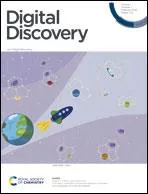
Deep generative design of porous organic cages via a variational autoencoder
文献情報
出版日
2023-10-26
DOI
10.1039/D3DD00154G
インパクトファクター
0
著者
Jiajun Zhou, Austin Mroz, Kim E. Jelfs
原文を見る
要旨
Porous organic cages (POCs) are a class of porous molecular materials characterised by their tunable, intrinsic porosity; this functional property makes them candidates for applications including guest storage and separation. Typically formed via dynamic covalent chemistry reactions from multifunctionalised molecular precursors, there is an enormous potential chemical space for POCs due to the fact they can be formed by combining two relatively small organic molecules, which themselves have an enormous chemical space. However, identifying suitable molecular precursors for POC formation is challenging, as POCs often lack shape persistence (the cage collapses upon solvent removal with loss of its cavity), thus losing a key functional property (porosity). Generative machine learning models have potential for targeted computational design of large functional molecular systems such as POCs. Here, we present a deep-learning-enabled generative model, Cage-VAE, for the targeted generation of shape-persistent POCs. We demonstrate the capacity of Cage-VAE to propose novel, shape-persistent POCs, via integration with multiple efficient sampling methods, including Bayesian optimisation and spherical linear interpolation.
関連文献
Orientation effects in morphology and electronic properties of anatase TiO2 one-dimensional nanostructures. II. Nanotubes
Dmitri B. Migas, Andrew B. Filonov, Victor E. Borisenko
2014-03-26
Paper
DOI: 10.1039/C3CP54906B
Influence of process variables on extraction of Cefalexin in a novel biocompatible ionic liquid based-aqueous two phase system
Shiva Abdolrahimi, Bahram Nasernejad, Gholamreza Pazuki
2014-11-07
Paper
DOI: 10.1039/C4CP02923B
Reactive simulations of the activation barrier to dissolution of amorphous silica in water
Michael Kagan, Glenn K. Lockwood, Stephen H. Garofalini
2014-04-09
Paper
DOI: 10.1039/C4CP00030G
Platinum–hydrogen vibrations and low energy electronic excitations of 13-atom Pt nanoclusters
Melanie Keppeler
2014-08-28
Paper
DOI: 10.1039/C4CP02052A
Effects on electrochemical performances for host material caused by structure change of modifying material
Yantao Zhang, Enlou Zhou, Dawei Song, Xixi Shi, Xiaoqing Wang, Jian Guo, Lianqi Zhang
2014-06-18
Paper
DOI: 10.1039/C4CP01897D
Systematic experimental charge density analysis of anion receptor complexes
Isabelle L. Kirby, Mark Brightwell, Mateusz B. Pitak, Claire Wilson, Simon J. Coles
2014-04-28
Paper
DOI: 10.1039/C3CP54858A
Di- and tri-oxalkyl derivatives of a boron dipyrromethene (BODIPY) rotor dye in lipid bilayers
Marie Olšinová, Piotr Jurkiewicz, Michal Pozník, Radek Šachl, Tereza Prausová, Martin Hof, Václav Kozmík, Filip Teplý, Jiří Svoboda, Marek Cebecauer
2014-04-10
Paper
DOI: 10.1039/C4CP00888J
Depth-selective microscopic observation of a photomobile liquid crystal polymer under UV illumination
Youngwoon Choi, Jeon Woong Kang, Zahid Yaqoob, Peter T. C. So, Tomomi Fujii, Shota Kuwahara, Kiyohide Takado, Tomiki Ikeda
2014-11-04
Paper
DOI: 10.1039/C4CP04602A
Timescales of water transport in viscous aerosol: measurements on sub-micron particles and dependence on conditioning history
Jessica W. Lu, Andrew M. J. Rickards, Jim S. Walker, Kerry J. Knox, Rachael E. H. Miles, Jonathan P. Reid
2013-11-29
Paper
DOI: 10.1039/C3CP54233E
Clay-supported novel bimetallic core–shell Co–Pt and Ni–Pt nanocrystals with high catalytic activities
2014-10-23
Communication
DOI: 10.1039/C4CP04194A
こちらもおすすめ
化合物よくある質問
S-(甲硅烷基丙基)異硫酰氯を取り扱う際の実験室安全事項は何ですか?
取り扱う際にはPPE(防護具)が必要です。特に手袋と面マスクは必須です。ドラフトチャンバーを使用して漏洩処理を行い、温度は常温、湿度は乾燥状態、容器はガラス容器...
84682-36-02-Amino-7,7-dimethox...
化合物よくある質問
8-硝基-咪唑并[1,2-a]吡啶とは何ですか?
8-硝基-咪唑并[1,2-a]吡啶は、CAS番号52310-46-0の化合物で、8-位に硝基を有する咪唑並みの结构をもつ吡啶の化合物です。この化合物は、酸化還元...
52310-46-08-Nitroimidazo[1,2-a...
化合物よくある質問
4-ブロモ-5-メトキシピリジン-2-甲醇の代替品はありますか?
4-ブロモ-5-メトキシピリジン-2-甲醇の代替品には、類似構造を持つ化合物や機能性に等しい代替試薬があります。例えば、4-クロロ-5-メトキシピリジン-2-甲...
1454849-84-3(4-Bromo-5-methoxy-2...
化合物よくある質問
全氟-1,2-二甲基環己烷を含む廃棄物はどのように処理すべきですか?
全氟-1,2-二甲基環己烷(CAS番号:306-98-9)の廃棄物は、特別な処理が必要です。まず、廃棄物を密閉容器に収集し、適切な防漏容器に保管します。次に、専...
306-98-91,1,2,2,3,3,4,4,5,6-...
化合物よくある質問
3-(溴甲基)苯乙酸の主な用途は何ですか?
3-(溴甲基)苯乙酸は主に研究用化学薬品として利用され、有機合成や医薬品の開発に用いられます。また、特定の化合物の合成中間体としても使用されることがあります。
118647-53-32-(3-(Bromomethyl)ph...
化合物よくある質問
5-イドキド-4-メチオキシ-6-メチルピリミジニン-2-アミンはどのように保存すればよいですか?
5-イドキド-4-メチオキシ-6-メチルピリミジニン-2-アミンは冷暗所で密栓の容器に保存し、直射日光を避けて保管することをお勧めします。温度は常温とし、湿気を...
23368-84-55-Iodo-4-methoxy-6-m...
化合物よくある質問
1-(2-溴-6-甲氧基苯基)乙酮を取り扱う際の実験室安全事項は何ですか?
実験室では、1-(2- Bromo-6-methoxyphenyl)ethanoneを取り扱う際には、ゴーグルや面具、手袋などのPPEを使用することが推奨されま...
380225-68-31-(2-Bromo-6-methoxy...
化合物よくある質問
5-(4,4,5,5-テトラメチル-1,3,2-ダイオキサボラロール-2-イル)-1,3-ジヒドロ-2-ベンゾフランは安全ですか?
5-(4,4,5,5-テトラメチル-1,3,2-ダイオキサボラロール-2-イル)-1,3-ジヒドロ-2-ベンゾフランは一般に安全ですが、取扱いには注意が必要です...
1352037-60-55-(4,4,5,5-Tetrameth...
化合物よくある質問
4-溴萘-1-甲酸の代替品はありますか?
4-溴萘-1-甲酸は比較的稀な化合物ですが、類似物としては、4-クロロ-1-ナフホリック酸やその他のブロモ置換ナフホリック酸が挙げられます。ただし、これらの代替...
16650-55-84-Bromo-1-naphthoic ...
化合物よくある質問
ε-白藜芦醇脱氢二聚体の代替品はありますか?
ε-白藜芦醇脱氢二聚体の代替品としては、ε-白藜芦醇、ポリフェノール類、フラボノイド類が挙げられます。これらは類似の化学構造と生物学的活性を持っています。ただし...
62218-08-05-{(2R,3R)-6-Hydroxy...
掲載誌
おすすめ化合物
![Sodium (2Z)-7-{[(2R)-2-amino-2-carboxyethyl]sulfanyl}-2-({[(1S)-2,2-dimethylcyclopropyl]carbonyl}amino)-2-heptenoate structure](https://static.chemtradehub.com/structs/811/81129-83-1-441c.webp "Sodium (2Z)-7-{[(2R)-2-amino-2-carboxyethyl]sulfanyl}-2-({[(1S)-2,2-dimethylcyclopropyl]carbonyl}amino)-2-heptenoate structure")
おすすめサプライヤー



免責事項
このページに表示される学術雑誌情報は、参考および研究目的のみを目的としています。当社は雑誌出版社とは提携しておらず、投稿の取り扱いも行っておりません。出版に関するお問い合わせは、各雑誌出版社に直接ご連絡ください。
表示されている情報に誤りがある場合は、support@chemtradehub.com までご連絡ください。迅速に確認し、対応いたします。