












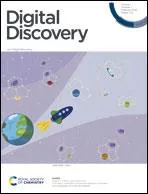
Inorganic synthesis-structure maps in zeolites with machine learning and crystallographic distances
文献情報
出版日
2023-10-27
DOI
10.1039/D3DD00134B
インパクトファクター
0
著者
Daniel Schwalbe-Koda, Daniel E. Widdowson, Tuan Anh Pham, Vitaliy A. Kurlin
原文を見る
要旨
Zeolites are inorganic materials known for their diversity of applications, synthesis conditions, and resulting polymorphs. Although their synthesis is controlled both by inorganic and organic synthesis conditions, computational studies of zeolite synthesis have focused mostly on the design of organic structure-directing agents (OSDAs). In this work, we combine distances between crystal structures and machine learning (ML) to create inorganic synthesis maps in zeolites. Starting with 253 known zeolites, we show how the continuous distances between frameworks reproduce inorganic synthesis conditions from the literature without using labels such as building units. An unsupervised learning analysis shows that neighboring zeolites according to two different representations often share similar inorganic synthesis conditions, even in OSDA-based routes. In combination with ML classifiers, we find synthesis-structure relationships for 14 common inorganic conditions in zeolites, namely Al, B, Be, Ca, Co, F, Ga, Ge, K, Mg, Na, P, Si, and Zn. By explaining the model predictions, we demonstrate how (dis)similarities towards known structures can be used as features for the synthesis space, thus quantifying the intuition that similar structures often share inorganic synthesis routes. Finally, we show how these methods can be used to predict inorganic synthesis conditions for unrealized frameworks in hypothetical databases and interpret the outcomes by extracting local structural patterns from zeolites. In combination with OSDA design, this work can accelerate the exploration of the space of synthesis conditions for zeolites.
関連文献
Electrodeposition of iron and iron–aluminium alloys in an ionic liquid and their magnetic properties
P. Giridhar, B. Weidenfeller, F. Endres
2014-03-26
Paper
DOI: 10.1039/C4CP00613E
Enhanced visible light photocatalytic activity of Cu2O via cationic–anionic passivated codoping
Yao Jiang, Hongkunag Yuan
2014-11-05
Paper
DOI: 10.1039/C4CP03631J
Lithium conductivity in glasses of the Li2O–Al2O3–SiO2 system
Sebastian Ross
2014-11-03
Paper
DOI: 10.1039/C4CP03609C
Polymer-grafted multiwall carbon nanotubes functionalized by nitrene chemistry: effect on cooperativity and phase miscibility
Goutam Prasanna Kar, Priti Xavier, Suryasarathi Bose
2014-06-25
Paper
DOI: 10.1039/C4CP01594K
Structural and dynamical characteristics of trehalose and sucrose matrices at different hydration levels as probed by FTIR and high-field EPR
M. Malferrari, A. Nalepa, F. Francia, W. Lubitz, A. Savitsky
2013-11-28
Paper
DOI: 10.1039/C3CP54043J
Interfacial processes studied by coupling electrochemistry at the polarised liquid–liquid interface with in situ confocal Raman spectroscopy
Lukasz Poltorak, Manuel Dossot, Grégoire Herzog, Alain Walcarius
2014-10-28
Paper
DOI: 10.1039/C4CP03254C
Direct observation of key photoinduced dynamics in a potential nano-delivery vehicle of cancer drugs
Samim Sardar, Siddhi Chaudhuri, Prasenjit Kar, Soumik Sarkar, Samir Kumar Pal
2014-10-28
Paper
DOI: 10.1039/C4CP03749A
The effect of a detonation nanodiamond coating on the thermal decomposition properties of RDX explosives
Yi Tong, Rui Liu, Tonglai Zhang
2014-06-26
Paper
DOI: 10.1039/C4CP02237H
Revisiting electroaccepting and electrodonating powers: proposals for local electrophilicity and local nucleophilicity descriptors
Christophe Morell, Alberto Vela, Frédéric Guégan, Henry Chermette
2014-10-03
Paper
DOI: 10.1039/C4CP03167A
The role of an active site Mg2+ in HDV ribozyme self-cleavage: insights from QM/MM calculations
Vojtěch Mlýnský, Nils G. Walter
2014-11-12
Paper
DOI: 10.1039/C4CP03857F
こちらもおすすめ
化合物よくある質問
S-(甲硅烷基丙基)異硫酰氯を取り扱う際の実験室安全事項は何ですか?
取り扱う際にはPPE(防護具)が必要です。特に手袋と面マスクは必須です。ドラフトチャンバーを使用して漏洩処理を行い、温度は常温、湿度は乾燥状態、容器はガラス容器...
84682-36-02-Amino-7,7-dimethox...
化合物よくある質問
8-硝基-咪唑并[1,2-a]吡啶とは何ですか?
8-硝基-咪唑并[1,2-a]吡啶は、CAS番号52310-46-0の化合物で、8-位に硝基を有する咪唑並みの结构をもつ吡啶の化合物です。この化合物は、酸化還元...
52310-46-08-Nitroimidazo[1,2-a...
化合物よくある質問
4-ブロモ-5-メトキシピリジン-2-甲醇の代替品はありますか?
4-ブロモ-5-メトキシピリジン-2-甲醇の代替品には、類似構造を持つ化合物や機能性に等しい代替試薬があります。例えば、4-クロロ-5-メトキシピリジン-2-甲...
1454849-84-3(4-Bromo-5-methoxy-2...
化合物よくある質問
全氟-1,2-二甲基環己烷を含む廃棄物はどのように処理すべきですか?
全氟-1,2-二甲基環己烷(CAS番号:306-98-9)の廃棄物は、特別な処理が必要です。まず、廃棄物を密閉容器に収集し、適切な防漏容器に保管します。次に、専...
306-98-91,1,2,2,3,3,4,4,5,6-...
化合物よくある質問
3-(溴甲基)苯乙酸の主な用途は何ですか?
3-(溴甲基)苯乙酸は主に研究用化学薬品として利用され、有機合成や医薬品の開発に用いられます。また、特定の化合物の合成中間体としても使用されることがあります。
118647-53-32-(3-(Bromomethyl)ph...
化合物よくある質問
5-イドキド-4-メチオキシ-6-メチルピリミジニン-2-アミンはどのように保存すればよいですか?
5-イドキド-4-メチオキシ-6-メチルピリミジニン-2-アミンは冷暗所で密栓の容器に保存し、直射日光を避けて保管することをお勧めします。温度は常温とし、湿気を...
23368-84-55-Iodo-4-methoxy-6-m...
化合物よくある質問
1-(2-溴-6-甲氧基苯基)乙酮を取り扱う際の実験室安全事項は何ですか?
実験室では、1-(2- Bromo-6-methoxyphenyl)ethanoneを取り扱う際には、ゴーグルや面具、手袋などのPPEを使用することが推奨されま...
380225-68-31-(2-Bromo-6-methoxy...
化合物よくある質問
5-(4,4,5,5-テトラメチル-1,3,2-ダイオキサボラロール-2-イル)-1,3-ジヒドロ-2-ベンゾフランは安全ですか?
5-(4,4,5,5-テトラメチル-1,3,2-ダイオキサボラロール-2-イル)-1,3-ジヒドロ-2-ベンゾフランは一般に安全ですが、取扱いには注意が必要です...
1352037-60-55-(4,4,5,5-Tetrameth...
化合物よくある質問
4-溴萘-1-甲酸の代替品はありますか?
4-溴萘-1-甲酸は比較的稀な化合物ですが、類似物としては、4-クロロ-1-ナフホリック酸やその他のブロモ置換ナフホリック酸が挙げられます。ただし、これらの代替...
16650-55-84-Bromo-1-naphthoic ...
化合物よくある質問
ε-白藜芦醇脱氢二聚体の代替品はありますか?
ε-白藜芦醇脱氢二聚体の代替品としては、ε-白藜芦醇、ポリフェノール類、フラボノイド類が挙げられます。これらは類似の化学構造と生物学的活性を持っています。ただし...
62218-08-05-{(2R,3R)-6-Hydroxy...
掲載誌
おすすめ化合物

おすすめサプライヤー




免責事項
このページに表示される学術雑誌情報は、参考および研究目的のみを目的としています。当社は雑誌出版社とは提携しておらず、投稿の取り扱いも行っておりません。出版に関するお問い合わせは、各雑誌出版社に直接ご連絡ください。
表示されている情報に誤りがある場合は、support@chemtradehub.com までご連絡ください。迅速に確認し、対応いたします。