












![5,7-Dihydroxy-3-(4-hydroxyphenyl)-6-[(1R,6R)-3-methyl-6-prop-1-en-2-ylcyclohex-2-en-1-yl]chromen-4-one structure](https://static.chemtradehub.com/structs/191/1914963-20-4-2b05.webp "5,7-Dihydroxy-3-(4-hydroxyphenyl)-6-[(1R,6R)-3-methyl-6-prop-1-en-2-ylcyclohex-2-en-1-yl]chromen-4-one structure")
Efficient regio- and stereo-selective C–H bond hydroxylation of steroids using an engineered heme-thiolate peroxygenase biocatalyst
文献情報
出版日
2023-10-05
DOI
10.1039/D3CY01223A
インパクトファクター
6.119
著者
Jinia Akter, Eva F. Hayball, Stephen G. Bell
原文を見る
要旨
A crucial reaction in chemical synthesis is the activation of unactivated carbon–hydrogen bonds in complex molecules. We demonstrate the regio- and stereo-selective hydroxlation of the steroids progesterone and androstenedione using the peroxygenase activity of an engineered bacterial cytochrome P450 enzyme, CYP154C8. By replacing a single amino acid of the I-helix we change this monooxygenase enzyme into a peroxygenase, enabling the efficient and selective biocatalytic formation of the 16α-hydroxy steroid metabolite.
関連文献
Oxidatively robust monophenolate-copper(ii) complexes as potential models of galactose oxidase
Robertus J. M. Klein Gebbink, Masayuki Watanabe, Russell C. Pratt, T. Daniel P. Stack
2003-02-06
Communication
DOI: 10.1039/B212921C
A unique eclipsed 2-D coordination polymer with removable iodine molecules in the open-channel structure
Jack Y. Lu, Amy M. Babb
2003-05-13
Communication
DOI: 10.1039/B210740F
Transformation of a C-methylcalix[4]resorcinarene-based host–guest complex from a wave-like to a novel triangular brick-wall architecture
Bao-Qing Ma, Philip Coppens
2003-01-22
Communication
DOI: 10.1039/B212548J
Synthesis and characteristion of LixBC—hole doping does not induce superconductivity
A. M. Fogg, J. B. Claridge, G. R. Darling, M. J. Rosseinsky
2003-05-19
Communication
DOI: 10.1039/B302058D
Stereoselective synthesis of individual isomers of Leu-enkephalin analogues containing substituted β-turn bicyclic dipeptide mimetics
Chiyi Xiong, Junyi Zhang, Peg Davis, Jinfa Ying, Frank Porreca, Victor J. Hruby
2003-06-04
Communication
DOI: 10.1039/B302235H
Direct catalytic sulfonation of methane with SO2 to methanesulfonic acid (MSA) in the presence of molecular O2
Sudip Mukhopadhyay, Alexis T. Bell
2003-06-03
Communication
DOI: 10.1039/B303561A
Formation of acetone enol on acidic zeolite ZSM-5 evidenced by H/D exchange
Mingcan Xu, Wei Wang, Michael Hunger
2003-02-18
Communication
DOI: 10.1039/B212701F
The phenolortho-oxygenation by mononuclear copper(i) complexes requires a dinuclear μ-η2∶η2-peroxodicopper(ii) complex rather than mononuclear CuO2 species
Giuseppe Battaini, Marco De Carolis, Enrico Monzani, Felix Tuczek, Luigi Casella
2003-02-17
Communication
DOI: 10.1039/B212683D
Visible light-induced nuclease activity of a ternary mono-phenanthroline copper(ii) complex containing l-methionine as a photosensitizer
Ashis K. Patra, Shanta Dhar, Munirathinam Nethaji, Akhil R. Chakravarty
2003-06-03
Communication
DOI: 10.1039/B303442A
Aziridinyl anions from a chiral, nonracemic 2-isopropylidineaziridine: surprisingly diastereoselective alkylation reactions
J. F. Hayes, N. Prévost, I. Prokeš, M. Shipman, A. M. Z. Slawin, H. Twin
2003-05-20
Communication
DOI: 10.1039/B303252C
こちらもおすすめ
化合物よくある質問
カルボニル基が付いた5-氰基-1-{[(2-メチル-2-プロpanyl)オキシ]カーボンイル}1H-吲哚-2-イリド-2-ボリン酸はどのように保存すればよいですか?
カルボニル基が付いた5-氰基-1-{[(2-メチル-2-プロpanyl)オキシ]カーボンイル}1H-吲哚-2-イリド-2-ボリン酸は、直射日光を避けて室温(15...
475102-15-9(5-Cyano-1-{[(2-meth...
化合物よくある質問
tert-ブチル2-クロロメチルピリジン-3-基炭酸エステルの市場動向や研究トレンドはどうですか?
この化合物は合成化学分野において、特にピリジン化合物の合成や改良に用いられます。最近の研究では、ピリジン化合物の新規合成法や特性の改良が注目されています。市場動...
1203498-98-9tert-Butyl 2-chloro-...
化合物よくある質問
聚二季戊四醇六丙烯酸酯はどの業界で使用されていますか?
聚二季戊四醇六丙烯酸酯は、医薬品、ポリマー、センサー、半導体などの業界で広く使用されています。特にポリマー業界では硬化剤として、医薬分野では医療機器の製造に使用...
29570-58-93-(Acryloyloxy)-2-({...
化合物よくある質問
1-氯-5-硝基异喹啉の市場動向や研究トレンドはどうですか?
1-氯-5-硝基异喹啉は、薬理学や合成化学の研究分野で注目されています。市場動向としては、その生物学的な活性や合成可能性を評価する研究が増えています。また、代替...
58142-97-51-Chloro-5-nitroisoq...
化合物よくある質問
2-チロール-5-メチルスルフェニル-3-trifルオルメチルベンゼンはどのように合成されますか?
2-チロール-5-メチルスルフェニル-3-trifルオルメチルベンゼンは、トリフルオロメチル化反応と硫化反応を経て合成されます。通常、トリフルオロメチル化剤と硫...
957066-04-51-Chloro-4-(methylsu...
化合物よくある質問
p-トールイルマグネシウムブロミドの物理化学的性質は何ですか?
p-トールイルマグネシウムブロミドのCAS番号は4294-57-9です。この化合物は白色の結晶性粉末で、分子量は204.32です。溶剤中で良好に溶解しますが、水...
4294-57-9p-Tolylmagnesium bro...
化合物よくある質問
1-(5-甲基-2-硫化素基)プロパン-1-酮の市場動向や研究トレンドはどうですか?
1-(5-甲基-2-硫化素基)プロパン-1-酮の市場動向は、化学産業全体の需要に影響を受けますが、最近では pharmaceutical 分野での応用が注目され...
59303-13-81-(5-Methyl-2-thieny...
化合物よくある質問
十一碳烯酰甘氨酸を取り扱う際の実験室安全事項は何ですか?
十一碳烯酰甘氨酸は吸入や皮膚から吸収されることがあり、取り扱う際には防塵マスクと手袋を使用してください。ドラフトチャンバーを用いて漏洩を処理し、適切なSDS(S...
54301-26-7N-10-Undecenoylglyci...
化合物よくある質問
1H,1H-全氟-3,6-二氧杂葵-1-醇を取り扱う際の実験室安全事項は何ですか?
この化合物は吸入や皮膚吸収による毒性があるため、防塵マスク、ゴーグル、防護手袋を使用する必要があります。ドラフトチャンバーでの操作が必要です。漏洩時には即座に換...
152914-73-32,2-Difluoro-2-[1,1,...
化合物よくある質問
3-(4-(フルオロメチルオキシ)フェニル)-1,2,4-オキサジアゾール-5-カルボハイドライドは安全ですか?
安全性は化合物の使用方法によります。直接的な毒性は報告されていませんが、吸入や皮膚接触には注意が必要です。適切な防護服を着用し、換気を図ることを推奨します。
883028-82-83-(4-(Trifluorometho...
掲載誌
Catalysis Science & Technology

CiteScore:
5.91
自己引用率:
4.5%
年間論文数:
600
Catalysis Science & Technology is committed to publishing research reporting high-quality, cutting-edge developments across the catalysis community at large. The journal places equal focus on publications from the heterogeneous, homogeneous, thermo-, electro-, photo-, organo- and biocatalysis communities. Works published in the journal feature a balanced mix of fundamental, technology-oriented, experimental, computational, digital and data-driven original research, thus appealing to catalysis practitioners in both academic and industrial environments. Original research articles published in the journal must demonstrate new catalytic discoveries and/or methodological advances that represent a significant advance on previously published work, from the molecular to the process scales. We welcome rigorous research in a wide range of timely or emerging applications related to the environment, health, energy and materials. Catalysis Science & Technology publishes Communications, Articles, Reviews and Perspectives. More details regarding manuscript types may be found in the Information for Authors section.
おすすめ化合物
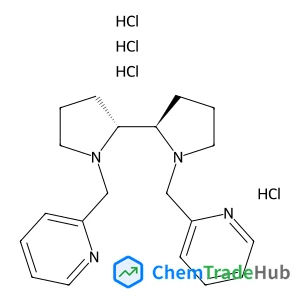
(2R,2'R)-1,1'-Bis(2-pyridinylmethyl)-2,2'-bipyrrolidine tetrahydrochloride
CAS番号:
1228077-88-0
分子式:
C20H30Cl4N4
![4,4-Difluoro-2-methyl-1-{[(2-methyl-2-propanyl)oxy]carbonyl}-L-proline structure](https://static.chemtradehub.com/structs/119/1194032-23-9-f426.webp "4,4-Difluoro-2-methyl-1-{[(2-methyl-2-propanyl)oxy]carbonyl}-L-proline structure")
4,4-Difluoro-2-methyl-1-{[(2-methyl-2-propanyl)oxy]carbonyl}-L-proline
CAS番号:
1194032-23-9
分子式:
C11H17F2NO4
おすすめサプライヤー





免責事項
このページに表示される学術雑誌情報は、参考および研究目的のみを目的としています。当社は雑誌出版社とは提携しておらず、投稿の取り扱いも行っておりません。出版に関するお問い合わせは、各雑誌出版社に直接ご連絡ください。
表示されている情報に誤りがある場合は、support@chemtradehub.com までご連絡ください。迅速に確認し、対応いたします。