












![[4-(Isobutyrylamino)phenyl]boronic acid structure](https://static.chemtradehub.com/structs/874/874219-50-8-6ab5.webp "[4-(Isobutyrylamino)phenyl]boronic acid structure")
The effect of thionation of the carbonyl group on the photophysics of compact spiro rhodamine-naphthalimide electron donor–acceptor dyads: intersystem crossing, charge separation, and electron spin dynamics
文献情報
出版日
2023-11-02
DOI
10.1039/D3CP04891H
インパクトファクター
3.676
著者
Xiao Xiao, Tong Mu, Andrey A. Sukhanov, Yihang Zhou, Peiran Yu, Fabiao Yu, Ayhan Elmali, Jianzhang Zhao, Ahmet Karatay, Violeta K. Voronkova
原文を見る
要旨
Herein, a spiro rhodamine (Rho)-thionated naphthalimide (NIS) electron donor–acceptor orthogonal dyad (Rho-NIS) was prepared to study the formation of a long-lived charge separation (CS) state via the electron spin control approach. The transient absorption (TA) spectra of Rho-NIS indicated that the intersystem crossing (ISC) occurs within 7–42 ps to produce the 3NIS state via the spin orbit coupling ISC (SOC-ISC). The energy order of 3CS (2.01 eV in n-hexane, HEX) and 3LE states (1.68 eV in HEX) depended on the solvent polarity. The 3NIS state having n–π* character and a lifetime of 0.38 μs was observed for Rho-NIS in toluene (TOL). Alternatively, in acetonitrile (ACN), the long-lived 3CS state (0.21 μs) with a high CS state quantum yield (ΦCS, 97%) was produced with the 3NIS state as the precursor and the CS took 134 ps. On the contrary, in the case of the reference Rho-naphthalimide (NI) Rho-NI dyad without thionation of its carbonyl group, a long-lived CS state (0.94 μs) with a high energy level (ECS = 2.12 eV) was generated even in HEX with a lower ΦCS (49%). In the presence of an acid, the Rho unit in the Rho-NIS adopted an open form (Rho-o) and the 3NIS state was produced within 24–47 ps with the 1Rho-o state as the precursor. Subsequently, slow intramolecular triplet–triplet energy transfer (TTET, 0.11–0.60 μs) produced the 3Rho-o state (9.4–13.6 μs). According to the time-resolved electron paramagnetic resonance (TREPR) spectra of NIS-NH2, the zero-field splitting (ZFS) parameter |D| and E of the triplet state were determined to be 6165 MHz and −1233 MHz, respectively, indicating that its triplet state has significant nπ* character, which was supported by its short triplet state lifetime (6.1 μs).
関連文献
Towards capturing cellular complexity: combining encapsulation and macromolecular crowding in a reverse micelle
Philipp Honegger, Othmar Steinhauser
2019-03-25
Paper
DOI: 10.1039/C9CP00053D
Deconstructing the behavior of donor–acceptor copolymers in solution & the melt: the case of PTB7
Sean M. Ryno, Chad Risko
2019-03-26
Paper
DOI: 10.1039/C9CP00777F
The effect of Fe vacancies and Cu adhesion on the magnetic properties of Fe3GeTe2
Jia Liu, Anping Wang, Kaisong Pu, Shaozheng Zhang, Terence Musho, Liang Chen
2019-03-12
Paper
DOI: 10.1039/C9CP00151D
Electrokinetic ion transport in an asymmetric double-gated nanochannel with a pH-tunable zwitterionic surface
Yu-Min Chen, Chih-Yuan Lin, Shiojenn Tseng
2019-03-18
Paper
DOI: 10.1039/C9CP00266A
Study of electronic structure in the L-edge spectroscopy of actinide materials: UO2 as an example
Harry Ramanantoanina, Goutam Kuri, Matthias Martin, Johannes Bertsch
2019-03-18
Paper
DOI: 10.1039/C9CP01021A
Interactions between cyclic nucleotides and common cations: an ab initio molecular dynamics study
Giuseppe Cassone, Holger Kruse, Jiri Sponer
2019-03-25
Paper
DOI: 10.1039/C8CP07492E
A single-atom catalyst of cobalt supported on a defective two-dimensional boron nitride material as a promising electrocatalyst for the oxygen reduction reaction: a DFT study
Rongxing He, Wei Shen, Ming Li, Tao Zhang
2019-03-02
Paper
DOI: 10.1039/C9CP00452A
The dramatic effect of N-methylimidazole on trans axial ligand binding to ferric heme: experiment and theory
Mohammad Aarabi, Reza Omidyan, Satchin Soorkia, Gilles Grégoire, Maria-Elisa Crestoni, Aurélien de la Lande, Benoît Soep, Niloufar Shafizadeh
2018-12-20
Paper
DOI: 10.1039/C8CP06210B
Substitutional disorder: structure and ion dynamics of the argyrodites Li6PS5Cl, Li6PS5Br and Li6PS5I
I. Hanghofer, M. Brinek, S. L. Eisbacher, B. Bitschnau, M. Volck, V. Hennige, D. Rettenwander
2019-03-27
Paper
DOI: 10.1039/C9CP00664H
Structural manifestation of partial proton ordering and defect mobility in ice Ih
2019-03-28
Paper
DOI: 10.1039/C9CP01234F
こちらもおすすめ
化合物よくある質問
6- bromo-1-cyclopropyl-1H-benzimidazoleの市場動向や研究トレンドはどうですか?
6- bromo-1-cyclopropyl-1H-benzimidazoleは、抗炎症、抗ウイルス作用を持つことが報告されており、新薬開発の研究対象として注目...
1416713-53-56-Bromo-1-cyclopropy...
化合物よくある質問
環氧プロpanol-d5を取り扱う際の実験室安全事項は何ですか?
取り扱う際には、防護眼鏡と手袋を使用し、ドラフトチャンバー内で操作することを推奨します。漏洩時には適切な手順で処理し、安全データシートを常に参照してください。
1246819-20-4Glycidol-d5
化合物よくある質問
2,2’-ジメチル-3,3’-ビピリジンはどのように合成されますか?
2,2’-ジメチル-3,3’-ビピリジンは、ピリジンと2-メチルアクリルアミドを有機合成反応で合成します。この反応では、ピリジンと2-メチルアクリルアミドを含有...
86156-55-02,2’-Dimethyl-3,3’-b...
化合物よくある質問
6-甲基ピリジン-2-ボリック酸の主な用途は何ですか?
6-甲基ピリジン-2-ボリック酸は、合成化学、医薬品合成、以及研究用途などに広く使用され、特に組換えDNA技術や分子生物学の研究において重要な役割を果たします。
372963-50-3(6-Methyl-2-pyridiny...
化合物よくある質問
(R)-3-(1-甲基-2-氧環己基)プロpano酸メチルは安全ですか?
(R)-3-(1-甲基-2-氧環己基)プロpano酸メチルは一定の安全性がありますが、直接的な皮膚接触や吸入は避けるべきです。使用する際は適切な個々の安全データ...
94089-47-1methyl 3-[(1R)-1-met...
化合物よくある質問
ketorolacはどのように保存すればよいですか?
ketorolacは、密封して遮光容器に保管し、直射日光や高温を避けて保存してください。温度は常温で保存し、湿度をなるべく低く保つことが推奨されます。
74103-06-3rac Ketorolac
化合物よくある質問
L-2,3-二氨基丙酸二盐酸盐を取り扱う際の実験室安全事項は何ですか?
L-2,3-二氨基丙酸二盐酸盐は腐食性が強く、皮膚や粘膜に刺激を与える可能性があります。取り扱う際は、防塵マスク、ゴーグル、手袋を使用し、適切な排気設備を使用し...
19777-68-5(S)-2,3-Diaminopropa...
化合物よくある質問
2-(4-溴ピリジン-2-基)乙腈の物理化学的性質は何ですか?
2-(4-溴ピリジン-2-基)乙腈のCAS番号は312325-73-8です。主に結晶形態で存在し、分子量は159.01 g/molです。この化合物は水に溶けやす...
312325-73-8(4-Bromo-2-pyridinyl...
化合物よくある質問
3-フローロ-[1,1-ベンジレン]-3,4-ジカルボン酸を取り扱う際の実験室安全事項は何ですか?
この化合物は毒性は低いですが、直接的な接触や吸入に注意が必要です。PPE(個人防護具)を着用し、ドラフトチャンバーを使用して操作することを推奨します。また、漏洩...
1261915-32-53'-Fluoro-[1,1'-biph...
化合物よくある質問
3-(1-氧代-1,3-二氢-2H-2-异吲哚)丙酸の主な用途は何ですか?
3-(1-氧代-1,3-二氢-2H-2-异吲哚)丙酸は、薬理学研究や医薬品製造において広く用いられる化合物です。また、工業的な用途でも一部の化学反応の触媒や助剤...
83747-30-23-(1-Oxo-1,3-dihydro...
掲載誌
Physical Chemistry Chemical Physics

CiteScore:
5.5
自己引用率:
10.3%
年間論文数:
3036
Physical Chemistry Chemical Physics (PCCP) is an international journal co-owned by 19 physical chemistry and physics societies from around the world. This journal publishes original, cutting-edge research in physical chemistry, chemical physics and biophysical chemistry. To be suitable for publication in PCCP, articles must include significant innovation and/or insight into physical chemistry; this is the most important criterion that reviewers and Editors will judge against when evaluating submissions. The journal has a broad scope and welcomes contributions spanning experiment, theory, computation and data science. Topical coverage includes spectroscopy, dynamics, kinetics, statistical mechanics, thermodynamics, electrochemistry, catalysis, surface science, quantum mechanics, quantum computing and machine learning. Interdisciplinary research areas such as polymers and soft matter, materials, nanoscience, energy, surfaces/interfaces, and biophysical chemistry are welcomed if they demonstrate significant innovation and/or insight into physical chemistry. Joined experimental/theoretical studies are particularly appreciated when complementary and based on up-to-date approaches.
おすすめ化合物
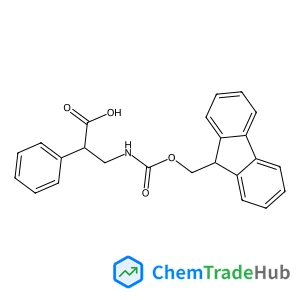
(S)-3-((((9H-Fluoren-9-yl)methoxy)carbonyl)amino)-2-phenylpropanoic acid
CAS番号:
1217663-60-9
分子式:
C24H21NO4
おすすめサプライヤー




免責事項
このページに表示される学術雑誌情報は、参考および研究目的のみを目的としています。当社は雑誌出版社とは提携しておらず、投稿の取り扱いも行っておりません。出版に関するお問い合わせは、各雑誌出版社に直接ご連絡ください。
表示されている情報に誤りがある場合は、support@chemtradehub.com までご連絡ください。迅速に確認し、対応いたします。