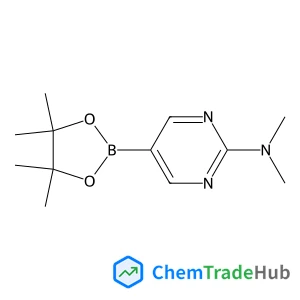
N,N-Dimethyl-5-(4,4,5,5-tetramethyl-1,3,2-dioxaborolan-2-yl)-2-pyrimidinamine
CAS番号:
1032759-30-0
分子式:
C12H20BN3O2
Mingna Zheng, Yanwei Li, Qingzhu Zhang, Wenxing Wang
A quantum mechanics/molecular mechanics (QM/MM) approach is a broadly used tool in computational enzymology. Treating the QM region with a high-level DFT method is one of the important branches. Here, taking leaf-branch compost cutinase-catalyzed polyethylene terephthalate depolymerization as an example, the convergence behavior of energy barriers as well as key structural and charge features with respect to the size of the QM region (up to 1000 atoms) is systematically investigated. BP86/6-31G(d)//CHARMM and M06-2X/6-311G(d,p)//CHARMM level of theories were applied for geometry optimizations and single-point energy calculations, respectively. Six independent enzyme conformations for all the four catalytic steps (steps (i)–(iv)) were considered. Most of the twenty-four cases show that at least 500 QM atoms are needed while only two rare cases show that ∼100 QM atoms are sufficient for convergence when only a single conformation was considered. This explains why most previous studies showed that 500 or more QM atoms are required while a few others showed that ∼100 QM atoms are sufficient for DFT/MM calculations. More importantly, average energy barriers and key structural/charge features from six conformations show an accelerated convergence than that in a single conformation. For instance, to reach energy barrier convergence (within 2.0 kcal mol−1) for step (ii), only ∼100 QM atoms are required if six conformations are considered while 500 or more QM atoms are needed with a single conformation. The convergence is accelerated to be more rapid if hundreds and thousands of conformations were considered, which aligns with previous findings that only several dozens of QM atoms are required for convergence with semi-empirical QM/MM MD simulations.
Mauro Boero
DOI: 10.1039/C8CP07467D
DOI: 10.1039/C8CP07077F
Yu Chen, Junyi Liu, Jiabing Yu
DOI: 10.1039/C8CP04669G
Narasimhan Loganathan, Geoffrey M. Bowers, Brice F. Ngouana Wakou, Andrey G. Kalinichev
DOI: 10.1039/C9CP00851A
Alexander K. Foote, Lydia H. Manger, Michael R. Holden, Martin Margittai, Randall H. Goldsmith
DOI: 10.1039/C8CP06971A
Enrique Montes, Giuseppe Foti, Héctor Vázquez
DOI: 10.1039/C8CP06290K
Enamul Haque, M. Anwar Hossain, Catherine Stampfl
DOI: 10.1039/C8CP07634K
Jia Liu, Anping Wang, Kaisong Pu, Shaozheng Zhang, Terence Musho, Liang Chen
DOI: 10.1039/C9CP00151D
Rongxing He, Wei Shen, Ming Li, Tao Zhang
DOI: 10.1039/C9CP00452A
Andrzej Poniewierski, Krzysztof Sozański, Ying Zhou, Anna Brzozowska-Elliott, Robert Holyst
DOI: 10.1039/C8CP06752J
6- bromo-1-cyclopropyl-1H-benzimidazoleは、抗炎症、抗ウイルス作用を持つことが報告されており、新薬開発の研究対象として注目...
取り扱う際には、防護眼鏡と手袋を使用し、ドラフトチャンバー内で操作することを推奨します。漏洩時には適切な手順で処理し、安全データシートを常に参照してください。
2,2’-ジメチル-3,3’-ビピリジンは、ピリジンと2-メチルアクリルアミドを有機合成反応で合成します。この反応では、ピリジンと2-メチルアクリルアミドを含有...
6-甲基ピリジン-2-ボリック酸は、合成化学、医薬品合成、以及研究用途などに広く使用され、特に組換えDNA技術や分子生物学の研究において重要な役割を果たします。
(R)-3-(1-甲基-2-氧環己基)プロpano酸メチルは一定の安全性がありますが、直接的な皮膚接触や吸入は避けるべきです。使用する際は適切な個々の安全データ...
ketorolacは、密封して遮光容器に保管し、直射日光や高温を避けて保存してください。温度は常温で保存し、湿度をなるべく低く保つことが推奨されます。
L-2,3-二氨基丙酸二盐酸盐は腐食性が強く、皮膚や粘膜に刺激を与える可能性があります。取り扱う際は、防塵マスク、ゴーグル、手袋を使用し、適切な排気設備を使用し...
2-(4-溴ピリジン-2-基)乙腈のCAS番号は312325-73-8です。主に結晶形態で存在し、分子量は159.01 g/molです。この化合物は水に溶けやす...
この化合物は毒性は低いですが、直接的な接触や吸入に注意が必要です。PPE(個人防護具)を着用し、ドラフトチャンバーを使用して操作することを推奨します。また、漏洩...
3-(1-氧代-1,3-二氢-2H-2-异吲哚)丙酸は、薬理学研究や医薬品製造において広く用いられる化合物です。また、工業的な用途でも一部の化学反応の触媒や助剤...

Physical Chemistry Chemical Physics (PCCP) is an international journal co-owned by 19 physical chemistry and physics societies from around the world. This journal publishes original, cutting-edge research in physical chemistry, chemical physics and biophysical chemistry. To be suitable for publication in PCCP, articles must include significant innovation and/or insight into physical chemistry; this is the most important criterion that reviewers and Editors will judge against when evaluating submissions. The journal has a broad scope and welcomes contributions spanning experiment, theory, computation and data science. Topical coverage includes spectroscopy, dynamics, kinetics, statistical mechanics, thermodynamics, electrochemistry, catalysis, surface science, quantum mechanics, quantum computing and machine learning. Interdisciplinary research areas such as polymers and soft matter, materials, nanoscience, energy, surfaces/interfaces, and biophysical chemistry are welcomed if they demonstrate significant innovation and/or insight into physical chemistry. Joined experimental/theoretical studies are particularly appreciated when complementary and based on up-to-date approaches.