












Biohybrid neural interfaces: improving the biological integration of neural implants
文献情報
出版日
2023-11-20
DOI
10.1039/D3CC05006H
インパクトファクター
6.222
著者
Marjolaine Boulingre, Roberto Portillo-Lara, Rylie A. Green
原文を見る
要旨
Implantable neural interfaces (NIs) have emerged in the clinic as outstanding tools for the management of a variety of neurological conditions caused by trauma or disease. However, the foreign body reaction triggered upon implantation remains one of the major challenges hindering the safety and longevity of NIs. The integration of tools and principles from biomaterial design and tissue engineering has been investigated as a promising strategy to develop NIs with enhanced functionality and performance. In this Feature Article, we highlight the main bioengineering approaches for the development of biohybrid NIs with an emphasis on relevant device design criteria. Technical and scientific challenges associated with the fabrication and functional assessment of technologies composed of both artificial and biological components are discussed. Lastly, we provide future perspectives related to engineering, regulatory, and neuroethical challenges to be addressed towards the realisation of the promise of biohybrid neurotechnology.
関連文献
Glass transition and mixing thermodynamics of a binary eutectic system
Wenkang Tu, Zeming Chen, Zijing Li, Yaqi Zhang, Riping Liu, Yongjun Tian, Li-Min Wang
2013-12-16
Paper
DOI: 10.1039/C3CP52868E
A new insight into the 5-carboxycytosine and 5-formylcytosine under typical bisulfite conditions: a deamination mechanism study
Wenliang Wang, Daodao Hu, Jian Lü
2013-12-16
Paper
DOI: 10.1039/C3CP54266A
Single bubble perturbation in cavitation proximity of solid glass: hot spot versus distance
Helmuth Möhwald, Kenneth Suslick
2013-08-21
Paper
DOI: 10.1039/C3CP52850B
Hydrogenation of PAH molecules through interaction with hydrogenated carbonaceous grains
John D. Thrower, Emil E. Friis, Anders L. Skov, Bjarke Jørgensen, Liv Hornekær
2013-11-15
Paper
DOI: 10.1039/C3CP54073A
A nickel hydroxide-coated 3D porous graphene hollow sphere framework as a high performance electrode material for supercapacitors
Fengqiao Zhang, Dong Zhu, Xi'an Chen, Xin Xu, Zhi Yang, Chao Zou, Keqin Yang, Shaoming Huang
2013-11-28
Paper
DOI: 10.1039/C3CP54334J
Optimization of amorphous silicon double junction solar cells for an efficient photoelectrochemical water splitting device based on a bismuth vanadate photoanode
Lihao Han, Paula Perez Rodriguez, Bernard Dam, Miro Zeman, Arno H. M. Smets
2014-01-02
Paper
DOI: 10.1039/C3CP55035D
In situ IR spectroscopic studies of Ni surface segregation induced by CO adsorption on Cu–Ni/SiO2 bimetallic catalysts
Yunxi Yao, D. Wayne Goodman
2014-01-03
Paper
DOI: 10.1039/C3CP54997F
こちらもおすすめ
化合物よくある質問
3-イチチルビフェニルはどのように合成されますか?
3-イチチルビフェニルは、ビフェニルとイチプロピオニトリルを回収率約90%で反応させて合成されます。触媒は通常、亜リチウムホウ素を用います。
5668-93-93-Ethylbiphenyl
化合物よくある質問
8-溴-5-三氟甲基喹啉はどのように合成されますか?
8-溴-5-三氟甲基喹啉は、5-トリフルオロメチル-2-メチル-1,3-ベンゼンジオールをブロモエタノールと反応させて生成します。この反応は塩基性条件下で行われ...
917251-92-48-Bromo-5-(trifluoro...
化合物よくある質問
ジメチル4-(4,4,5,5-テトラメチル-1,3,2-ドioxaborolan-2-基)-2,6-ピリジンジカルボイル酸フェニルアミニドの代替品はありますか?
ジメチル4-(4,4,5,5-テトラメチル-1,3,2-ドioxaborolan-2-基)-2,6-ピリジンジカルボイル酸フェニルアミニドの代替品としては、4-...
741709-66-0Dimethyl 4-(4,4,5,5-...
化合物よくある質問
N-(3,5-ヘキサクロロ-4-ピリドインイル)-8-メチオキシ-5-キノリンカーボン酸の市場動向や研究トレンドはどのようなものでしょうか?
N-(3,5-ヘキサクロロ-4-ピリドインイル)-8-メチオキシ-5-キノリンカーボン酸の市場動向は、主に産業用途での需要により影響を受けます。研究トレンドとし...
199871-63-1N-(3,5-Dichloro-4-py...
化合物よくある質問
イソステアロイルグリセリルは安全ですか?
イソステアロイルグリセリルは一般的に安全性が高いとされていますが、過度な使用や個人差により皮�owsん炎などの反応が起こる可能性があります。使用前に医師に相談す...
222723-55-92-[(5Z,8Z,11Z,14Z)-5...
化合物よくある質問
1-(二苯甲基)-3,3-二氟-氮杂环丁烷の市場動向や研究トレンドはどうですか?
1-(二苯甲基)-3,3-二氟-氮杂环丁烷の市場動向は、医薬品や合成化学の研究分野で注目を集めています。新興研究は、該当化合物の合成改良と生体内での作用メカニズ...
288315-02-61-Benzhydryl-3,3-dif...
化合物よくある質問
3-チオフェンスチオールの物理化学的性質は何ですか?
3-チオフェンスチオールのCAS番号は7774-73-4です。結晶性の白色粉末で、分子量は122.17です。この化合物は水に微溶解し、エタノールやジクロロメタン...
7774-73-43-Thiophenethiol
化合物よくある質問
2-Methyl-2-propanyl (2S)-2-(aminomethyl)-1-piperidinecarboxylateは安全ですか?
2-Methyl-2-propanyl (2S)-2-(aminomethyl)-1-piperidinecarboxylateは一定の安全性基準を満たしていま...
475105-35-22-Methyl-2-propanyl ...
化合物よくある質問
CAS番号1316822-90-8の化合物は安全ですか?
CAS番号1316822-90-8の化合物は安全性に関しては評価が不足していますが、一般的には生物学的に活性な物質であり、取り扱いには適切な安全防護措置が必要で...
1316822-90-8Gal beta(1-3)[Neu5Ac...
化合物よくある質問
Tert-butyl 2-(2-羟基乙基)哌嗪-1-羧酸はどのように保存すればよいですか?
Tert-butyl 2-(2-羟基乙基)哌嗪-1-羧酸は、冷暗所で保存し、直射日光から遠ざけてください。容器は密閉し、高湿度や高温を避けて保管してください。
517866-79-4Tert-butyl 2-(2-hydr...
掲載誌
Chemical Communications

CiteScore:
8.6
自己引用率:
4.7%
年間論文数:
2458
ChemComm publishes urgent research which is of outstanding significance and interest to experts in the field, while also appealing to the journal’s broad chemistry readership. Our communication format is ideally suited to short, urgent studies that are of such importance that they require accelerated publication. Our scope covers all topics in chemistry, and research at the interface of chemistry and other disciplines (such as materials science, nanoscience, physics, engineering and biology) where there is a significant novelty in the chemistry aspects. Major topic areas covered include: Analytical Chemistry Catalysis Chemical Biology and medicinal chemistry Computational Chemistry and Machine Learning Energy and sustainable chemistry Environmental Chemistry Green Chemistry Inorganic Chemistry Materials Chemistry Nanoscience Organic Chemistry Physical Chemistry Polymer Chemistry Supramolecular Chemistry
おすすめ化合物
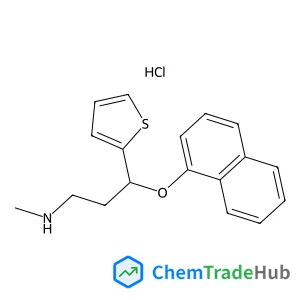
N-Methyl-3-(1-naphthyloxy)-3-(2-thienyl)-1-propanamine hydrochloride (1:1)
CAS番号:
1188266-11-6
分子式:
C18H20ClNOS
おすすめサプライヤー




免責事項
このページに表示される学術雑誌情報は、参考および研究目的のみを目的としています。当社は雑誌出版社とは提携しておらず、投稿の取り扱いも行っておりません。出版に関するお問い合わせは、各雑誌出版社に直接ご連絡ください。
表示されている情報に誤りがある場合は、support@chemtradehub.com までご連絡ください。迅速に確認し、対応いたします。