


Iron-optimized oxygen vacancy concentration to strengthen the electrocatalytic ability of the urea oxidation reaction
文献情報
出版日
2023-11-06
DOI
10.1039/D3CC03889K
インパクトファクター
6.222
著者
Yingzhen Zhang, Wei Zhang, Yonggang Lei, Zhiqun Lin
原文を見る
要旨
Iron-modified Ni(OH)2/NiSe2 enhances oxygen vacancies, expanding the electrochemically active surface area, which exhibiting superior selectivity and stability in urea oxidation reaction, outperforming pristine Ni(OH)2@NiSe2. It also demonstrates superior catalytic performance in the oxidation reactions of other small molecules.
おすすめジャーナル

Journal of Medical Biochemistry

Foundations of Chemistry

Journal of Enzyme inhibition and Medicinal Chemistry

Physical Chemistry Chemical Physics

Angewandte Chemie International Edition

Mini-Reviews in Medicinal Chemistry

Coloration Technology

Molecular Diversity

Contact Lens & Anterior Eye

Faraday Discussions
関連文献
Structure and thermal properties of salicylate-based-protic ionic liquids as new heat storage media. COSMO-RS structure characterization and modeling of heat capacities
Johan Jacquemin, Joanna Feder-Kubis, Michał Zorębski, Katarzyna Grzybowska, Mirosław Chorążewski, Stella Hensel-Bielówka, Edward Zorębski, Marian Paluch, Marzena Dzida
2013-12-06
Paper
DOI: 10.1039/C3CP54533D
A XANES study of LiVPO4F: a factor analysis approach
Yan Qin, Yang Ren, Steve M. Heald, Chengjun Sun, Dehua Zhou, Bryant J. Polzin, Steve E. Trask, Khalil Amine, Yinjin Wei, Gang Chen, Ira Bloom, Zonghai Chen
2014-01-10
Paper
DOI: 10.1039/C3CP54588A
Effects of process parameters on the defects in graphene oxide–polyaniline composites investigated by positron annihilation spectroscopy
Utpal Rana, P. M. G. Nambissan, Sudip Malik, Kuntal Chakrabarti
2013-12-16
Paper
DOI: 10.1039/C3CP54032D
Progress on extending the light absorption spectra of photocatalysts
Zeyan Wang, Yuanyuan Liu, Baibiao Huang, Ying Dai, Zaizhu Lou, Gang Wang, Xiaoyang Zhang, Xiaoyan Qin
2013-11-11
Perspective
DOI: 10.1039/C3CP53817F
A new approach to determine vapour pressures and hygroscopicities of aqueous aerosols containing semi-volatile organic compounds
D. J. Stewart, T. C. Preston, J. S. Walker, Y.-H. Zhang, J. P. Reid
2014-01-02
Paper
DOI: 10.1039/C3CP54948H
Graphene/g-C3N4 bilayer: considerable band gap opening and effective band structure engineering
Xinru Li, Ying Dai, Yandong Ma, Shenghao Han, Baibiao Huang
2014-01-06
Paper
DOI: 10.1039/C3CP54592J
Lithium diffusion in congruent LiNbO3 single crystals at low temperatures probed by neutron reflectometry
E. Hüger, J. Rahn, J. Stahn, T. Geue
2014-01-02
Paper
DOI: 10.1039/C3CP54939A
Conformer-selective photoelectron spectroscopy of α-lactalbumin derived multianions in the gas phase
Matthias Vonderach, Marc-Oliver Winghart, Luke MacAleese, Fabien Chirot, Rodolphe Antoine, Philippe Dugourd, Patrick Weis
2013-12-12
Paper
DOI: 10.1039/C3CP54596B
こちらもおすすめ
化合物よくある質問
3-イチチルビフェニルはどのように合成されますか?
3-イチチルビフェニルは、ビフェニルとイチプロピオニトリルを回収率約90%で反応させて合成されます。触媒は通常、亜リチウムホウ素を用います。
5668-93-93-Ethylbiphenyl
化合物よくある質問
8-溴-5-三氟甲基喹啉はどのように合成されますか?
8-溴-5-三氟甲基喹啉は、5-トリフルオロメチル-2-メチル-1,3-ベンゼンジオールをブロモエタノールと反応させて生成します。この反応は塩基性条件下で行われ...
917251-92-48-Bromo-5-(trifluoro...
化合物よくある質問
ジメチル4-(4,4,5,5-テトラメチル-1,3,2-ドioxaborolan-2-基)-2,6-ピリジンジカルボイル酸フェニルアミニドの代替品はありますか?
ジメチル4-(4,4,5,5-テトラメチル-1,3,2-ドioxaborolan-2-基)-2,6-ピリジンジカルボイル酸フェニルアミニドの代替品としては、4-...
741709-66-0Dimethyl 4-(4,4,5,5-...
化合物よくある質問
N-(3,5-ヘキサクロロ-4-ピリドインイル)-8-メチオキシ-5-キノリンカーボン酸の市場動向や研究トレンドはどのようなものでしょうか?
N-(3,5-ヘキサクロロ-4-ピリドインイル)-8-メチオキシ-5-キノリンカーボン酸の市場動向は、主に産業用途での需要により影響を受けます。研究トレンドとし...
199871-63-1N-(3,5-Dichloro-4-py...
化合物よくある質問
イソステアロイルグリセリルは安全ですか?
イソステアロイルグリセリルは一般的に安全性が高いとされていますが、過度な使用や個人差により皮�owsん炎などの反応が起こる可能性があります。使用前に医師に相談す...
222723-55-92-[(5Z,8Z,11Z,14Z)-5...
化合物よくある質問
1-(二苯甲基)-3,3-二氟-氮杂环丁烷の市場動向や研究トレンドはどうですか?
1-(二苯甲基)-3,3-二氟-氮杂环丁烷の市場動向は、医薬品や合成化学の研究分野で注目を集めています。新興研究は、該当化合物の合成改良と生体内での作用メカニズ...
288315-02-61-Benzhydryl-3,3-dif...
化合物よくある質問
3-チオフェンスチオールの物理化学的性質は何ですか?
3-チオフェンスチオールのCAS番号は7774-73-4です。結晶性の白色粉末で、分子量は122.17です。この化合物は水に微溶解し、エタノールやジクロロメタン...
7774-73-43-Thiophenethiol
化合物よくある質問
2-Methyl-2-propanyl (2S)-2-(aminomethyl)-1-piperidinecarboxylateは安全ですか?
2-Methyl-2-propanyl (2S)-2-(aminomethyl)-1-piperidinecarboxylateは一定の安全性基準を満たしていま...
475105-35-22-Methyl-2-propanyl ...
化合物よくある質問
CAS番号1316822-90-8の化合物は安全ですか?
CAS番号1316822-90-8の化合物は安全性に関しては評価が不足していますが、一般的には生物学的に活性な物質であり、取り扱いには適切な安全防護措置が必要で...
1316822-90-8Gal beta(1-3)[Neu5Ac...
化合物よくある質問
Tert-butyl 2-(2-羟基乙基)哌嗪-1-羧酸はどのように保存すればよいですか?
Tert-butyl 2-(2-羟基乙基)哌嗪-1-羧酸は、冷暗所で保存し、直射日光から遠ざけてください。容器は密閉し、高湿度や高温を避けて保管してください。
517866-79-4Tert-butyl 2-(2-hydr...
掲載誌
Chemical Communications

CiteScore:
8.6
自己引用率:
4.7%
年間論文数:
2458
ChemComm publishes urgent research which is of outstanding significance and interest to experts in the field, while also appealing to the journal’s broad chemistry readership. Our communication format is ideally suited to short, urgent studies that are of such importance that they require accelerated publication. Our scope covers all topics in chemistry, and research at the interface of chemistry and other disciplines (such as materials science, nanoscience, physics, engineering and biology) where there is a significant novelty in the chemistry aspects. Major topic areas covered include: Analytical Chemistry Catalysis Chemical Biology and medicinal chemistry Computational Chemistry and Machine Learning Energy and sustainable chemistry Environmental Chemistry Green Chemistry Inorganic Chemistry Materials Chemistry Nanoscience Organic Chemistry Physical Chemistry Polymer Chemistry Supramolecular Chemistry
おすすめ化合物
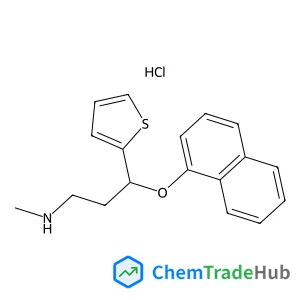
N-Methyl-3-(1-naphthyloxy)-3-(2-thienyl)-1-propanamine hydrochloride (1:1)
CAS番号:
1188266-11-6
分子式:
C18H20ClNOS

おすすめサプライヤー






免責事項
このページに表示される学術雑誌情報は、参考および研究目的のみを目的としています。当社は雑誌出版社とは提携しておらず、投稿の取り扱いも行っておりません。出版に関するお問い合わせは、各雑誌出版社に直接ご連絡ください。
表示されている情報に誤りがある場合は、support@chemtradehub.com までご連絡ください。迅速に確認し、対応いたします。