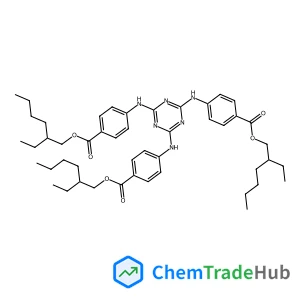
Tris(2-ethylhexyl) 4,4',4''-(1,3,5-triazine-2,4,6-triyltriimino)tribenzoate
CAS番号:
88122-99-0
分子式:
C48H66N6O6
Elizabeth R. Piedmont, Erin E. Christensen, Benjamin E. Partridge
The aggregation of incompletely or incorrectly folded proteins is implicated in diseases including Alzheimer's, cataracts, and other maladies. Natural systems express protein chaperones to prevent or even reverse harmful protein aggregation. Synthetic chaperone-like systems have sought to mimic the action of their biological counterparts but typically require substantial optimization and high concentrations to be functional, or lack programmability that would enable the targeting of specific protein substrates. Here we report a series of amphiphilic dendrons that undergo assembly and inhibit the aggregation of fragment 16–22 amyloid β protein (Aβ16–22). We show that monodisperse dendrons with hydrophilic tetraethylene glycol chains and a hydrophobic core based on naphthyl and benzyl ethers undergo supramolecular assembly in aqueous solutions to form sphere-like particles. The solubility of these dendrons and their assemblies is tuned by varying the relative sizes of their hydrophilic and hydrophobic regions. Two water-soluble dendrons are discovered and shown, via fluorescence experiments with rhodamine 6G, to generate a hydrophobic environment. Furthermore, we demonstrate that sub-stoichiometric concentrations of these amphiphilic dendrons stabilize Aβ16–22 peptide with respect to aggregation, mimicking the activity of holdase chaperones. Our results highlight the potential of these amphiphilic molecules as the basis for a novel approach to artificial chaperones that may address many of the challenges associated with existing synthetic chaperone mimics.
Tenglong Guo, Quanbin Jiang
DOI: 10.1039/C6QO90004F
Yi Zhu, Yao Li, Qingbin Meng, Xin Li
DOI: 10.1039/C6QO00038J
Jian-Guo Fu, Guang-Qiang Xu, Rui Ding, Guo-Qiang Lin, Bing-Feng Sun
DOI: 10.1039/C5QO00355E
Wenlei Zhai, Akina Yoshizawa, Hui-Chen Wang, Stephen A. Hodge, Tony D. James, Eric V. Anslyn, John S. Fossey
DOI: 10.1039/C6QO00171H
Andivelu Ilangovan, Ashok Polu, Gandhesiri Satish
DOI: 10.1039/C5QO00246J
Qin Xu, Peng Gu, Feijun Wang
DOI: 10.1039/C5QO00155B
Tony Roy, Sachin Suresh Bhojgude, Trinadh Kaicharla, Manikandan Thangaraj, Bikash Garai, Akkattu T. Biju
DOI: 10.1039/C5QO00328H
この化合物はCAS番号1142209-81-1であり、GHS分類では corrosive (腐食性物質) と classified (分類物質) として指定され...
2,2-二氟-1,3-ベンゾジオキサン-5-カルボキシlic酸は、CAS番号656-46-2の化合物で、化学式はC8H4F2O4です。この化合物は白色の結晶性粉...
8-氯-4-色原酮(CAS番号: 49701-11-3)の代替品には、他の色原酮類似物や、構造が似ている化合物があります。例えば、8-メチル-4-色原酮や、他の...
エチル6,6-ジメチル-4,5,6,7-テトラヒドロ-1H-インドアゼー-3-カルボキシレートは、CAS番号1233243-56-5を有する化合物です。これは有...
4-叔丁基-6-氯-嘧啶はCAS番号3435-24-3で、GHS分類では毒性物質とみなし、GHSの危険性分類が適用されます。REACH規則では登録が必要で、Eu...
維库溴铵杂质Bは、アンドロステンデンから始まり、一連の合成反応、包括的な選択性と高い収率で合成されます。具体的には、ブロミド化、酸化、ジマーゼ反応、アミド化など...
CAS番号350017-04-8の2-(4-氟苄基)-吡咯烷は、結晶性の白色粉末です。分子量は199.17 g/molで、水に溶けにくいです。化学反応では比較的...
3-喹啉甲醛(2-チロール-8-エチル)は一定の毒性を持つため、取扱には注意が必要です。使用する際は適切な防護具を着用し、密閉容器で保管・搬送し、直接的な接触を...
エチル3-(ヒドロキシメチル)-1H-ピロール-2-カルボキシレートは、室温(25℃)以下で保存し、直射日光を避け、乾燥した環境で保管することが推奨されます。ま...