












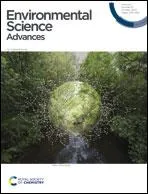
Back cover
文献情報
出版日
2022-03-28
DOI
10.1039/D2VA90004A
インパクトファクター
0
著者
原文を見る
要旨
A graphical abstract is available for this content
関連文献
A novel photoelectrochemical flow cell with online mass spectrometric detection: oxidation of formic acid on a nanocrystalline TiO2 electrode
Robert Reichert, Zenonas Jusys, R. Jürgen Behm
2014-10-03
Paper
DOI: 10.1039/C4CP03320E
The influence of charge on the structure and dynamics of water encapsulated in reverse micelles
Animesh Patra, Trung Quan Luong, Rajib Kumar Mitra, Martina Havenith
2014-05-12
Paper
DOI: 10.1039/C4CP00386A
The first tyrosyl radical intermediate formed in the S2–S3 transition of photosystem II
Marius Retegan, Nicholas Cox, Wolfgang Lubitz, Frank Neese, Dimitrios A. Pantazis
2014-04-03
Paper
DOI: 10.1039/C4CP00696H
Flue gas CO2 mineralization using thermally activated serpentine: from single- to double-step carbonation
Mischa Werner, Subrahmaniam Hariharan, Marco Mazzotti
2014-09-30
Paper
DOI: 10.1039/C4CP02786H
Correction: A reduced radial potential energy function for the halogen bond and the hydrogen bond in complexes B⋯XY and B⋯HX, where X and Y are halogen atoms
2014-10-17
Correction
DOI: 10.1039/C4CP90149E
Creation of mesopores in carbon nanotubes with improved capacities for lithium ion batteries
Jiang Gong, Ryszard J. Kalenczuk, Ewa Mijiowska, Wenbin Liu, Tao Tang
2014-10-15
Paper
DOI: 10.1039/C4CP04386C
In situ particle film ATR FTIR spectroscopy of poly (N-isopropyl acrylamide) (PNIPAM) adsorption onto talc
David A. Beattie, Jonas Addai-Mensah, Audrey Beaussart, George V. Franks, Kai-Ying Yeap
2014-10-16
Paper
DOI: 10.1039/C4CP03161J
Diastereomeric preference of a triply axial chiral binaphthyl based molecule: a concentration dependent study by chiroptical spectroscopies
Zahra Dezhahang, Mohammad Reza Poopari, Florencio Eloy Hernández, Carlos Diaz, Yunjie Xu
2014-05-08
Paper
DOI: 10.1039/C4CP01704H
Quantifying the dependence of dead lithium losses on the cycling period in lithium metal batteries
Asghar Aryanfar, Daniel J. Brooks, Agustín J. Colussi, Michael R. Hoffmann
2014-10-10
Paper
DOI: 10.1039/C4CP03590A
Hydrogen-bonded intermediates and transition states during spontaneous and acid-catalyzed hydrolysis of the carcinogen (+)-anti-BPDE
Mark C. Palenik, Jorge H. Rodriguez
2014-05-21
Communication
DOI: 10.1039/C4CP01310G
こちらもおすすめ
化合物よくある質問
1-{3-[5-(エチルカルボンイル)-2,4-ジメチル-1H-ピロロール-3-基]プロパニル}ピペリジン-4-カルボン酸について、適用される法規ガイドラインは何ですか?
この化合物はCAS番号1142209-81-1であり、GHS分類では corrosive (腐食性物質) と classified (分類物質) として指定され...
1142209-81-11-{3-[5-(Ethoxycarbo...
化合物よくある質問
2,2-二氟-1,3-ベンゾジオキサン-5-カルボキシlic酸とは何ですか?
2,2-二氟-1,3-ベンゾジオキサン-5-カルボキシlic酸は、CAS番号656-46-2の化合物で、化学式はC8H4F2O4です。この化合物は白色の結晶性粉...
656-46-22,2-Difluoro-1,3-ben...
化合物よくある質問
8-氯-4-色原酮の代替品はありますか?
8-氯-4-色原酮(CAS番号: 49701-11-3)の代替品には、他の色原酮類似物や、構造が似ている化合物があります。例えば、8-メチル-4-色原酮や、他の...
49701-11-38-Chloro-2,3-dihydro...
化合物よくある質問
エチル6,6-ジメチル-4,5,6,7-テトラヒドロ-1H-インドアゼー-3-カルボキシレートとは何ですか?
エチル6,6-ジメチル-4,5,6,7-テトラヒドロ-1H-インドアゼー-3-カルボキシレートは、CAS番号1233243-56-5を有する化合物です。これは有...
1233243-56-5Ethyl 6,6-dimethyl-4...
化合物よくある質問
4-叔丁基-6-氯-嘧啶に適用される法規ガイドラインは何ですか?
4-叔丁基-6-氯-嘧啶はCAS番号3435-24-3で、GHS分類では毒性物質とみなし、GHSの危険性分類が適用されます。REACH規則では登録が必要で、Eu...
3435-24-34-Tert-butyl-6-chlor...
化合物よくある質問
維库溴铵杂质Bはどのように合成されますか?
維库溴铵杂质Bは、アンドロステンデンから始まり、一連の合成反応、包括的な選択性と高い収率で合成されます。具体的には、ブロミド化、酸化、ジマーゼ反応、アミド化など...
50587-95-6(2beta,3alpha,5alpha...
化合物よくある質問
2-(4-氟苄基)-吡咯烷の物理化学的性質は何ですか?
CAS番号350017-04-8の2-(4-氟苄基)-吡咯烷は、結晶性の白色粉末です。分子量は199.17 g/molで、水に溶けにくいです。化学反応では比較的...
350017-04-82-(4-Fluorobenzyl)py...
化合物よくある質問
3-喹啉甲醛(2-チロール-8-エチル)は安全ですか?
3-喹啉甲醛(2-チロール-8-エチル)は一定の毒性を持つため、取扱には注意が必要です。使用する際は適切な防護具を着用し、密閉容器で保管・搬送し、直接的な接触を...
335196-05-92-Chloro-8-ethyl-3-q...
化合物よくある質問
エチル3-(ヒドロキシメチル)-1H-ピロール-2-カルボキシレートはどのように保存すればよいですか?
エチル3-(ヒドロキシメチル)-1H-ピロール-2-カルボキシレートは、室温(25℃)以下で保存し、直射日光を避け、乾燥した環境で保管することが推奨されます。ま...
75448-69-0Ethyl 3-(hydroxymeth...
119410-05-88-Chloro-11-(4-piper...
掲載誌
おすすめ化合物


![3-[(4-Nitrobenzyl)oxy]-3-oxopropanoic Acid structure](https://static.chemtradehub.com/structs/773/77359-11-6-0d04.webp "3-[(4-Nitrobenzyl)oxy]-3-oxopropanoic Acid structure")

おすすめサプライヤー





免責事項
このページに表示される学術雑誌情報は、参考および研究目的のみを目的としています。当社は雑誌出版社とは提携しておらず、投稿の取り扱いも行っておりません。出版に関するお問い合わせは、各雑誌出版社に直接ご連絡ください。
表示されている情報に誤りがある場合は、support@chemtradehub.com までご連絡ください。迅速に確認し、対応いたします。