












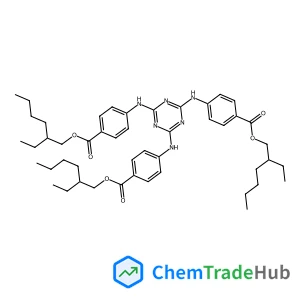
Tris(2-ethylhexyl) 4,4',4''-(1,3,5-triazine-2,4,6-triyltriimino)tribenzoate
CAS番号:
88122-99-0
分子式:
C48H66N6O6
Amrita Nighojkar, Karl Zimmermann, Mohamed Ateia, Benoit Barbeau, Madjid Mohseni, Satheesh Krishnamurthy, Fuhar Dixit, Balasubramanian Kandasubramanian
With growing environmental consciousness, biomaterials (BMs) have garnered attention as sustainable materials for the adsorption of hazardous water contaminants. These BMs are engineered using surface treatments or physical alterations to enhance their adsorptive properties. The lab-scale methods generally employ a One Variable at a Time (OVAT) approach to analyze the impact of biomaterial modifications, their characteristics and other process variables such as pH, temperature, dosage, etc., on the removal of metals via adsorption. Although implementing the adsorption procedure using BMs seems simple, the conjugate effects of adsorbent properties and process attributes implicate complex nonlinear interactions. As a result, artificial neural networks (ANN) have gained traction in the quest to understand the complex metal adsorption processes on biomaterials, with applications in environmental remediation and water reuse. This review discusses recent progress using ANN frameworks for metal adsorption using modified biomaterials. Subsequently, the paper comprehensively evaluates the development of a hybrid-ANN system to estimate isothermal, kinetic and thermodynamic parameters in multicomponent adsorption systems.
Mainak Ganguly, Chanchal Mondal, Anjali Pal, Saied Md Pratik, Jaya Pal, Tarasankar Pal
DOI: 10.1039/C4CP00497C
C. Korte, J. Keppner, A. Peters, N. Schichtel, H. Aydin, J. Janek
DOI: 10.1039/C4CP03055A
Yong Zhang, Edward J. Maginn
DOI: 10.1039/C4CP01048E
Hyuck Lim, Cang Zhao
DOI: 10.1039/C4CP01610F
Ryota Ashizawa, Takumi Noguchi
DOI: 10.1039/C3CP54742F
Marius Retegan, Nicholas Cox, Wolfgang Lubitz, Frank Neese, Dimitrios A. Pantazis
DOI: 10.1039/C4CP00696H
Agustín S. Picco, Gustavo F. Silbestri, R. Darío Falcone, Omar Azzaroni, Marcelo Ceolín, N. Mariano Correa
DOI: 10.1039/C4CP01333F
Indrani Jha, Pankaj Attri, Pannuru Venkatesu
DOI: 10.1039/C3CP54398F
Frank Müh, Dominik Lindorfer, Marcel Schmidt am Busch, Thomas Renger
DOI: 10.1039/C3CP55166K
この化合物はCAS番号1142209-81-1であり、GHS分類では corrosive (腐食性物質) と classified (分類物質) として指定され...
2,2-二氟-1,3-ベンゾジオキサン-5-カルボキシlic酸は、CAS番号656-46-2の化合物で、化学式はC8H4F2O4です。この化合物は白色の結晶性粉...
8-氯-4-色原酮(CAS番号: 49701-11-3)の代替品には、他の色原酮類似物や、構造が似ている化合物があります。例えば、8-メチル-4-色原酮や、他の...
エチル6,6-ジメチル-4,5,6,7-テトラヒドロ-1H-インドアゼー-3-カルボキシレートは、CAS番号1233243-56-5を有する化合物です。これは有...
4-叔丁基-6-氯-嘧啶はCAS番号3435-24-3で、GHS分類では毒性物質とみなし、GHSの危険性分類が適用されます。REACH規則では登録が必要で、Eu...
維库溴铵杂质Bは、アンドロステンデンから始まり、一連の合成反応、包括的な選択性と高い収率で合成されます。具体的には、ブロミド化、酸化、ジマーゼ反応、アミド化など...
CAS番号350017-04-8の2-(4-氟苄基)-吡咯烷は、結晶性の白色粉末です。分子量は199.17 g/molで、水に溶けにくいです。化学反応では比較的...
3-喹啉甲醛(2-チロール-8-エチル)は一定の毒性を持つため、取扱には注意が必要です。使用する際は適切な防護具を着用し、密閉容器で保管・搬送し、直接的な接触を...
エチル3-(ヒドロキシメチル)-1H-ピロール-2-カルボキシレートは、室温(25℃)以下で保存し、直射日光を避け、乾燥した環境で保管することが推奨されます。ま...

![1-(Hexopyranosyloxy)-4a,5-dihydroxy-7-methyl-1,4a,5,6,7,7a-hexahydrocyclopenta[c]pyran-7-yl 3-phenylacrylate structure](https://static.chemtradehub.com/structs/192/19210-12-9-ecae.webp "1-(Hexopyranosyloxy)-4a,5-dihydroxy-7-methyl-1,4a,5,6,7,7a-hexahydrocyclopenta[c]pyran-7-yl 3-phenylacrylate structure")





