












![N-[(9H-Fluoren-9-ylmethoxy)carbonyl]-beta-phenyl-L-phenylalanine structure](https://static.chemtradehub.com/structs/201/201484-50-6-c2fc.webp "N-[(9H-Fluoren-9-ylmethoxy)carbonyl]-beta-phenyl-L-phenylalanine structure")
Deamidation reaction network mapping of pharmacologic and related proteins: impact of solvation dielectric on the degradation energetics of asparagine dipeptides
文献情報
出版日
2022-04-01
DOI
10.1039/D2RE00110A
インパクトファクター
4.239
著者
Katherine E. Lawson, Joseph K. Dekle, Megan N. Evans, Andrew J. Adamczyk
原文を見る
要旨
Monoclonal antibodies (mAbs) are one of the most lucrative pharmacologics currently on the market due to their diverse array of applications. However, the diversity of these therapeutics is often limited by the degradation mechanisms experienced both in the formulation process and on the shelf after production. Due to the size constraints of experimental approaches, molecular models are crucial for studying these degradation mechanisms. One such mechanism of interest is deamidation, also known as the transition from neutral residues to acidic residues. In this study, we mapped out the deamidation of Asn-X dipeptides into Asp-X dipeptides using density functional theory (DFT). Full network mapping enabled us to predict the selectivity of the deamidation reaction between three primary pathways, as well as one theoretical pathway, as a function of solvent dielectric (Fig. 1). To meet this goal, we studied a total of 115 dipeptide reactions per modeled dielectric (460 total reactions). Modeled at a neutral pH and using quantum chemical and statistical thermodynamic methods, we computed the following values: enthalpy of reaction (ΔHRXN), entropy (ΔSRXN), Gibbs free energy of reaction (ΔGRXN), activation energy (EA), and the Arrhenius pre-exponential factor (log(A)) for each dipeptide. Additionally, by using chemical reaction principles, we generated a database of computed rate coefficients for all possible N-terminus Asn-X deamidation reactions at a neutral pH, predicted the most likely deamidation reaction mechanism for each dipeptide reaction, and matched our results against quantitative and qualitative trends previously noted by experimental literature.
おすすめジャーナル
関連文献
Charge regulation of colloidal particles in aqueous solutions
Amin Bakhshandeh, Derek Frydel, Yan Levin
2020-09-15
Paper
DOI: 10.1039/D0CP03633A
Free volume, gas permeation, and proton conductivity in MIL-101-SO3H/Nafion composite membranes
Chongshan Yin, Chunqing He, Qicheng Liu, Bangyun Xiong, Xiaowei Zhang, Libing Qian, Jingjing Li, Yawei Zhou
2019-10-19
Paper
DOI: 10.1039/C9CP04832D
Correlation of electrochemical and ab initio investigations of iron poly-bipyridine coordination complexes for battery applications: impact of the anionic environment and the local geometries of the redox complexes on the electrochemical response
Adama Sy, Asif Iqbal Bhatti, Fahim Hamidouche, Olivier Le Bacq, Lauréline Lecarme, Jean-Claude Leprêtre
2020-07-20
Paper
DOI: 10.1039/D0CP01576H
Excellent thermoelectric properties of monolayer RbAgM (M = Se and Te): first-principles calculations
Jinjie Gu, Xilong Qu
2020-10-23
Paper
DOI: 10.1039/D0CP04565A
Surface functionalization: an efficient alternative for promoting the catalytic activity of closed shell gold clusters‡
Manzoor Ahmad Dar
2020-09-21
Paper
DOI: 10.1039/D0CP01918F
Micro-solvation of CO in water: infrared spectra and structural calculations for (D2O)2–CO and (D2O)3–CO
A. J. Barclay, A. Pietropolli Charmet, K. H. Michaelian, A. R. W. McKellar, N. Moazzen-Ahmadi
2019-11-21
Paper
DOI: 10.1039/C9CP05480D
Energy conversion based on superhydrophobic surfaces
Yang Chen, Jiyu Liu, Rui Liu, Danyang Zhao, Shungang Hua, Yao Lu
2020-10-13
Perspective
DOI: 10.1039/D0CP04257A
Triangulenes and theirs ions: reaching the limits of Clar's rule
Eduardo Martín Rico-Sotomayor, José Enrique Barquera-Lozada
2020-09-29
Paper
DOI: 10.1039/D0CP03305G
New approach to increase the sensitivity of Tb–Eu-based luminescent thermometer
Alexander I. Dalinger, Leonid S. Lepnev, Sergey Z. Vatsadze
2020-10-07
Communication
DOI: 10.1039/D0CP04909C
Hydrogen in methanol catalysts by neutron imaging
Hans Geerlings, Pavel Trtik, Anders Kaestner
2020-09-21
Paper
DOI: 10.1039/D0CP03414B
こちらもおすすめ
化合物よくある質問
噻奈普汀乙酯の物理化学的性質は何ですか?
CAS番号66981-77-9の噻奈普汀乙酯は、結晶性白色粉末であり、分子量は476.9 g/molです。この化合物は水に溶けにくく、一般的には有機溶媒で溶解し...
66981-77-9Ethyl 7-[(3-chloro-6...
化合物よくある質問
アミピシリン不純物Fとは何ですか?
アミピシリン不純物Fは、CAS番号124774-48-7の化合物です。これは、抗生物質アミピシリンの生産過程で生成される不純物の一つであり、(4S)-2-({[...
124774-48-7Ampicillin impurity ...
化合物よくある質問
イリジウム(I)ヘキサフルオロフォスファートの代替品はありますか?
イリジウム(I)ヘキサフルオロフォスファートの代替品として、他の有機金属化合物や非有機金属化合物が使用されることがあります。具体的には、ダイゾニウム塩や他の金属...
870077-94-43-Di-i-propylphosphi...
化合物よくある質問
含有3-(苯氧基甲基)苯硼酸频那醇酯の廃棄物はどのように処理すべきですか?
含有3-(苯氧基甲基)苯硼酸频那醇酯の廃棄物は、安全な方法で処理する必要があります。まず、廃棄物を適切な容器に収集し、避けて保管します。次に、専門の廃棄処理業者...
912569-68-74,4,5,5-Tetramethyl-...
化合物よくある質問
2-甲基辛-1-醇を取り扱う際の実験室安全事項は何ですか?
取り扱う際は、密閉のゴーグルと手袋を着用することが推奨されます。ドラフトチャンバーを使用し、漏洩時には速やかに取り扱いを中止し、適切な排気設備を使用してください...
818-81-52-Methyl-1-octanol
14066-05-8Scandium triperchlor...
化合物よくある質問
3α-アセトキノイドコレステロールエステルはどのように保存すればよいですか?
3α-アセトキノイドコレステロールエステルは、常温から低温(0-5℃)の暗所で保存し、密閉容器に入れることで安定性を保つことが推奨されます。また、湿気や酸素から...
30365-63-0Methyl (3alpha,5beta...
化合物よくある質問
2-ぶンジロキシ-4-(トリフルオロメチル)フェノルビノン酸の主な用途は何ですか?
2-ぶンジロキシ-4-(トリフルオロメチル)フェノルビノン酸は、化学合成の触媒としての使用や、医薬品の合成材料としての役割があります。また、特定の合成路線で使用...
1701435-39-3[2-(Benzyloxy)-4-(tr...
化合物よくある質問
(2S,3R)-2-氨基-3-甲基丁二酸はどのように合成されますか?
(2S,3R)-2-氨基-3-甲基丁二酸は、2-ヒドロキシ-3-メチル丁酸とアミノ化反応を行うことで合成されます。触媒としてジクロロメタンが使用され、選択性と収...
121570-10-3(2S,3R)-2-amino-3-me...
化合物よくある質問
1-Benzyl-2-phenyl-1H-imidazoleはどのように保存すればよいですか?
この化合物は常温で避けてください。直射日光を避け、密閉容器で保存し、湿気を防水の容器に入れて保管してください。
37734-89-71-Benzyl-2-phenyl-1H...
掲載誌
Reaction Chemistry & Engineering

CiteScore:
0
自己引用率:
8.8%
年間論文数:
284
Reaction Chemistry & Engineering is an interdisciplinary journal reporting cutting-edge research focused on enhancing the understanding and efficiency of reactions. Reaction engineering leverages the interface where fundamental molecular chemistry meets chemical engineering and technology. Challenges in chemistry can be overcome by the application of new technologies, while engineers may find improved solutions for process development from the latest developments in reaction chemistry. Reaction Chemistry & Engineering is a unique forum for researchers whose interests span the broad areas of chemical engineering and chemical sciences to come together in solving problems of importance to wider society. All papers should be written to be approachable by readers across the engineering and chemical sciences. Papers that consider multiple scales, from the laboratory up to and including plant scale, are particularly encouraged.
おすすめ化合物
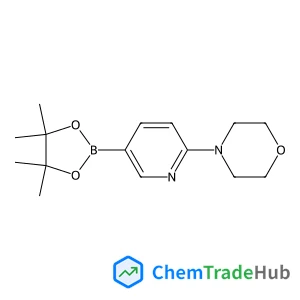
4-(5-(4,4,5,5-tetramethyl-1,3,2-dioxaborolan-2-yl)pyridin-2-yl)morpholine
CAS番号:
485799-04-0
分子式:
C15H23BN2O3
![N-[(1S,2R,4S)-2-Amino-4-(dimethylcarbamoyl)cyclohexyl]-N'-(5-chloro-2-pyridinyl)ethanediamide structure](https://static.chemtradehub.com/structs/480/480452-37-7-0898.webp "N-[(1S,2R,4S)-2-Amino-4-(dimethylcarbamoyl)cyclohexyl]-N'-(5-chloro-2-pyridinyl)ethanediamide structure")
おすすめサプライヤー





免責事項
このページに表示される学術雑誌情報は、参考および研究目的のみを目的としています。当社は雑誌出版社とは提携しておらず、投稿の取り扱いも行っておりません。出版に関するお問い合わせは、各雑誌出版社に直接ご連絡ください。
表示されている情報に誤りがある場合は、support@chemtradehub.com までご連絡ください。迅速に確認し、対応いたします。