












Copper supported silica-based nanocatalysts for CuAAC and cross-coupling reactions
文献情報
出版日
2022-06-23
DOI
10.1039/D2RE00095D
インパクトファクター
4.239
著者
Nithya Velusamy, Pounraj Thanasekaran, King-Chuen Lin, Seenivasan Rajagopal
原文を見る
要旨
Copper nanoparticles supported on silica (CuNPs–SiO2) have been explored as sustainable catalysts for various catalytic reactions such as Huisgen 1,3-dipolar cycloaddition (click reaction), carbon-sulfur (C–S), carbon-nitrogen (C–N), and carbon–oxygen (C–O) coupling reactions. The Cu-catalyzed azide–alkyne cycloaddition (CuAAC) protocol that belongs to the family of click chemistry is one of the most reliable and widespread synthetic transformations in organic chemistry, with multidisciplinary applications. The Cu-based SiO2 nanocomposites exhibit superior catalytic activity, stability, and recyclability compared to their unsupported counterparts. Thus, it reveals the advantages and importance of designing Cu nanocomposites with desirable catalytic properties. This review discusses a better understanding of the catalytic behavior of CuNPs–SiO2 nanocatalysts than that of some commercial Cu catalysts with regard to the metal loadings, reaction time, yield of products, recycle tests, and other protocols. Furthermore, recent signs of progress in the synthesis, characterization, and industrial applications of CuNPs–SiO2 nanocatalysts are summarized and discussed along with the prospective outlook of the relevant research fields.
関連文献
Correlation of electrochemical and ab initio investigations of iron poly-bipyridine coordination complexes for battery applications: impact of the anionic environment and the local geometries of the redox complexes on the electrochemical response
Adama Sy, Asif Iqbal Bhatti, Fahim Hamidouche, Olivier Le Bacq, Lauréline Lecarme, Jean-Claude Leprêtre
2020-07-20
Paper
DOI: 10.1039/D0CP01576H
Magnetism modulation and conductance quantization in a gadolinium oxide memristor
Shuang Gao, Huali Yang, Gang Liu, Run-Wei Li
2020-10-31
Paper
DOI: 10.1039/D0CP03767B
Anharmonic coupling behind vibrational spectra of solvated ammonium: lighting up overtone states by Fermi resonance through tuning solvation environments
Chih-Kai Lin, Qian-Rui Huang, Jer-Lai Kuo
2020-09-30
Paper
DOI: 10.1039/D0CP03519J
Rotational spectra of van der Waals complexes: pyrrole–Ne and pyrrole–Ne2
Isabel Peña, Carlos Cabezas
2020-10-26
Paper
DOI: 10.1039/D0CP04580B
Brushes and lamellar mesophases of comb-shaped (co)polymers: a self-consistent field theory
Ivan V. Mikhailov, Ekaterina B. Zhulina
2020-10-13
Paper
DOI: 10.1039/D0CP02954H
GCIceNet: a graph convolutional network for accurate classification of water phases
QHwan Kim, Joon-Hyuk Ko, Sunghoon Kim, Wonho Jhe
2020-11-12
Paper
DOI: 10.1039/D0CP03456H
Solvent-dependent termination, size and stability in polyynes synthesized via laser ablation in liquids
Sonia Peggiani, Pietro Marabotti, Riccardo Alberto Lotti, Anna Facibeni, Patrick Serafini, Alberto Milani, Valeria Russo, Andrea Li Bassi, Carlo Spartaco Casari
2020-10-16
Paper
DOI: 10.1039/D0CP04132G
Relativistic effects on the aromaticity of E3M3H3 (E = C–Pb; M = N–Bi) benzene analogues
Ricardo Pino-Rios, Alejandro Vásquez-Espinal, Luis Alvarez-Thon, William Tiznado
2020-10-01
Paper
DOI: 10.1039/D0CP04446F
Opening dynamics of HIV-1 gp120 upon receptor binding is dictated by a key hydrophobic core
Lin-Tai Da, Mengna Lin
2019-11-11
Paper
DOI: 10.1039/C9CP04613E
Single photon ionization of methyl isocyanide and the subsequent unimolecular decomposition of its cation: experiment and theory
A. Bellili, M. C. Gazeau, Y. Bénilan, N. Fray, J. C. Guillemin, M. Hochlaf, M. Schwell
2019-09-26
Paper
DOI: 10.1039/C9CP04310A
こちらもおすすめ
化合物よくある質問
噻奈普汀乙酯の物理化学的性質は何ですか?
CAS番号66981-77-9の噻奈普汀乙酯は、結晶性白色粉末であり、分子量は476.9 g/molです。この化合物は水に溶けにくく、一般的には有機溶媒で溶解し...
66981-77-9Ethyl 7-[(3-chloro-6...
化合物よくある質問
アミピシリン不純物Fとは何ですか?
アミピシリン不純物Fは、CAS番号124774-48-7の化合物です。これは、抗生物質アミピシリンの生産過程で生成される不純物の一つであり、(4S)-2-({[...
124774-48-7Ampicillin impurity ...
化合物よくある質問
イリジウム(I)ヘキサフルオロフォスファートの代替品はありますか?
イリジウム(I)ヘキサフルオロフォスファートの代替品として、他の有機金属化合物や非有機金属化合物が使用されることがあります。具体的には、ダイゾニウム塩や他の金属...
870077-94-43-Di-i-propylphosphi...
化合物よくある質問
含有3-(苯氧基甲基)苯硼酸频那醇酯の廃棄物はどのように処理すべきですか?
含有3-(苯氧基甲基)苯硼酸频那醇酯の廃棄物は、安全な方法で処理する必要があります。まず、廃棄物を適切な容器に収集し、避けて保管します。次に、専門の廃棄処理業者...
912569-68-74,4,5,5-Tetramethyl-...
化合物よくある質問
2-甲基辛-1-醇を取り扱う際の実験室安全事項は何ですか?
取り扱う際は、密閉のゴーグルと手袋を着用することが推奨されます。ドラフトチャンバーを使用し、漏洩時には速やかに取り扱いを中止し、適切な排気設備を使用してください...
818-81-52-Methyl-1-octanol
14066-05-8Scandium triperchlor...
化合物よくある質問
3α-アセトキノイドコレステロールエステルはどのように保存すればよいですか?
3α-アセトキノイドコレステロールエステルは、常温から低温(0-5℃)の暗所で保存し、密閉容器に入れることで安定性を保つことが推奨されます。また、湿気や酸素から...
30365-63-0Methyl (3alpha,5beta...
化合物よくある質問
2-ぶンジロキシ-4-(トリフルオロメチル)フェノルビノン酸の主な用途は何ですか?
2-ぶンジロキシ-4-(トリフルオロメチル)フェノルビノン酸は、化学合成の触媒としての使用や、医薬品の合成材料としての役割があります。また、特定の合成路線で使用...
1701435-39-3[2-(Benzyloxy)-4-(tr...
化合物よくある質問
(2S,3R)-2-氨基-3-甲基丁二酸はどのように合成されますか?
(2S,3R)-2-氨基-3-甲基丁二酸は、2-ヒドロキシ-3-メチル丁酸とアミノ化反応を行うことで合成されます。触媒としてジクロロメタンが使用され、選択性と収...
121570-10-3(2S,3R)-2-amino-3-me...
化合物よくある質問
1-Benzyl-2-phenyl-1H-imidazoleはどのように保存すればよいですか?
この化合物は常温で避けてください。直射日光を避け、密閉容器で保存し、湿気を防水の容器に入れて保管してください。
37734-89-71-Benzyl-2-phenyl-1H...
掲載誌
Reaction Chemistry & Engineering

CiteScore:
0
自己引用率:
8.8%
年間論文数:
284
Reaction Chemistry & Engineering is an interdisciplinary journal reporting cutting-edge research focused on enhancing the understanding and efficiency of reactions. Reaction engineering leverages the interface where fundamental molecular chemistry meets chemical engineering and technology. Challenges in chemistry can be overcome by the application of new technologies, while engineers may find improved solutions for process development from the latest developments in reaction chemistry. Reaction Chemistry & Engineering is a unique forum for researchers whose interests span the broad areas of chemical engineering and chemical sciences to come together in solving problems of importance to wider society. All papers should be written to be approachable by readers across the engineering and chemical sciences. Papers that consider multiple scales, from the laboratory up to and including plant scale, are particularly encouraged.
おすすめ化合物
![Ethyl 3-((6-(4,5-dihydro-1H-benzo[d]azepin-3(2H)-yl)-2-(pyridin-2-yl)pyrimidin-4-yl)amino)propanoate structure](https://static.chemtradehub.com/structs/137/1373423-53-0-496a.webp "Ethyl 3-((6-(4,5-dihydro-1H-benzo[d]azepin-3(2H)-yl)-2-(pyridin-2-yl)pyrimidin-4-yl)amino)propanoate structure")
![N-[(5,6-Dichloro-1H-benzimidazol-2-yl)methyl]-9-(1-methyl-1H-pyrazol-4-yl)-2-(4-morpholinyl)-9H-purin-6-amine structure](https://static.chemtradehub.com/structs/238/2387704-62-1-25f4.webp "N-[(5,6-Dichloro-1H-benzimidazol-2-yl)methyl]-9-(1-methyl-1H-pyrazol-4-yl)-2-(4-morpholinyl)-9H-purin-6-amine structure")
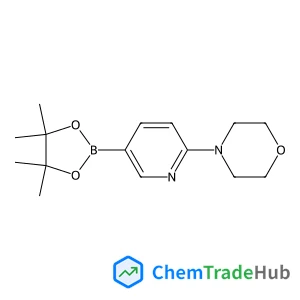
4-(5-(4,4,5,5-tetramethyl-1,3,2-dioxaborolan-2-yl)pyridin-2-yl)morpholine
CAS番号:
485799-04-0
分子式:
C15H23BN2O3
おすすめサプライヤー






免責事項
このページに表示される学術雑誌情報は、参考および研究目的のみを目的としています。当社は雑誌出版社とは提携しておらず、投稿の取り扱いも行っておりません。出版に関するお問い合わせは、各雑誌出版社に直接ご連絡ください。
表示されている情報に誤りがある場合は、support@chemtradehub.com までご連絡ください。迅速に確認し、対応いたします。