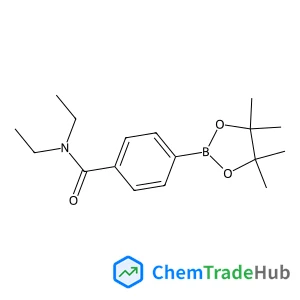
N,N-Diethyl-4-(4,4,5,5-tetramethyl-1,3,2-dioxaborolan-2-yl)benzamide
CAS番号:
325142-99-2
分子式:
C17H26BNO3
Minghang Ji, Shengquan Zheng, Chen Zou, Min Chen
As a powerful synthetic tool, ruthenium-catalyzed ring-opening metathesis polymerization (ROMP) has been widely used to prepare diverse polymers. In this paper, we demonstrated the polymerization of cyclooctene in the presence of diazoacetate or (bis)diazoacetate compounds. For the copolymerization of cyclooctene and diazoacetate, well-defined telechelic polymers bearing –COOEt, –COOBn or –TMS groups were presented along with efficient tuning of the polymer molecular weight. When using (bis)diazoacetate compounds, various random functionalized copolymers were produced with different functional groups and incorporation ratios (up to 11%). With a NaBArF cocatalyst, the conversion of diazoacetates or (bis)diazoacetates was significantly promoted, and the mechanism was also explored during the polymerization. After hydrogenation, polar functionalized high-density polyethylene was accessed which exhibited good properties because of the introduction of ester groups in the main chain.
Joonhee Kang, Seung Hyo Noh, Jeemin Hwang, Hoje Chun, Hansung Kim, Byungchan Han
DOI: 10.1039/C8CP03801E
Wojciech Skomorowski, Sahil Gulania, Anna I. Krylov
DOI: 10.1039/C7CP08227D
Alicia Lund, Asif Equbal
DOI: 10.1039/C8CP04167A
Felix Ameseder, Aurel Radulescu, Marina Khaneft, Wiebke Lohstroh, Andreas M. Stadler
DOI: 10.1039/C7CP08292D
Anders S. Gertsen, Mads Koerstz, Kurt V. Mikkelsen
DOI: 10.1039/C8CP00588E
James McKenzie, Christopher A. Hunter
DOI: 10.1039/C8CP05470C
Cezhou Zhao, Chun Zhao, Weitao Su, Yannick J. Dappe, Richard J. Nichols
DOI: 10.1039/C8CP02877J
Tanwi Debnath, Pulak Kumar Ghosh
DOI: 10.1039/C8CP04419H
DOI: 10.1039/C8CP03615B
Yunyun Huang, Chaoyan Chen, Hongtao Li, Aoxiang Xiao, Tuan Guo, Bai-Ou Guan
DOI: 10.1039/C7CP07915J
2-ヒドロキシ-5-ニトロベンジンブロモイドは特定の化学反応に適しているため、代替品は限られています。しかし、同様の構造を持つ2-ヒドロキシ-4-ニトロベンジン...
N-(2-ブロモフェニル)-1-チロール-3-オキソ-3-(ピペリジニル)プロペン-2-イル)ベンゼンアミドは有毒で、皮膚や粘膜に刺激を与える可能性があります。...
この化合物は、新規治療薬の開発に注目されています。市場では、その有効性と安全性が評価され、研究分野では、分子生物学と医薬化学の新たな発見が期待されています。
Succinimidyl-alanyl-phenylalanyl-prolyl-phenylalanine 4-nitroanilide は主に医薬品開発やポ...
メチル6-アミノ-5-クロロピリジン-2-カーボイル酸(CAS番号: 1256794-05-4)の使用には、GHS( Globally Harmonized S...
取り扱いには、耐薬品性の容器を使用し、通気性の良い場所で操作することを推奨します。漏れ時は、SDS(安全データシート)を参照して適切な措置を取ること。手洗いと洗...
(S)-3-ベンZYルピペリジン塩酸塩は、CAS番号1258940-00-9で表される化合物です。これは、(S)-3-苯基哌啶的盐酸盐であり、主に医薬品の原料と...
3,5-二甲基金剛胺は、主に医薬品の原料として使用され、また抗うつ薬や抗アルツハイマー薬の開発に利用されます。さらに、化粧品や食品添加物の製造でも重要な役割を果...
ビス(4-メチル-2-ペンチル)フェニルカルボン酸エステル (CAS番号: 1398066-13-1) の代替品には、ビス(2-エチルヘキシル)フェノールカルボ...

Polymer Chemistry welcomes submissions in all areas of polymer science that have a strong focus on macromolecular chemistry. Manuscripts may cover a broad range of fields, yet no direct application focus is required.