












![5,10-Dihydroindeno[2,1-a]indene structure](https://static.chemtradehub.com/structs/654/6543-29-9-71ca.webp "5,10-Dihydroindeno[2,1-a]indene structure")
Insights from computational analysis: how does the SARS-CoV-2 Delta (B.1.617.2) variant hijack ACE2 more effectively?
文献情報
出版日
2022-03-21
DOI
10.1039/D2CP00843B
インパクトファクター
3.676
著者
Danyang Xiong, Xiaoyu Zhao, Song Luo, Lili Duan
原文を見る
要旨
The SARS-CoV-2 Delta (B.1.617.2) variant was identified in India in October 2020, and it has quickly become the mainstream strain with strong toxicity and spread, posing great challenges to epidemic control. However, the molecular mechanism of its powerful infectivity remains unclear. It is meaningful to investigate the process of Delta variant's receptor-binding domain (RBD) binding to angiotensin-converting enzyme 2 (ACE2). Here, we performed three repeated molecular dynamics simulations for each system to avoid accidents, and the alanine scanning combined with the interaction entropy (ASIE) method was utilized to evaluate the binding free energy. Through the detailed energy and conformational analysis, the binding mechanism of the Delta variant was illustrated. The results showed that the existence of L452R and T478K mutations can trigger the effective hijacking of ACE2 by the Delta variant through the following three ways: (i) these two mutations can significantly enhance the electrostatic energy of the system by the introduction of two positively charged amino acids (Arg and Lys), thereby increasing the binding affinity of RBD and ACE2, (ii) the Loops 1, 3, and 4 in the receptor-binding motif (RBM) of RBD form a tighter conformation under the dominance of the T478K mutation, allowing ACE2 to be captured more effectively than the wild-type system, and (iii) these conformational changes lead to a more stable hydrogen bond in the Delta variant, which further ensures the stability of the binding. In addition, to explore the effect of mutations on the antibody, the key residues contributing to the changes in the binding ability of RBD in the Delta variant with the existing 42 neutralizing monoclonal antibodies (mAbs) have been preliminarily evaluated. The present study reveals the molecular mechanism for the increased infectivity of SARS-CoV-2 caused by mutations, and the key sites that cause antigenic changes were screened. It provides important theoretical insights for the development of novel targeted RBD drugs and antibodies.
おすすめジャーナル
関連文献
Efficient and economical synthesis of dendrimer-like polystyrene with long subchains through arm-first divergent strategy
Xue-Song Ge, Chen He, Wei-Dong He, Sheng-Qi Chen
2014-04-28
Paper
DOI: 10.1039/C4PY00425F
Engineering the band gap and energy level of conjugated polymers using a second acceptor unit
Khalid Mahmood, Heng Lu, Zheng-Ping Liu, Cuihong Li, Zhen Lu, Xiao Liu, Tao Fang, Qiaohong Peng, Guangwu Li, Lin Li, Zhishan Bo
2014-04-16
Paper
DOI: 10.1039/C4PY00004H
Effect of polymer chemistry on globular protein–polymer block copolymer self-assembly
Dongsook Chang, Christopher N. Lam, Shengchang Tang, Bradley D. Olsen
2014-06-30
Paper
DOI: 10.1039/C4PY00448E
Self-assembly of plasma protein through disulfide bond breaking and its use as a nanocarrier for lipophilic drugs
Shudong Wang, Guangming Gong, Hua Su, Wenya Liu, Zhen Wang, Li Li
2014-05-16
Communication
DOI: 10.1039/C4PY00212A
Synthesis of triphenylamine based polysiloxane as a blue phosphorescent host
Dianming Sun, Zhaomin Yang, Xiaoli Sun, Huihui Li, Zhongjie Ren, Junteng Liu, Dongge Ma, Shouke Yan
2014-05-02
Paper
DOI: 10.1039/C4PY00450G
ATRP with a light switch: photoinduced ATRP using a household fluorescent lamp
Tao Zhang, Tao Chen, Ihsan Amin, Rainer Jordan
2014-04-01
Paper
DOI: 10.1039/C4PY00346B
Fast and accurate partial hydrolysis of poly(2-ethyl-2-oxazoline) into tailored linear polyethylenimine copolymers
Victor R. de la Rosa, Eva Bauwens, Bryn D. Monnery, Bruno G. De Geest, Richard Hoogenboom
2014-04-11
Paper
DOI: 10.1039/C4PY00355A
Synthesis of core cross-linked star polystyrene with functional end groups and self-assemblies templated by breath figures
Liang-Wei Zhu, Wu Yang, Ling-Shu Wan, Zhi-Kang Xu
2014-05-14
Paper
DOI: 10.1039/C4PY00491D
こちらもおすすめ
化合物よくある質問
2,3-スチオエポキシマドルを取り扱う際の実験室安全事項は何ですか?
取り扱いにはPPE(プロテクティブ・パーソナル・エイド)が必要で、防ぐ手袋と保護眼鏡を着用してください。ドラフトチャンバーの使用を推奨します。漏洩した場合は、適...
4267-80-52,3-Thioepoxy Madol
53981-25-22-Amino-6-fluorophen...
化合物よくある質問
BOC-S-3-アミニ-4-(4-メチオキシベンチル)-ブタン酸の代替品はありますか?
この化合物の代替品としては、BOC保護基を有さないアミノ酸やその他の保護基化合物が考えられます。また、メチオキシ基を有しない他の芳香族アミノ酸も代替品として挙げ...
126800-59-7(3S)-4-(4-Methoxyphe...
化合物よくある質問
Methyl 2-(chloromethyl)-3-nitrobenzoate(1218910-61-2)の代替品はありますか?
Methyl 2-(chloromethyl)-3-nitrobenzoate(1218910-61-2)の代替品としては、化学組成を変えることで効果を達成する...
1218910-61-2Methyl 2-(chlorometh...
化合物よくある質問
(2R)-2-アミノ-N-ベンジル-3-ヒドロキシプロパナミドを含む廃棄物はどのように処理すべきですか?
(2R)-2-アミノ-N-ベンジル-3-ヒドロキシプロパナミドを含む廃棄物は、適切な廃棄物管理ガイドラインに基づき処理する必要があります。まず、廃棄物を適切に収...
175481-39-7(2R)-2-amino-N-benzy...
化合物よくある質問
6,7-二氢-咪唑並[1,2-a]ピリドイン-8(5h)-酮はどのように合成されますか?
6,7-二氢-咪唑並[1,2-a]ピリドイン-8(5h)-酮は、2-ブロモフェニルアセトインとリン酸ハロゲン化物を反応させることで合成できます。この反応は高温で...
457949-09-66,7-Dihydroimidazo[1...
化合物よくある質問
エチル(3R)-3-ピロリジニル酢酸水和塩とは何ですか?
エチル(3R)-3-ピロリジニル酢酸水和塩は、CAS番号1332459-32-1の化合物で、(R)-乙基2-(ピロリジン-3-基)酢酸塩水和塩と呼ばれます。この...
1332459-32-1Ethyl (3R)-3-pyrroli...
化合物よくある質問
(2S)-{[(2-メチルエチルオキシ]カルボニル}アミノ)[2-(トリアフルオロメチルフェニル]エチカシック酸の物理化学的性質は何ですか?
(2S)-{[(2-メチルエチルオキシ]カルボニル}アミノ)[2-(トリアフルオロメチルフェニル]エチカシック酸のCAS番号は1203454-45-8です。この...
1203454-45-8(2S)-({[(2-Methyl-2-...
化合物よくある質問
2-ブロモ-1-(2-メチル-2-プロパニル)-4-ニトロベンゼンはどのように保存すればよいですか?
2-ブロモ-1-(2-メチル-2-プロパニル)-4-ニトロベンゼンは、直射日光を避けて暗所で、室温(約15℃〜25℃)、乾燥した場所に保存する必要があります。ま...
6310-17-42-Bromo-1-(2-methyl-...
化合物よくある質問
1-[(4-硝基フェニル)スルホニル]-1H-1,2,4-三唑の市場動向や研究トレンドはどうですか?
市場動向としては、1-[(4-硝基フェニル)スルホニル]-1H-1,2,4-三唑は主に農業用除草剤や合成化学製品の原料として利用されています。研究トレンドとして...
57777-84-11-[(4-Nitrophenyl)su...
掲載誌
Physical Chemistry Chemical Physics

CiteScore:
5.5
自己引用率:
10.3%
年間論文数:
3036
Physical Chemistry Chemical Physics (PCCP) is an international journal co-owned by 19 physical chemistry and physics societies from around the world. This journal publishes original, cutting-edge research in physical chemistry, chemical physics and biophysical chemistry. To be suitable for publication in PCCP, articles must include significant innovation and/or insight into physical chemistry; this is the most important criterion that reviewers and Editors will judge against when evaluating submissions. The journal has a broad scope and welcomes contributions spanning experiment, theory, computation and data science. Topical coverage includes spectroscopy, dynamics, kinetics, statistical mechanics, thermodynamics, electrochemistry, catalysis, surface science, quantum mechanics, quantum computing and machine learning. Interdisciplinary research areas such as polymers and soft matter, materials, nanoscience, energy, surfaces/interfaces, and biophysical chemistry are welcomed if they demonstrate significant innovation and/or insight into physical chemistry. Joined experimental/theoretical studies are particularly appreciated when complementary and based on up-to-date approaches.
おすすめ化合物
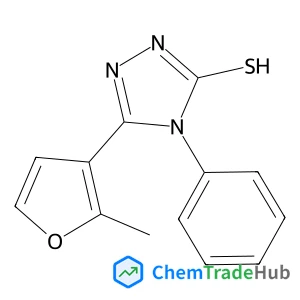
5-(2-Methyl-3-furyl)-4-phenyl-2,4-dihydro-3H-1,2,4-triazole-3-thione
CAS番号:
346464-59-3
分子式:
C13H11N3OS
![1-[4-(4-Methyl-1H-imidazol-1-yl)phenyl]ethanone structure](https://static.chemtradehub.com/structs/142/142161-53-3-7f55.webp "1-[4-(4-Methyl-1H-imidazol-1-yl)phenyl]ethanone structure")
![N-[2-(2-Pyridinyl)ethyl]-1-propanamine structure](https://static.chemtradehub.com/structs/554/55496-57-6-22b4.webp "N-[2-(2-Pyridinyl)ethyl]-1-propanamine structure")
おすすめサプライヤー





免責事項
このページに表示される学術雑誌情報は、参考および研究目的のみを目的としています。当社は雑誌出版社とは提携しておらず、投稿の取り扱いも行っておりません。出版に関するお問い合わせは、各雑誌出版社に直接ご連絡ください。
表示されている情報に誤りがある場合は、support@chemtradehub.com までご連絡ください。迅速に確認し、対応いたします。