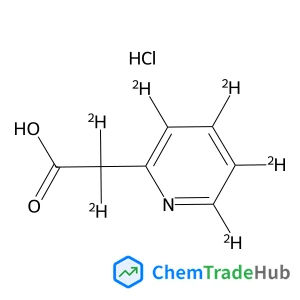
2,2-dideuterio-2-(3,4,5,6-tetradeuterio-2-pyridyl)acetic acid;hydrochloride
CAS番号:
1329799-67-8
分子式:
C7H2ClD6NO2
Subham Ray, Soumik Laha, Manik Das, Uttam Kumar Das, Arijit Bag, Indranil Choudhuri, Nandan Bhattacharya, Bidhan Chandra Samanta, Tithi Maity
The current study shows that Schiff base HL, (Z)-2,4-dibromo-6-(((piperidin-2-ylmethyl)imino)methyl)phenol, can be used successfully as a selective chemosensor for Zn(II) and Ni(II) among several competing cations in purely aqueous and semi-aqueous media. Under UV light in methanol–water (9 : 1) HEPES buffer, the receptor gives its response by changing its color to cyan color in the presence of Zn(II) and to bluish cyan color in the presence of Ni(II). Surprisingly, the chemosensor can only reliably identify Zn(II) in a hundred percent aqueous medium by changing its color to light yellow. UV and fluorescence studies in both aqueous and semi-aqueous media are used to further investigate this Zn(II) and Ni(II) recognition phenomenon. The high values of the host–guest binding constants, obtained by electronic and fluorescence titration, ensure that a strong bond exists between HL and Ni(II)/Zn(II). As anticipated, two highly luminescent mononuclear, crystalline compounds, complexes 1 and 2, have been developed by a separate reaction of HL and Zn(II)/Ni(II), and the high luminous properties are due to the occurrence of Chelation Enhanced Fluorescence (CHEF). According to the single crystal structure, the asymmetric units of both complexes consist of two deprotonated chemosensor units and one Zn(II)/Ni(II), leading to the formation of an octahedral complex. For Ni(II) and Zn(II) sensing, the predicted LOD is in the nanomolar range. Both complexes 1 and 2 are fluorescence active and studies to check their ATP detection ability, but intriguingly, only complex 2 is capable of detecting ATP in a fully aqueous solution. Finally, the live cell imaging study validates the two sensors’ biosensing functionality.
Dattatraya H. Dethe, Vijay Kumar B., Rakesh Maiti
DOI: 10.1039/C8OB01092G
DOI: 10.1039/C8OB01382A
Dan Zhao, Jingyan Luo, Lu Liu
DOI: 10.1039/D1QO01184G
Kennosuke Itoh, Mukund P. Sibi
DOI: 10.1039/C8OB90113A
Mingjie Sun, Xinyang Chen, Zichao Feng, Guobo Deng, Yuan Yang, Yun Liang
DOI: 10.1039/D1QO01103K
Chang-You Sie, Che-Ping Chuang
DOI: 10.1039/C8OB01170B
Ramón J. Zaragozá, María J. Aurell, Miguel A. González-Cardenete
DOI: 10.1039/C8OB01035H
Jia-Le Wu, Cong-Shuai Wang, Jin-Rong Wang, Guang-Jian Mei, Feng Shi
DOI: 10.1039/C8OB01427B
Bo Ren, Lu Gan, Li Zhang, Ningning Yan, Hai Dong
DOI: 10.1039/C8OB01464G
CAS番号163217-74-1の「邻羟基阿托伐他汀内酯标准品」は、GHS分類では危険物に分類されず、主にREACH規則とFDA/EPAの管理対象となります。R...
メチル(3R)-3-アミノ-2,3-ジヒドロ-1-ベンゾファンラニン-5-カルボイル酸塩塩酸塩は、医薬品や合成化学の研究に広く用いられます。また、特定の薬物の前...
トランス-4-メチルピロリジン-3-オール塩酸塩は、4-メチルピロリジンの塩酸塩化によって合成されます。一般的な合成方法では、4-メチルピロリジンを塩酸に加えて...
硫雜環丁烷-1,1-二氧化物は安全ではありません。毒性は報告されていませんが、高温下で分解し、可燃性があるため、高圧ガスは注意が必要です。密閉した容器で保管し、...
9-ヒドロキシエリプチシネ塩酸塩は、エリプチシネから塩酸を添加することで合成されます。選択性は高いですが、収率は約70%です。
5-塩素-2-(メチルアミノ)フェニル-(2-塩素フェニル)メタン酮のCAS番号は5621-86-3です。この化合物は白色の結晶性粉末で、分子量は415.03で...
1-[2-(4-甲氧基-苯氧基)-乙基]-哌嗪は、直射日光を避けて暗所に、室温(15-25℃)で保管し、密閉容器に入れることで安定性を保つことができます。
2-[3-(4-甲氧基フェニル)プロピル]-4,4,5,5-四メチル-1,3,2-ドイボロロールアンは、医薬品の合成、有機合成化学、および新材料の研究で使用され...

Analyst publishes analytical and bioanalytical research that reports premier fundamental discoveries and inventions, and the applications of those discoveries, unconfined by traditional discipline barriers.