












Self-supervised learning for inter-laboratory variation minimization in surface-enhanced Raman scattering spectroscopy
文献情報
出版日
2023-02-10
DOI
10.1039/D2AN01569B
インパクトファクター
4.616
著者
Seongyong Park, Abdul Wahab
原文を見る
要旨
Surface-enhanced Raman scattering (SERS) spectroscopy is still considered poorly reproducible despite its numerous advantages and is not a sufficiently robust analytical technique for routine implementation outside of academia. In this article, we present a self-supervised deep learning-based information fusion technique to minimize the variance in the SERS measurements of multiple laboratories for the same target analyte. In particular, a variation minimization model, coined the minimum-variance network (MVNet), is designed. Moreover, a linear regression model is trained using the output of the proposed MVNet. The proposed model showed improved performance in predicting the concentration of the unseen target analyte. The linear regression model trained on the output of the proposed model was evaluated by several well-known metrics, such as root mean square error of prediction (RMSEP), BIAS, standard error of prediction (SEP), and coefficient of determination (R2). The leave-one-lab-out cross-validation (LOLABO-CV) results indicate that the MVNet also minimizes the variance of completely unseen laboratory datasets while improving the reproducibility and linear fit of the regression model. The Python implementation of MVNet and the code for the analysis can be found on the GitHub page https://github.com/psychemistz/MVNet.
関連文献
Sample collection and amino acids analysis of extracellular fluid of mouse brain slices with low flow push–pull perfusion
G. Ojeda-Torres, L. Williams
2015-08-18
Paper
DOI: 10.1039/C5AN00805K
A new electrochemical substrate for rapid and sensitive in vivo monitoring of β-galactosidase gene expressions
Kesavan Manibalan, Veerappan Mani
2015-07-10
Paper
DOI: 10.1039/C5AN01036E
Ion mobility-mass spectrometry of charge-reduced protein complexes reveals general trends in the collisional ejection of compact subunits
Russell E. Bornschein, Brandon T. Ruotolo
2015-08-24
Paper
DOI: 10.1039/C5AN01242B
Positively charged polymer brush-functionalized filter paper for DNA sequence determination following Dot blot hybridization employing a pyrrolidinyl peptide nucleic acid probe
Tirayut Vilaivan, Voravee P. Hoven
2012-10-19
Paper
DOI: 10.1039/C2AN36133G
Multimodal chemical imaging of molecular messengers in emerging Pseudomonas aeruginosa bacterial communities
Nameera F. Baig, Sage J. B. Dunham, Jonathan V. Sweedler, Paul W. Bohn
2015-08-24
Paper
DOI: 10.1039/C5AN01149C
A peptide array-based serological protein kinase A activity assay and its application in cancer diagnosis
Deok-Hoon Kong, Se-Hui Jung, Hye-Yoon Jeon, Woo-Jin Kim, Young-Myeong Kim, Kwon-Soo Ha
2015-08-14
Paper
DOI: 10.1039/C5AN01151E
A biomimetic mussel-inspired photoelectrochemical biosensing chip for the sensitive detection of CD146
Hongmin Ma, Tao Yan, Yong Zhang, Picheng Gao, Xuehui Pang, Bin Du, Qin Wei
2015-06-01
Communication
DOI: 10.1039/C5AN00873E
Dependence of negative-mode electrospray ionization response factors on mobile phase composition and molecular structure for newly-authenticated neutral acylsucrose metabolites
Banibrata Ghosh
2015-08-27
Paper
DOI: 10.1039/C4AN02124J
Single molecule array (Simoa) assay with optimal antibody pairs for cytokine detection in human serum samples
Danlu Wu, Milena Dumont Milutinovic, David R. Walt
2015-08-06
Paper
DOI: 10.1039/C5AN01238D
こちらもおすすめ
28770-01-62-(2-Isopropyl-1,3-o...
化合物よくある質問
「邻羟基阿托伐他汀内酯标准品」に適用される法規ガイドelinesは何ですか?
CAS番号163217-74-1の「邻羟基阿托伐他汀内酯标准品」は、GHS分類では危険物に分類されず、主にREACH規則とFDA/EPAの管理対象となります。R...
163217-74-1ortho-Hydroxy Atorva...
化合物よくある質問
メチル(3R)-3-アミノ-2,3-ジヒドロ-1-ベンゾファンラニン-5-カルボイル酸塩塩酸塩の主な用途は何ですか?
メチル(3R)-3-アミノ-2,3-ジヒドロ-1-ベンゾファンラニン-5-カルボイル酸塩塩酸塩は、医薬品や合成化学の研究に広く用いられます。また、特定の薬物の前...
2241594-15-8Methyl (3R)-3-amino-...
化合物よくある質問
トランス-4-メチルピロリジン-3-オール塩酸塩はどのように合成されますか?
トランス-4-メチルピロリジン-3-オール塩酸塩は、4-メチルピロリジンの塩酸塩化によって合成されます。一般的な合成方法では、4-メチルピロリジンを塩酸に加えて...
265108-42-7trans-4-Methylpyrrol...
化合物よくある質問
硫雜環丁烷-1,1-二氧化物は安全ですか?
硫雜環丁烷-1,1-二氧化物は安全ではありません。毒性は報告されていませんが、高温下で分解し、可燃性があるため、高圧ガスは注意が必要です。密閉した容器で保管し、...
5687-92-3Thietane 1,1-dioxide
6054-10-02H, 8H-Benzo[1,2-b
化合物よくある質問
9-ヒドロキシエリプチシネ塩酸塩はどのように合成されますか?
9-ヒドロキシエリプチシネ塩酸塩は、エリプチシネから塩酸を添加することで合成されます。選択性は高いですが、収率は約70%です。
52238-35-49-Hydroxyellipticine...
化合物よくある質問
5-塩素-2-(メチルアミノ)フェニル-(2-塩素フェニル)メタン酮の物理化学的性質は何ですか?
5-塩素-2-(メチルアミノ)フェニル-(2-塩素フェニル)メタン酮のCAS番号は5621-86-3です。この化合物は白色の結晶性粉末で、分子量は415.03で...
5621-86-3[5-Chloro-2-(methyla...
化合物よくある質問
1-[2-(4-甲氧基-苯氧基)-乙基]-哌嗪はどのように保存すればよいですか?
1-[2-(4-甲氧基-苯氧基)-乙基]-哌嗪は、直射日光を避けて暗所に、室温(15-25℃)で保管し、密閉容器に入れることで安定性を保つことができます。
117132-44-21-[2-(4-Methoxy-phen...
化合物よくある質問
2-[3-(4-甲氧基フェニル)プロピル]-4,4,5,5-四メチル-1,3,2-ドイボロロールアンの主な用途は何ですか?
2-[3-(4-甲氧基フェニル)プロピル]-4,4,5,5-四メチル-1,3,2-ドイボロロールアンは、医薬品の合成、有機合成化学、および新材料の研究で使用され...
1073371-72-82-[3-(4-Methoxypheny...
掲載誌
Analyst

CiteScore:
7.8
自己引用率:
5.6%
年間論文数:
653
Analyst publishes analytical and bioanalytical research that reports premier fundamental discoveries and inventions, and the applications of those discoveries, unconfined by traditional discipline barriers.
おすすめ化合物
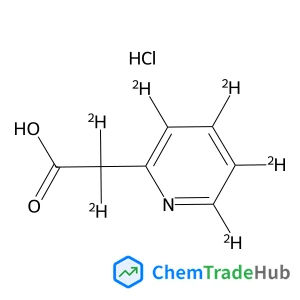
2,2-dideuterio-2-(3,4,5,6-tetradeuterio-2-pyridyl)acetic acid;hydrochloride
CAS番号:
1329799-67-8
分子式:
C7H2ClD6NO2
おすすめサプライヤー



免責事項
このページに表示される学術雑誌情報は、参考および研究目的のみを目的としています。当社は雑誌出版社とは提携しておらず、投稿の取り扱いも行っておりません。出版に関するお問い合わせは、各雑誌出版社に直接ご連絡ください。
表示されている情報に誤りがある場合は、support@chemtradehub.com までご連絡ください。迅速に確認し、対応いたします。