



NiOx-supported PtRh nanoalloy enables high-performance hydrogen evolution reaction under universal pH conditions
文献情報
出版日
2021-09-10
DOI
10.1039/D1SE01331A
インパクトファクター
6.367
著者
Dinesh Bhalothia, Yu-Min Yu, Yi-Ru Lin, Tzu- Hsi Huang, Che Yan, Jyh-Fu Lee, Kuan-Wen Wang
原文を見る
要旨
An ultra-fine (∼1.9 nm) tri-metallic nanocatalyst (NC) comprised of a high density of PtRh nanoalloy over an NiOx support was developed with a Pt-loading of only 1.1 wt%. This material (denoted as PtRhNi) exhibited an outstanding HER performance in both acidic (0.5 M H2SO4) and alkaline (1.0 M KOH) media, outperforming the pure Pt catalyst with an exceptional mass activity (MA) of 4489 A gPt−1 and 1663 A gPt−1, respectively. Notably, PtRhNi NC achieved a remarkably lower overpotential (η) of 28 mV (at the cathodic current density of 10 mA cm−2) and Tafel slope of 30 mV dec−1 in acidic medium, while a similar overpotential (28 mV @ 10 mA cm−2) and competitive Tafel slope of 73 mV dec−1 were maintained in alkaline medium. More interestingly, this material retained a high performance in the chronoamperometric (CA) stability test for up to 6 h under a pH-universal environment. The experimental observations suggest that its enhanced HER performance originates from the synergistic effect between the neighbouring reaction sites in the sub-nanometer domains of PtRh nanoalloy, where the Rh-modifier and Pt-dimer sites synergistically trigger the proton adsorption (i.e., the discharge step) and reduction (i.e., the coupling of protons and electrons for accelerating the desorption step) kinetics, respectively. Besides, the RhOx and NiOx sites favour HO–H bond cleavage, and hence provide active centres for the dissociation of water. We envision that the proposed scenarios will open further opportunities for the rational design of Pt-based NCs with tailored structural and functional properties at the atomic level.
おすすめジャーナル

AIAA Journal

Australian Journal of Chemistry

Cement and Concrete Research

Journal of the Chinese Chemical Society

Accounts of Chemical Research

Chemistry of Heterocyclic Compounds

Bulletin of the Chemical Society of Japan

Analyst

Advances in Colloid and Interface Science

Journal of the American Chemical Society
関連文献
Ketonization of the remarkably strongly acidic elongated enol generated by flash photolytic decarboxylation of p-benzoylphenylacetic acid in aqueous solution
Yvonne Chiang, A. Jerry Kresge, Ikenna Onyido, John P. Richard, Peter Wan, Musheng Xu
2005-07-27
Communication
DOI: 10.1039/B506706E
Efficient two-step synthesis of 3-halo-3-enals or 2-halo-2-alkenyl ketones from propargylic bromides via a unique cationic 1,2-aryl or proton shift in electrophilic addition reaction of 2,3-allenols with X+
Chunling Fu, Jing Li
2005-07-13
Communication
DOI: 10.1039/B508069J
Enantiomerically pure P-chiral phosphinoselenoic chlorides: inversion of configuration at the P-chirogenic center in the synthesis and reaction of these substances
Tsutomu Kimura, Toshiaki Murai
2005-07-13
Communication
DOI: 10.1039/B507755A
A facile route to fabrication of inorganic–small organic molecule cable-like nanocomposite arrays
Weigang Ju, Mingming Gu, Xiangmin Meng, Wensheng Shi, Xiaohong Zhang, Shuittong Lee
2005-07-21
Communication
DOI: 10.1039/B506459G
The vicinal F–C–C–F moiety as a tool for influencing peptide conformation
Martin Schüler, David O'Hagan, Alexandra M. Z. Slawin
2005-07-14
Communication
DOI: 10.1039/B506010A
Structure elucidation of a novel family of mycolactonetoxins from the frog pathogen Mycobacterium sp. MU128FXT by mass spectrometry
Hui Hong, Tim Stinear, Paul Skelton, Jonathan B. Spencer, Peter F. Leadlay
2005-08-05
Communication
DOI: 10.1039/B506835E
Amphiphilic p-sulfonatocalix[4]arene-coated CdSe/ZnS quantum dots for the optical detection of the neurotransmitter acetylcholine
Takashi Jin, Fumihiko Fujii, Hiroshi Sakata, Mamoru Tamura, Masataka Kinjo
2005-07-11
Communication
DOI: 10.1039/B506608E
A new simple synthesis of poly(thiophene-methine)s
Md. Badruz Zaman, Dmitrii F. Perepichka
2005-07-20
Communication
DOI: 10.1039/B506138E
こちらもおすすめ
化合物よくある質問
2-メトキシ-4-(メチルスルフィニル)アミンの主な用途は何ですか?
2-メトキシ-4-(メチルスルフィニル)アミンは、主に医薬品および農薬の製造に使用されます。また、合成化学の一部として研究用材料としても利用されます。
41608-73-52-Methoxy-4-(methyls...
118684-13-24-(Bromomethyl)-3-me...
化合物よくある質問
4,6-二氯-N-甲基ピラミジンアミンの代替品はありますか?
代替品としては、4,6-二クロロピラミジンアミンや他のピラミジン系化合物が考えられます。ただし、目的と用途によって最適な代替品は異なります。
10397-15-64,6-Dichloro-N-methy...
化合物よくある質問
6-氯-4-甲基-1H-吲哚を含む廃棄物はどのように処理すべきですか?
6-氯-4-甲基-1H-吲哚の廃棄物は、適切な容器に収集し、密閉して保管します。温度は常温、湿度は低く、直射日光を避けて保管することを推奨します。廃棄処理は専門...
885520-84-36-chloro-4-methyl-1H...
化合物よくある質問
2-フローユロ-4-(トリフルオロメチル)ベンゾイドについて「に適用される法規ガイドラインは何ですか」
2-フローユロ-4-(トリフルオロメチル)ベンゾイドのCAS番号は207974-08-1です。この化合物はGHS分類で毒性物質と有害な反応物質として分類されます...
207974-08-1[2-Fluoro-4-(trifluo...
化合物よくある質問
4-ニトロフェニルN-[(ベンゼルオキシルカーボンイル]グリシングリシングリシン酸はどのように保存すればよいですか?
4-ニトロフェニルN-[(ベンゼルオキシルカーボンイル]グリシングリシングリシン酸は、室温で暗所に保管し、乾燥した環境で保存することを推奨します。容器は密閉性の...
19811-64-44-Nitrophenyl N-[(be...
化合物よくある質問
イソデスロラタドリンの代替品はありますか?
イソデスロラタドリンの代替品としては、デスロラタドリンや他の抗ヒスタミン薬が挙げられます。具体的には、デスロラタドリン、ラセカミド、フェルタドリンなどが、症状や...
183198-49-4Iso Desloratadine
化合物よくある質問
5-甲氧基-1,2,3,4-四氢异喹啉盐酸盐はどのように合成されますか?
5-甲氧基-1,2,3,4-四氢异喹啉盐酸盐の一般的な合成方法は、メタノール中で5-メトキシ-1,2,3,4-四ヒュドロイソキシンを塩酸で塩化します。この反応で...
103030-69-95-Methoxy-1,2,3,4-te...
化合物よくある質問
4-アミノ-5-メトキシ-2-トルエンサルホニック酸についての法規ガイドラインは何ですか?
CAS番号6471-78-9の4-アミノ-5-メトキシ-2-トルエンサルホニック酸は、GHS分類では corrosive(腐食性)と識別されます。EUのREAC...
6471-78-94-Amino-5-Methoxy-2-...
化合物よくある質問
甲基孕酮を取り扱う際の実験室安全事項は何ですか?
甲基孕酮の取り扱いは、PPE(個人保護具)の使用が必要な重要な安全事項を伴います。防塵マスク、ゴーグル、手袋を着用することが推奨されます。ドラフトチャンバーを使...
204063-33-22-[(Diphenylmethyl)a...
掲載誌
おすすめ化合物
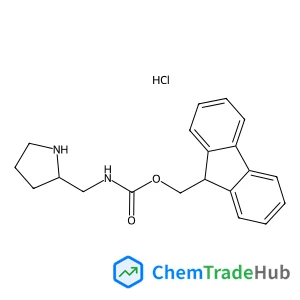
(S)-(9H-Fluoren-9-yl)methyl (pyrrolidin-2-ylmethyl)carbamate hydrochloride
CAS番号:
1217813-15-4
分子式:
C20H23ClN2O2
![2-Methylbenzo[h]quinoline structure](https://static.chemtradehub.com/structs/605/605-88-9-ac43.webp "2-Methylbenzo[h]quinoline structure")
おすすめサプライヤー






免責事項
このページに表示される学術雑誌情報は、参考および研究目的のみを目的としています。当社は雑誌出版社とは提携しておらず、投稿の取り扱いも行っておりません。出版に関するお問い合わせは、各雑誌出版社に直接ご連絡ください。
表示されている情報に誤りがある場合は、support@chemtradehub.com までご連絡ください。迅速に確認し、対応いたします。