



A graphitic carbon nitride metal-free visible light photocatalyst with controllable carbon self-doping towards efficient hydrogen evolution
文献情報
出版日
2021-09-02
DOI
10.1039/D1SE01244D
インパクトファクター
6.367
著者
Lin Lei, Weijia Wang, Zhengfeng Xie, Xiaobo Wu, Arun Kumar Yadav, Huiqing Fan
原文を見る
要旨
Controlling molecular defects via element doping is an effective strategy for tailoring electronic structures and charge separation in photocatalysts. However, the rational design of self-doped catalysts is generally confronted with the need for expensive reagents, high dopant ratios and environmentally unfriendly materials. Herein, carbon self-doped graphitic carbon nitride (DCN-x) is obtained via one-pot thermal polymerization of urea and D-mannitol. The sp2-hybridized nitrogen atoms are partially substituted by carbon atoms from dopants. The corresponding defects provide the photocatalyst with extended light harvesting up to 600 nm, a tunable optical bandgap, and the formation of more delocalized electrons with a uniform distribution at the defect scope of a C–C bond. In addition, increased band-tail states are found in DCN-3, which greatly enhance charge separation. A high photocatalytic hydrogen evolution rate of 3180 μmol g−1 h−1 is achieved under visible light irradiation (λ > 420 nm), which is about 5.3 fold higher than that of pristine g-C3N4. This work provides a green and economical method to synthesize g-C3N4 with controllable carbon self-doping sites for efficient energy conversion related applications.
おすすめジャーナル

Chemistry Education Research and Practice

Russian Journal of General Chemistry

Journal of Saudi Chemical Society

Russian Journal of Coordination Chemistry

Saudi Pharmaceutical Journal

Russian Journal of Applied Chemistry

Chemical Communications

Crystallography Reports

Current Opinion in Colloid & Interface Science

Organic Process Research & Development
関連文献
Understanding of the C–H stretch region of infra-red spectroscopy: an analysis of the final state wavefunctions
Swati Yadav, Subrata Banik, M. Durga Prasad
2021-03-18
Paper
DOI: 10.1039/D0CP01157F
Monitoring the active sites for the hydrogen evolution reaction at model carbon surfaces
Regina M. Kluge, Richard W. Haid, Ifan E. L. Stephens, Federico Calle-Vallejo
2021-03-25
Paper
DOI: 10.1039/D1CP00434D
Characterizing the lone pair⋯π–hole interaction in complexes of ammonia with perfluorinated arenes
Weixing Li, Imanol Usabiaga, Luca Evangelisti, Assimo Maris, Laura B. Favero, Sonia Melandri
2021-03-23
Paper
DOI: 10.1039/D1CP00451D
Ionic-strength and pH dependent reactivities of ascorbic acid toward ozone in aqueous micro-droplets studied using aerosol optical tweezers
Shan-Jung Wu, Min-Sian Lin, Che-Yu Chiang, Genin Gary Huang
2021-03-31
Paper
DOI: 10.1039/D0CP06493A
Through space JFH spin–spin coupling constant transmission pathways in 2-(trifluoromethyl)thiophenol: formation of unusual stabilizing bifurcated CF⋯HS and CF⋯SH interactions
Vinícius C. Port, Lucas A. Zeoly, Fernando Coelho, Rodrigo A. Cormanich
2021-02-23
Paper
DOI: 10.1039/D0CP05887D
Electrodeposition of neodymium and dysprosium from organic electrolytes
Pieter Geysens, Pin-Cheng Lin, Jan Fransaer, Koen Binnemans
2021-04-06
Paper
DOI: 10.1039/D0CP06606K
The primary photolysis dynamics of oxalate in aqueous solution: decarboxylation
Jan Thøgersen, Tobias Weidner, Frank Jensen
2021-04-12
Paper
DOI: 10.1039/D1CP00205H
Cesium and iodine release from fluoride-based molten salt reactor fuel
O. Beneš, E. Capelli, N. Morelová, J.-Y. Colle, A. Tosolin, T. Wiss, B. Cremer, R. J. M. Konings
2021-04-13
Paper
DOI: 10.1039/D0CP05794K
Spectroscopy and photochemistry of copper nitrate clusters
Tobias F. Pascher, Milan Ončák, Christian van der Linde, Martin K. Beyer
2021-04-06
Paper
DOI: 10.1039/D1CP00629K
Nonlinear light absorption in many-electron systems excited by an instantaneous electric field: a non-perturbative approach
Stefano Pittalis, Alice Ruini, Carlo Andrea Rozzi
2021-04-14
Paper
DOI: 10.1039/D0CP04958A
こちらもおすすめ
化合物よくある質問
2-メトキシ-4-(メチルスルフィニル)アミンの主な用途は何ですか?
2-メトキシ-4-(メチルスルフィニル)アミンは、主に医薬品および農薬の製造に使用されます。また、合成化学の一部として研究用材料としても利用されます。
41608-73-52-Methoxy-4-(methyls...
118684-13-24-(Bromomethyl)-3-me...
化合物よくある質問
4,6-二氯-N-甲基ピラミジンアミンの代替品はありますか?
代替品としては、4,6-二クロロピラミジンアミンや他のピラミジン系化合物が考えられます。ただし、目的と用途によって最適な代替品は異なります。
10397-15-64,6-Dichloro-N-methy...
化合物よくある質問
6-氯-4-甲基-1H-吲哚を含む廃棄物はどのように処理すべきですか?
6-氯-4-甲基-1H-吲哚の廃棄物は、適切な容器に収集し、密閉して保管します。温度は常温、湿度は低く、直射日光を避けて保管することを推奨します。廃棄処理は専門...
885520-84-36-chloro-4-methyl-1H...
化合物よくある質問
2-フローユロ-4-(トリフルオロメチル)ベンゾイドについて「に適用される法規ガイドラインは何ですか」
2-フローユロ-4-(トリフルオロメチル)ベンゾイドのCAS番号は207974-08-1です。この化合物はGHS分類で毒性物質と有害な反応物質として分類されます...
207974-08-1[2-Fluoro-4-(trifluo...
化合物よくある質問
4-ニトロフェニルN-[(ベンゼルオキシルカーボンイル]グリシングリシングリシン酸はどのように保存すればよいですか?
4-ニトロフェニルN-[(ベンゼルオキシルカーボンイル]グリシングリシングリシン酸は、室温で暗所に保管し、乾燥した環境で保存することを推奨します。容器は密閉性の...
19811-64-44-Nitrophenyl N-[(be...
化合物よくある質問
イソデスロラタドリンの代替品はありますか?
イソデスロラタドリンの代替品としては、デスロラタドリンや他の抗ヒスタミン薬が挙げられます。具体的には、デスロラタドリン、ラセカミド、フェルタドリンなどが、症状や...
183198-49-4Iso Desloratadine
化合物よくある質問
5-甲氧基-1,2,3,4-四氢异喹啉盐酸盐はどのように合成されますか?
5-甲氧基-1,2,3,4-四氢异喹啉盐酸盐の一般的な合成方法は、メタノール中で5-メトキシ-1,2,3,4-四ヒュドロイソキシンを塩酸で塩化します。この反応で...
103030-69-95-Methoxy-1,2,3,4-te...
化合物よくある質問
4-アミノ-5-メトキシ-2-トルエンサルホニック酸についての法規ガイドラインは何ですか?
CAS番号6471-78-9の4-アミノ-5-メトキシ-2-トルエンサルホニック酸は、GHS分類では corrosive(腐食性)と識別されます。EUのREAC...
6471-78-94-Amino-5-Methoxy-2-...
化合物よくある質問
甲基孕酮を取り扱う際の実験室安全事項は何ですか?
甲基孕酮の取り扱いは、PPE(個人保護具)の使用が必要な重要な安全事項を伴います。防塵マスク、ゴーグル、手袋を着用することが推奨されます。ドラフトチャンバーを使...
204063-33-22-[(Diphenylmethyl)a...
掲載誌
おすすめ化合物
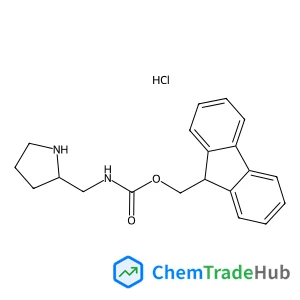
(S)-(9H-Fluoren-9-yl)methyl (pyrrolidin-2-ylmethyl)carbamate hydrochloride
CAS番号:
1217813-15-4
分子式:
C20H23ClN2O2
おすすめサプライヤー







免責事項
このページに表示される学術雑誌情報は、参考および研究目的のみを目的としています。当社は雑誌出版社とは提携しておらず、投稿の取り扱いも行っておりません。出版に関するお問い合わせは、各雑誌出版社に直接ご連絡ください。
表示されている情報に誤りがある場合は、support@chemtradehub.com までご連絡ください。迅速に確認し、対応いたします。