














High surface area MnO2 nanomaterials synthesized by selective cation dissolution for efficient water oxidation
文献情報
出版日
2021-12-09
DOI
10.1039/D1SE01080H
インパクトファクター
6.367
著者
Ravi K. Kunchala, Pushpendra, Rimple Kalia, Boddu S. Naidu
原文を見る
要旨
Artificial photosynthesis is a promising method that directly transforms solar energy into chemical energy. To achieve artificial photosynthesis, efficient water oxidation catalysts (WOCs) are essential. In nature, the manganese-oxo-calcium cluster (Mn4CaO5) in the oxygen-evolving center (OEC) of photosystem II catalyzes water oxidation. Inspired by this process, abundant and inexpensive manganese oxides have been recognized for their high potential as effective and reliable materials for water oxidation reaction. However, in contrast to RuO2 and IrO2, manganese oxide catalysts still exhibit less water oxidation efficiency. Herein, we report a simple method for synthesizing high surface area, porous MnO2 with different crystal structures from the CaMnO3 precursor by treating with dilute HNO3 solution followed by heating at different temperatures. These porous MnO2 nanomaterials have a surface area in the range of 106–272 m2 g−1. These nanomaterials exhibit remarkable photochemical water oxidation activity with a maximum turnover frequency (TOF) of 3.29 × 10⁻³ s−1. Our findings suggest a simple way to design and synthesize low-cost, high surface area, porous MnO2 nanostructures for efficient water oxidation.
関連文献
Top-ranked efficiency under indoor light of DSSCs enabled by iodide-based DES-like solvent electrolyte
Chiara Liliana Boldrini, Andrea Francesca Quivelli, Filippo Maria Perna, Paolo Biagini, Vito Capriati, Alessandro Abbotto, Norberto Manfredi
2023-12-11
Paper
DOI: 10.1039/D3SE00949A
Unraveling the effect of particle size of active metals in Ni/MgO on methane activation and carbon growth mechanism
Shengzhuo Chen, Juntian Niu, Xianrong Zheng, Haiyu Liu, Yan Jin, Jingyu Ran
2023-12-15
Paper
DOI: 10.1039/D3CP05435G
Tunable Li-ion diffusion properties in MoSSe bilayer anodes by strain gradient
Li Zhong, Xiaobao Li, Yuxue Pu, Meiqin Wang, Chunxiao Zhan, Xinle Xiao
2023-11-30
Paper
DOI: 10.1039/D3CP04650H
Temperature gradient reduction in a tubular direct ammonia solid oxide fuel cell by fluidizing the cathode particles
Yu Qiu, Yanxin Yang, Enkang Fu, Rui Xiao
2024-01-03
Paper
DOI: 10.1039/D3SE01168B
Solar-driven electrochemical NH3 splitting into H2 and N2 on BiVO4-based photoanodes
Miwako Teranishi, Shin-ichi Naya, Hiroaki Tada
2023-12-13
Paper
DOI: 10.1039/D3SE01513K
Dense arrangement of crown ethers in graphene: novel graphitic carbon oxides with enhanced optoelectronic properties
Hongyan Li, Jiang Xiang, Jing Xu, Wei Liu
2023-12-12
Paper
DOI: 10.1039/D3CP03902A
Giant exchange bias field above room temperature in perovskite YbCr1−xFexO3 (x = 0.6–0.9)
Kang Zhao, Dao Wang, Sajjad Ur Rehman
2023-12-06
Paper
DOI: 10.1039/D3CP04883G
Pressure effects on both fluorescent emission and charge transport properties of organic semiconductors: a computational study
Yi Zeng, Wen Shi, Qian Peng, Yingli Niu, Zhiying Ma, Xiaoyan Zheng
2023-12-05
Paper
DOI: 10.1039/D3CP03852A
From brew to clean fuel: harnessing distillery wastewater for electrolysis H2 generation using nano scale nickle selenide water oxidation catalysts
Michael Walsh, Jeannie Z. Y. Tan, Sanjay Nagarajan, Kenneth Macgregor, John M. Andresen, M. Mercedes Maroto-Valer, Sudhagar Pitchaimuthu
2023-11-24
Communication
DOI: 10.1039/D3SE01445B
こちらもおすすめ
化合物よくある質問
2-メトキシ-4-(メチルスルフィニル)アミンの主な用途は何ですか?
2-メトキシ-4-(メチルスルフィニル)アミンは、主に医薬品および農薬の製造に使用されます。また、合成化学の一部として研究用材料としても利用されます。
41608-73-52-Methoxy-4-(methyls...
118684-13-24-(Bromomethyl)-3-me...
化合物よくある質問
4,6-二氯-N-甲基ピラミジンアミンの代替品はありますか?
代替品としては、4,6-二クロロピラミジンアミンや他のピラミジン系化合物が考えられます。ただし、目的と用途によって最適な代替品は異なります。
10397-15-64,6-Dichloro-N-methy...
化合物よくある質問
6-氯-4-甲基-1H-吲哚を含む廃棄物はどのように処理すべきですか?
6-氯-4-甲基-1H-吲哚の廃棄物は、適切な容器に収集し、密閉して保管します。温度は常温、湿度は低く、直射日光を避けて保管することを推奨します。廃棄処理は専門...
885520-84-36-chloro-4-methyl-1H...
化合物よくある質問
2-フローユロ-4-(トリフルオロメチル)ベンゾイドについて「に適用される法規ガイドラインは何ですか」
2-フローユロ-4-(トリフルオロメチル)ベンゾイドのCAS番号は207974-08-1です。この化合物はGHS分類で毒性物質と有害な反応物質として分類されます...
207974-08-1[2-Fluoro-4-(trifluo...
化合物よくある質問
4-ニトロフェニルN-[(ベンゼルオキシルカーボンイル]グリシングリシングリシン酸はどのように保存すればよいですか?
4-ニトロフェニルN-[(ベンゼルオキシルカーボンイル]グリシングリシングリシン酸は、室温で暗所に保管し、乾燥した環境で保存することを推奨します。容器は密閉性の...
19811-64-44-Nitrophenyl N-[(be...
化合物よくある質問
イソデスロラタドリンの代替品はありますか?
イソデスロラタドリンの代替品としては、デスロラタドリンや他の抗ヒスタミン薬が挙げられます。具体的には、デスロラタドリン、ラセカミド、フェルタドリンなどが、症状や...
183198-49-4Iso Desloratadine
化合物よくある質問
5-甲氧基-1,2,3,4-四氢异喹啉盐酸盐はどのように合成されますか?
5-甲氧基-1,2,3,4-四氢异喹啉盐酸盐の一般的な合成方法は、メタノール中で5-メトキシ-1,2,3,4-四ヒュドロイソキシンを塩酸で塩化します。この反応で...
103030-69-95-Methoxy-1,2,3,4-te...
化合物よくある質問
4-アミノ-5-メトキシ-2-トルエンサルホニック酸についての法規ガイドラインは何ですか?
CAS番号6471-78-9の4-アミノ-5-メトキシ-2-トルエンサルホニック酸は、GHS分類では corrosive(腐食性)と識別されます。EUのREAC...
6471-78-94-Amino-5-Methoxy-2-...
化合物よくある質問
甲基孕酮を取り扱う際の実験室安全事項は何ですか?
甲基孕酮の取り扱いは、PPE(個人保護具)の使用が必要な重要な安全事項を伴います。防塵マスク、ゴーグル、手袋を着用することが推奨されます。ドラフトチャンバーを使...
204063-33-22-[(Diphenylmethyl)a...
掲載誌
おすすめ化合物
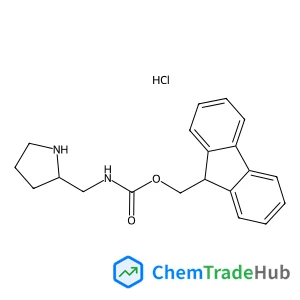
(S)-(9H-Fluoren-9-yl)methyl (pyrrolidin-2-ylmethyl)carbamate hydrochloride
CAS番号:
1217813-15-4
分子式:
C20H23ClN2O2


おすすめサプライヤー





免責事項
このページに表示される学術雑誌情報は、参考および研究目的のみを目的としています。当社は雑誌出版社とは提携しておらず、投稿の取り扱いも行っておりません。出版に関するお問い合わせは、各雑誌出版社に直接ご連絡ください。
表示されている情報に誤りがある場合は、support@chemtradehub.com までご連絡ください。迅速に確認し、対応いたします。