



Renewable N-doped microporous carbons from walnut shells for CO2 capture and conversion
文献情報
出版日
2021-08-10
DOI
10.1039/D1SE01000J
インパクトファクター
6.367
著者
Xianzhao Shao, Yujia Zhang, Xinyi Miao, Wei Wang, Zhifeng Liu, Quan Liu, Tianlei Zhang, Jianwei Ji, Xiaohui Ji
原文を見る
要旨
The development of advanced porous carbon-based materials is a burgeoning field, especially for CO2 capture and utilization. In this research, renewable, microporous granular nitrogen-doped carbons were prepared by KOH activation of melamine modified walnut shells making use of two different protocols at a relatively low pyrolysis temperature (650 °C). The microporous carbons had a 0.6–1.5 nm micropore size and exhibited high surface areas of 949–2847 m2 g−1. Furthermore, the synthesized microporous carbons manifested a good capacity to capture CO2 owing to the existence of a large number of narrow micropores and nitrogen-bearing functionalities. The equilibrium CO2 capture capacities of these carbons at 1 atm were respectively in ranges of 4.1–6.6 and 2.7–4.0 mmol g−1 at 0 °C and 25 °C. Even in a CO2/N2 mixture, it exhibited a high selectivity for the capture of CO2 with a separation factor of 19. Thanks to its excellent CO2 adsorption capability, the incorporation of Ag(0) nanoparticles makes it serve as an efficient catalyst for the conversion of propargylic alcohols with CO2 into carbonates via a cycloaddition reaction under mild conditions. The sorbent has a multitude of advantages including the ease of its synthesis, high CO2 uptake capacity, low cost, regenerability, and selectivity, which demonstrate that great potential is manifested by nanoporous nitrogen-doped carbon for CO2 capture and utilization.
おすすめジャーナル

Main Group Chemistry

Bioorganic & Medicinal Chemistry

Herald of the Russian Academy of Sciences

Chinese Journal of Chemistry

Atomization and Sprays

Critical Reviews in Solid State and Materials Sciences

Journal of the Indian Institute of Science

Colloid Journal

Bioorganic & Medicinal Chemistry Letters

Acta Metallurgica Sinica-English Letters
関連文献
Molecular oxygen interaction with Bi2O3 : a spectroscopic and spectromagnetic investigation
Davide Barreca, Franca Morazzoni, Gian Andrea Rizzi, Roberto Scotti, Eugenio Tondello
2001-03-29
Paper
DOI: 10.1039/B009482J
Equilibrium adsorption of linear and branched C6 alkanes on silicalite-1 studied by the tapered element oscillating microbalance
W. Zhu, F. Kapteijn, B. van der Linden, J. A. Moulijn
2001-03-22
Paper
DOI: 10.1039/B100941I
Symmetric binary polymer blends confined in thin films between competing walls: Interplay between finite size and wetting behavior
E. V. Albano
2001-02-13
Paper
DOI: 10.1039/B008627O
Melting and freezing of water in ordered mesoporous silica materials
Andreas Schreiber, Ingke Ketelsen, Gerhard H. Findenegg
2001-03-08
Paper
DOI: 10.1039/B010086M
The oxidation of ascorbate at poly(aniline)–poly(vinylsulfonate) composite coated electrodes
2001-03-15
Paper
DOI: 10.1039/B009377G
Analysis of thermosensitive core–shell colloids by small-angle neutron scattering including contrast variation
P. Lindner, T. Narayanan
2001-02-07
Paper
DOI: 10.1039/B009104I
Solution self-assembly of fluorinated polymers, an overview
Marc Guerre, Gérald Lopez, Bruno Améduri, Mona Semsarilar, Vincent Ladmiral
2021-05-25
Review Article
DOI: 10.1039/D1PY00221J
The energetically favorable cis peptide bond for the azaglycine-containing peptide: For-AzGly-NH2 model
Ho-Jin Lee, Jong-Won Song, Young-Sang Choi, Seonggu Ro, Chang-Ju Yoon
2001-04-04
Paper
DOI: 10.1039/B009651M
こちらもおすすめ
化合物よくある質問
カルボニル基が付いた5-氰基-1-{[(2-メチル-2-プロpanyl)オキシ]カーボンイル}1H-吲哚-2-イリド-2-ボリン酸はどのように保存すればよいですか?
カルボニル基が付いた5-氰基-1-{[(2-メチル-2-プロpanyl)オキシ]カーボンイル}1H-吲哚-2-イリド-2-ボリン酸は、直射日光を避けて室温(15...
475102-15-9(5-Cyano-1-{[(2-meth...
化合物よくある質問
tert-ブチル2-クロロメチルピリジン-3-基炭酸エステルの市場動向や研究トレンドはどうですか?
この化合物は合成化学分野において、特にピリジン化合物の合成や改良に用いられます。最近の研究では、ピリジン化合物の新規合成法や特性の改良が注目されています。市場動...
1203498-98-9tert-Butyl 2-chloro-...
化合物よくある質問
聚二季戊四醇六丙烯酸酯はどの業界で使用されていますか?
聚二季戊四醇六丙烯酸酯は、医薬品、ポリマー、センサー、半導体などの業界で広く使用されています。特にポリマー業界では硬化剤として、医薬分野では医療機器の製造に使用...
29570-58-93-(Acryloyloxy)-2-({...
化合物よくある質問
1-氯-5-硝基异喹啉の市場動向や研究トレンドはどうですか?
1-氯-5-硝基异喹啉は、薬理学や合成化学の研究分野で注目されています。市場動向としては、その生物学的な活性や合成可能性を評価する研究が増えています。また、代替...
58142-97-51-Chloro-5-nitroisoq...
化合物よくある質問
2-チロール-5-メチルスルフェニル-3-trifルオルメチルベンゼンはどのように合成されますか?
2-チロール-5-メチルスルフェニル-3-trifルオルメチルベンゼンは、トリフルオロメチル化反応と硫化反応を経て合成されます。通常、トリフルオロメチル化剤と硫...
957066-04-51-Chloro-4-(methylsu...
化合物よくある質問
p-トールイルマグネシウムブロミドの物理化学的性質は何ですか?
p-トールイルマグネシウムブロミドのCAS番号は4294-57-9です。この化合物は白色の結晶性粉末で、分子量は204.32です。溶剤中で良好に溶解しますが、水...
4294-57-9p-Tolylmagnesium bro...
化合物よくある質問
1-(5-甲基-2-硫化素基)プロパン-1-酮の市場動向や研究トレンドはどうですか?
1-(5-甲基-2-硫化素基)プロパン-1-酮の市場動向は、化学産業全体の需要に影響を受けますが、最近では pharmaceutical 分野での応用が注目され...
59303-13-81-(5-Methyl-2-thieny...
化合物よくある質問
十一碳烯酰甘氨酸を取り扱う際の実験室安全事項は何ですか?
十一碳烯酰甘氨酸は吸入や皮膚から吸収されることがあり、取り扱う際には防塵マスクと手袋を使用してください。ドラフトチャンバーを用いて漏洩を処理し、適切なSDS(S...
54301-26-7N-10-Undecenoylglyci...
化合物よくある質問
1H,1H-全氟-3,6-二氧杂葵-1-醇を取り扱う際の実験室安全事項は何ですか?
この化合物は吸入や皮膚吸収による毒性があるため、防塵マスク、ゴーグル、防護手袋を使用する必要があります。ドラフトチャンバーでの操作が必要です。漏洩時には即座に換...
152914-73-32,2-Difluoro-2-[1,1,...
化合物よくある質問
3-(4-(フルオロメチルオキシ)フェニル)-1,2,4-オキサジアゾール-5-カルボハイドライドは安全ですか?
安全性は化合物の使用方法によります。直接的な毒性は報告されていませんが、吸入や皮膚接触には注意が必要です。適切な防護服を着用し、換気を図ることを推奨します。
883028-82-83-(4-(Trifluorometho...
掲載誌
おすすめ化合物
![7-Bromo-5-chloro-1H-pyrazolo[4,3-b]pyridine structure](https://static.chemtradehub.com/structs/135/1351813-70-1-a716.webp "7-Bromo-5-chloro-1H-pyrazolo[4,3-b]pyridine structure")
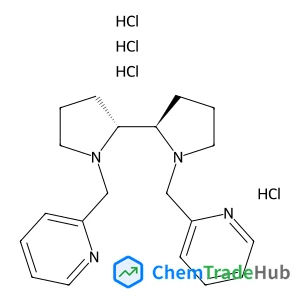
(2R,2'R)-1,1'-Bis(2-pyridinylmethyl)-2,2'-bipyrrolidine tetrahydrochloride
CAS番号:
1228077-88-0
分子式:
C20H30Cl4N4
![4,4-Difluoro-2-methyl-1-{[(2-methyl-2-propanyl)oxy]carbonyl}-L-proline structure](https://static.chemtradehub.com/structs/119/1194032-23-9-f426.webp "4,4-Difluoro-2-methyl-1-{[(2-methyl-2-propanyl)oxy]carbonyl}-L-proline structure")
4,4-Difluoro-2-methyl-1-{[(2-methyl-2-propanyl)oxy]carbonyl}-L-proline
CAS番号:
1194032-23-9
分子式:
C11H17F2NO4
おすすめサプライヤー






免責事項
このページに表示される学術雑誌情報は、参考および研究目的のみを目的としています。当社は雑誌出版社とは提携しておらず、投稿の取り扱いも行っておりません。出版に関するお問い合わせは、各雑誌出版社に直接ご連絡ください。
表示されている情報に誤りがある場合は、support@chemtradehub.com までご連絡ください。迅速に確認し、対応いたします。