












Deep eutectic solvents – a new additive in the encapsulation of lipase B from Candida antarctica: biocatalytic applications
文献情報
出版日
2021-11-23
DOI
10.1039/D1RE00469G
インパクトファクター
4.239
著者
Adrian Ioan Dudu, Laszlo Csaba Bencze, Csaba Paizs, Monica Ioana Toşa
原文を見る
要旨
Enzyme encapsulation in a sol–gel matrix can be improved using some additives acting on enzyme activity and/or stability. Ionic liquids, polyhydroxy compounds, sugars, etc. have been previously reported as additives. This study focuses on the possibility to use deep eutectic solvents as additives in the immobilization of lipase B from Candida antarctica (CaL-B) through sol–gel encapsulation. The transesterification of 1-phenylethanol was chosen as a model reaction. Process optimization was successfully performed regarding the most important reaction parameters (an alcohol/lipase weight ratio of 20 : 1, an alcohol/acyl donor molar ratio of 1 : 2, n-hexane as a solvent, 30 °C reaction temperature, vinyl acetate as an acyl donor and a substrate concentration of 100 mM). Under the optimal conditions, the reaction mediated by the most active biocatalyst (SG-3, containing a deep eutectic solvent formed from choline chloride and fructose, as a 30% aqueous solution) reached ∼48% after only four hours, maintaining almost 85% of its initial activity even after eight reaction cycles.
おすすめジャーナル
関連文献
Improved 3D DOSY-TOCSY experiment for mixture analysis
Stéphane Viel, Stefano Caldarelli
2008-03-31
Communication
DOI: 10.1039/B802789G
A novel mediator–polymer-modified anode for microbial fuel cells
Masanori Adachi, Tatsuo Shimomura, Makoto Komatsu, Hiroshi Yakuwa, Akiko Miya
2008-02-20
Communication
DOI: 10.1039/B717773A
Use of ionic liquids (ILs) for the IL-anion size-dependent formation of Cr, Mo and W nanoparticles from metal carbonyl M(CO)6 precursors
Engelbert Redel, Ralf Thomann, Christoph Janiak
2008-03-14
Communication
DOI: 10.1039/B718055A
Construction of aryl-substituted triquinanes through the interrupted Nazarov reaction
Curtis J. Rieder, Ryan J. Fradette, F. G. West
2008-02-25
Communication
DOI: 10.1039/B800800K
A new NCN pincer ruthenium complex and its catalytic activity for enantioselective hydrogenation of ketones
Jun-ichi Ito, Satoshi Ujiie, Hisao Nishiyama
2008-03-12
Communication
DOI: 10.1039/B800387D
Mild electrophilic trifluoromethylation of secondary and primary aryl- and alkylphosphines using hypervalent iodine(iii)–CF3 reagents
Patrick Eisenberger, Iris Kieltsch, Nicolas Armanino, Antonio Togni
2008-03-03
Communication
DOI: 10.1039/B801424H
Single microbead SELEX for efficient ssDNA aptamer generation against botulinum neurotoxin‡
Jeffrey B.-H. Tok, Nicholas O. Fischer
2008-03-18
Communication
DOI: 10.1039/B717936G
Solid-state NMR studies of weak interactions in supramolecular systems
Michele R. Chierotti, Roberto Gobetto
2008-01-07
Feature Article
DOI: 10.1039/B711551B
Mutual induced coordination in halogen-bonded anionic assemblies with (6,3) cation-templated topologies
Pierangelo Metrangolo, Frank Meyer, Tullio Pilati, Giancarlo Terraneo
2008-01-14
Communication
DOI: 10.1039/B716879A
こちらもおすすめ
化合物よくある質問
3-イチチルビフェニルはどのように合成されますか?
3-イチチルビフェニルは、ビフェニルとイチプロピオニトリルを回収率約90%で反応させて合成されます。触媒は通常、亜リチウムホウ素を用います。
5668-93-93-Ethylbiphenyl
化合物よくある質問
8-溴-5-三氟甲基喹啉はどのように合成されますか?
8-溴-5-三氟甲基喹啉は、5-トリフルオロメチル-2-メチル-1,3-ベンゼンジオールをブロモエタノールと反応させて生成します。この反応は塩基性条件下で行われ...
917251-92-48-Bromo-5-(trifluoro...
化合物よくある質問
ジメチル4-(4,4,5,5-テトラメチル-1,3,2-ドioxaborolan-2-基)-2,6-ピリジンジカルボイル酸フェニルアミニドの代替品はありますか?
ジメチル4-(4,4,5,5-テトラメチル-1,3,2-ドioxaborolan-2-基)-2,6-ピリジンジカルボイル酸フェニルアミニドの代替品としては、4-...
741709-66-0Dimethyl 4-(4,4,5,5-...
化合物よくある質問
N-(3,5-ヘキサクロロ-4-ピリドインイル)-8-メチオキシ-5-キノリンカーボン酸の市場動向や研究トレンドはどのようなものでしょうか?
N-(3,5-ヘキサクロロ-4-ピリドインイル)-8-メチオキシ-5-キノリンカーボン酸の市場動向は、主に産業用途での需要により影響を受けます。研究トレンドとし...
199871-63-1N-(3,5-Dichloro-4-py...
化合物よくある質問
イソステアロイルグリセリルは安全ですか?
イソステアロイルグリセリルは一般的に安全性が高いとされていますが、過度な使用や個人差により皮�owsん炎などの反応が起こる可能性があります。使用前に医師に相談す...
222723-55-92-[(5Z,8Z,11Z,14Z)-5...
化合物よくある質問
1-(二苯甲基)-3,3-二氟-氮杂环丁烷の市場動向や研究トレンドはどうですか?
1-(二苯甲基)-3,3-二氟-氮杂环丁烷の市場動向は、医薬品や合成化学の研究分野で注目を集めています。新興研究は、該当化合物の合成改良と生体内での作用メカニズ...
288315-02-61-Benzhydryl-3,3-dif...
化合物よくある質問
3-チオフェンスチオールの物理化学的性質は何ですか?
3-チオフェンスチオールのCAS番号は7774-73-4です。結晶性の白色粉末で、分子量は122.17です。この化合物は水に微溶解し、エタノールやジクロロメタン...
7774-73-43-Thiophenethiol
化合物よくある質問
2-Methyl-2-propanyl (2S)-2-(aminomethyl)-1-piperidinecarboxylateは安全ですか?
2-Methyl-2-propanyl (2S)-2-(aminomethyl)-1-piperidinecarboxylateは一定の安全性基準を満たしていま...
475105-35-22-Methyl-2-propanyl ...
化合物よくある質問
CAS番号1316822-90-8の化合物は安全ですか?
CAS番号1316822-90-8の化合物は安全性に関しては評価が不足していますが、一般的には生物学的に活性な物質であり、取り扱いには適切な安全防護措置が必要で...
1316822-90-8Gal beta(1-3)[Neu5Ac...
化合物よくある質問
Tert-butyl 2-(2-羟基乙基)哌嗪-1-羧酸はどのように保存すればよいですか?
Tert-butyl 2-(2-羟基乙基)哌嗪-1-羧酸は、冷暗所で保存し、直射日光から遠ざけてください。容器は密閉し、高湿度や高温を避けて保管してください。
517866-79-4Tert-butyl 2-(2-hydr...
掲載誌
Reaction Chemistry & Engineering

CiteScore:
0
自己引用率:
8.8%
年間論文数:
284
Reaction Chemistry & Engineering is an interdisciplinary journal reporting cutting-edge research focused on enhancing the understanding and efficiency of reactions. Reaction engineering leverages the interface where fundamental molecular chemistry meets chemical engineering and technology. Challenges in chemistry can be overcome by the application of new technologies, while engineers may find improved solutions for process development from the latest developments in reaction chemistry. Reaction Chemistry & Engineering is a unique forum for researchers whose interests span the broad areas of chemical engineering and chemical sciences to come together in solving problems of importance to wider society. All papers should be written to be approachable by readers across the engineering and chemical sciences. Papers that consider multiple scales, from the laboratory up to and including plant scale, are particularly encouraged.
おすすめ化合物
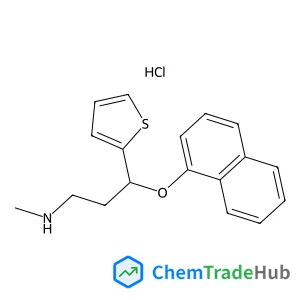
N-Methyl-3-(1-naphthyloxy)-3-(2-thienyl)-1-propanamine hydrochloride (1:1)
CAS番号:
1188266-11-6
分子式:
C18H20ClNOS
![N-{15-[(2,5-Dioxo-1-pyrrolidinyl)oxy]-15-oxo-3,6,9,12-tetraoxapentadec-1-yl}-2-(2-propyn-1-yloxy)acetamide structure](https://static.chemtradehub.com/structs/210/2101206-92-0-2eb5.webp "N-{15-[(2,5-Dioxo-1-pyrrolidinyl)oxy]-15-oxo-3,6,9,12-tetraoxapentadec-1-yl}-2-(2-propyn-1-yloxy)acetamide structure")
おすすめサプライヤー





免責事項
このページに表示される学術雑誌情報は、参考および研究目的のみを目的としています。当社は雑誌出版社とは提携しておらず、投稿の取り扱いも行っておりません。出版に関するお問い合わせは、各雑誌出版社に直接ご連絡ください。
表示されている情報に誤りがある場合は、support@chemtradehub.com までご連絡ください。迅速に確認し、対応いたします。