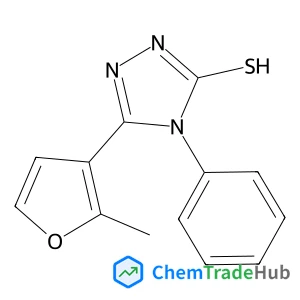
5-(2-Methyl-3-furyl)-4-phenyl-2,4-dihydro-3H-1,2,4-triazole-3-thione
CAS番号:
346464-59-3
分子式:
C13H11N3OS
Jayendran Iyer, Fatima Jalid, Tuhin S. Khan, M. Ali Haider
An ab initio micro-kinetic model (MKM) is constructed to understand the reactivity trend of the single atom alloys (SAAs) of Cu and Au for non-oxidative dehydrogenation (NODH) of ethanol to produce acetaldehyde. The model utilizes well-known scaling relations between the transition state (TS) and final state (FS) structures to calculate product formation rates. The turnover frequencies (TOFs) of the product are plotted with respect to the two descriptors: carbon and oxygen binding energies on the catalyst surface. The resulting MKM has predicted no significant change in the activity of NODH on the NiCu SAA (TOF ∼ 10−4 s−1) as compared to that on Cu (111) (TOF ∼ 10−4 s−1). This stands in contrast to the experimental reports. A similar erroneous trend is calculated for NiAu, PtCu and PdCu SAAs using the scaling MKM. In parallel, an attempt is made to utilize a machine learning (ML) approach to augment descriptor prediction for the Cu based SAAs in the scaling MKM; however, the resulting trend remained similar and contradictory to experiments. The underlying reason for this discrepancy is unraveled in density functional theory (DFT) calculations of the NODH reaction over SAA surfaces, wherein a clear departure from scaling relations is observed, resulting in significant reduction in the activation barriers of the initial O–H or α-C–H activation steps in ethanol. Following which, a full-DFT parameterized non-scaling MKM is considered essential to estimate the reactivity trend of SAAs. Consistent with the experimental reports, the non-scaling ab initio MKM predicted the trend of the Cu based alloys as NiCu > PtCu ∼ PdCu > Cu at 400 K and Au based alloy as NiAu > Au at 500 K. The non-scaling MKM has further revealed the dominant mechanistic route for the NODH reaction via the initial O–H or α-C–H activation in ethanol. Except for PtCu, all other prominent SAAs (NiCu, PdCu and NiAu) are expected to follow the initial O–H scission route to produce acetaldehyde, while in the case of PtCu, both the mechanistic routes are likely to compete.
Shannon R. Pattenaude, Kenji Mochizuki, Dor Ben-Amotz
DOI: 10.1039/C6CP04379H
Jie Cui, Shuhua Liang, Jianmin Zhang
DOI: 10.1039/C6CP03946D
Katharina Keller, Mian Qi, Vanessa Koch, Julia Wegner, Henrik Hintz, Adelheid Godt, Gunnar Jeschke, Anton Savitsky, Maxim Yulikov
DOI: 10.1039/C6CP04884F
Daniele Pontiroli, Mónica Jiménez-Ruiz, Mark Johnson, Matteo Aramini, Mattia Gaboardi, Stewart F. Parker, Mauro Riccó, Stéphane Rols
DOI: 10.1039/C6CP04727K
Bassil M. El-Zaatari, Abhishek U. Shete, Brian J. Adzima
DOI: 10.1039/C6CP04950H
Yuqi Li, Hui Zhang, Jiandong Zhuang, Lihui Chen
DOI: 10.1039/C6CP04284H
Shikun Liu, Zhongqiu Tong, Jiupeng Zhao, Xusong Liu, Jing wang, Xiaoxuan Ma, Caixia Chi, Yu Yang, Yao Li
DOI: 10.1039/C6CP04064K
Dingqing Li, Jan Schwabedissen, Hans-Georg Stammler, Norbert W. Mitzel, Helge Willner, Xiaoqing Zeng
DOI: 10.1039/C6CP05377G
Valery V. Bashevoy, Irina V. Blonskaya, Nikolay E. Lizunov, Oleg L. Orelovitch
DOI: 10.1039/C6CP05465J
取り扱いにはPPE(プロテクティブ・パーソナル・エイド)が必要で、防ぐ手袋と保護眼鏡を着用してください。ドラフトチャンバーの使用を推奨します。漏洩した場合は、適...
この化合物の代替品としては、BOC保護基を有さないアミノ酸やその他の保護基化合物が考えられます。また、メチオキシ基を有しない他の芳香族アミノ酸も代替品として挙げ...
Methyl 2-(chloromethyl)-3-nitrobenzoate(1218910-61-2)の代替品としては、化学組成を変えることで効果を達成する...
(2R)-2-アミノ-N-ベンジル-3-ヒドロキシプロパナミドを含む廃棄物は、適切な廃棄物管理ガイドラインに基づき処理する必要があります。まず、廃棄物を適切に収...
6,7-二氢-咪唑並[1,2-a]ピリドイン-8(5h)-酮は、2-ブロモフェニルアセトインとリン酸ハロゲン化物を反応させることで合成できます。この反応は高温で...
エチル(3R)-3-ピロリジニル酢酸水和塩は、CAS番号1332459-32-1の化合物で、(R)-乙基2-(ピロリジン-3-基)酢酸塩水和塩と呼ばれます。この...
(2S)-{[(2-メチルエチルオキシ]カルボニル}アミノ)[2-(トリアフルオロメチルフェニル]エチカシック酸のCAS番号は1203454-45-8です。この...
2-ブロモ-1-(2-メチル-2-プロパニル)-4-ニトロベンゼンは、直射日光を避けて暗所で、室温(約15℃〜25℃)、乾燥した場所に保存する必要があります。ま...
市場動向としては、1-[(4-硝基フェニル)スルホニル]-1H-1,2,4-三唑は主に農業用除草剤や合成化学製品の原料として利用されています。研究トレンドとして...

Reaction Chemistry & Engineering is an interdisciplinary journal reporting cutting-edge research focused on enhancing the understanding and efficiency of reactions. Reaction engineering leverages the interface where fundamental molecular chemistry meets chemical engineering and technology. Challenges in chemistry can be overcome by the application of new technologies, while engineers may find improved solutions for process development from the latest developments in reaction chemistry. Reaction Chemistry & Engineering is a unique forum for researchers whose interests span the broad areas of chemical engineering and chemical sciences to come together in solving problems of importance to wider society. All papers should be written to be approachable by readers across the engineering and chemical sciences. Papers that consider multiple scales, from the laboratory up to and including plant scale, are particularly encouraged.
![5,10-Dihydroindeno[2,1-a]indene structure](https://static.chemtradehub.com/structs/654/6543-29-9-71ca.webp "5,10-Dihydroindeno[2,1-a]indene structure")