












Global opportunities and challenges on net-zero CO2 emissions towards a sustainable future
文献情報
出版日
2021-09-21
DOI
10.1039/D1RE00233C
インパクトファクター
4.239
著者
A. Joseph Nathanael, Kumaran Kannaiyan, Aruna K Kunhiraman, Seeram Ramakrishna
原文を見る
要旨
In recent years, global warming has been showing its deadliest impact on civilization through natural calamities. Given this situation, sustainable and economically viable CO2 capture, utilization, and storage (CCUS) techniques are the need of the hour more than ever before. Herein, cutting-edge technologies and materials for CO2 capture, conversion, and utilization are briefly discussed. The advances of various carbon capture technologies such as absorption, adsorption, membrane, and biochemical are investigated. Furthermore, the conversion of CO2 into value-added products with the help of single-atom catalysts, plasma technology, metal–organic frameworks (MOFs), and covalent organic frameworks (COFs) is discussed in detail. MOFs and COFs have been receiving a great deal of attention as they offer material design flexibility to enhance the CO2 conversion efficiency. Among the existing methods, plasma technology has received the least attention; however, it has the potential to enhance the conversion rate, as demonstrated. On CO2 utilization, two significant energy-intensive technologies, refrigeration and air-conditioning and the organic Rankine cycle, that have the potential to utilize either pure or blended CO2 as their working fluid, are discussed. Specifically, the blending of CO2 with hydrocarbons has grabbed attention as a potential alternative natural working fluid with minimal environmental impact. The utilization of CO2 in commercial technologies primarily relies on the balance between performance enhancement and environmental benefits. Pilot-scale research projects and opportunities on CCUS technologies have also been discussed.
関連文献
Mild electrophilic trifluoromethylation of secondary and primary aryl- and alkylphosphines using hypervalent iodine(iii)–CF3 reagents
Patrick Eisenberger, Iris Kieltsch, Nicolas Armanino, Antonio Togni
2008-03-03
Communication
DOI: 10.1039/B801424H
Single microbead SELEX for efficient ssDNA aptamer generation against botulinum neurotoxin‡
Jeffrey B.-H. Tok, Nicholas O. Fischer
2008-03-18
Communication
DOI: 10.1039/B717936G
Amplified nitric oxide photorelease in DNA proximity
Fiorella L. Callari, Salvatore Sortino
2008-03-20
Communication
DOI: 10.1039/B800132D
Angle-controlled arrangement of single-walled carbon nanotubes solubilised by 8-quinolinol metal chelate derivatives on mica
Kazuyuki Nobusawa, Atsushi Ikeda, Yasunori Tanaka, Mineo Hashizume, Jun-ichi Kikuchi, Michihiro Shirakawa, Tatsuya Kitahara, Norifumi Fujita, Seiji Shinkai
2008-02-26
Communication
DOI: 10.1039/B715960A
Unique intermolecular reaction of simple porphyrins at a metal surface gives covalent nanostructures
Mendel In’t Veld, Patrizia Iavicoli, Sam Haq, David B. Amabilino, Rasmita Raval
2008-02-20
Communication
DOI: 10.1039/B718865J
Unimolecular binary half-adders with orthogonal chemical inputs
Lu Zhang, Wesley A. Whitfield, Lei Zhu
2008-02-20
Communication
DOI: 10.1039/B719644J
Clean and efficient synthesis of O-silylcarbamates and ureas in supercritical carbon dioxide
Matthew J. Fuchter, Catherine J. Smith, Alistair Boyer, Simon Saubern, John H. Ryan, Andrew B. Holmes
2008-04-02
Communication
DOI: 10.1039/B801537F
Benzo[1,2-b:4,5-b′]bis[b]benzothiophene as solution processible organic semiconductor for field-effect transistors
Peng Gao, Dirk Beckmann, Hoi Nok Tsao, Xinliang Feng, Volker Enkelmann, Wojciech Pisula, Klaus Müllen
2008-01-25
Communication
DOI: 10.1039/B717608B
TNTadsorption on Au(111): electrochemistry and adlayer structure
Rui Wen, Hong-Xia Zhang, Cun-Ji Yan, Hui-Juan Yan, Ge-Bo Pan, Li-Jun Wan
2008-03-18
Communication
DOI: 10.1039/B719888D
こちらもおすすめ
化合物よくある質問
3-イチチルビフェニルはどのように合成されますか?
3-イチチルビフェニルは、ビフェニルとイチプロピオニトリルを回収率約90%で反応させて合成されます。触媒は通常、亜リチウムホウ素を用います。
5668-93-93-Ethylbiphenyl
化合物よくある質問
8-溴-5-三氟甲基喹啉はどのように合成されますか?
8-溴-5-三氟甲基喹啉は、5-トリフルオロメチル-2-メチル-1,3-ベンゼンジオールをブロモエタノールと反応させて生成します。この反応は塩基性条件下で行われ...
917251-92-48-Bromo-5-(trifluoro...
化合物よくある質問
ジメチル4-(4,4,5,5-テトラメチル-1,3,2-ドioxaborolan-2-基)-2,6-ピリジンジカルボイル酸フェニルアミニドの代替品はありますか?
ジメチル4-(4,4,5,5-テトラメチル-1,3,2-ドioxaborolan-2-基)-2,6-ピリジンジカルボイル酸フェニルアミニドの代替品としては、4-...
741709-66-0Dimethyl 4-(4,4,5,5-...
化合物よくある質問
N-(3,5-ヘキサクロロ-4-ピリドインイル)-8-メチオキシ-5-キノリンカーボン酸の市場動向や研究トレンドはどのようなものでしょうか?
N-(3,5-ヘキサクロロ-4-ピリドインイル)-8-メチオキシ-5-キノリンカーボン酸の市場動向は、主に産業用途での需要により影響を受けます。研究トレンドとし...
199871-63-1N-(3,5-Dichloro-4-py...
化合物よくある質問
イソステアロイルグリセリルは安全ですか?
イソステアロイルグリセリルは一般的に安全性が高いとされていますが、過度な使用や個人差により皮�owsん炎などの反応が起こる可能性があります。使用前に医師に相談す...
222723-55-92-[(5Z,8Z,11Z,14Z)-5...
化合物よくある質問
1-(二苯甲基)-3,3-二氟-氮杂环丁烷の市場動向や研究トレンドはどうですか?
1-(二苯甲基)-3,3-二氟-氮杂环丁烷の市場動向は、医薬品や合成化学の研究分野で注目を集めています。新興研究は、該当化合物の合成改良と生体内での作用メカニズ...
288315-02-61-Benzhydryl-3,3-dif...
化合物よくある質問
3-チオフェンスチオールの物理化学的性質は何ですか?
3-チオフェンスチオールのCAS番号は7774-73-4です。結晶性の白色粉末で、分子量は122.17です。この化合物は水に微溶解し、エタノールやジクロロメタン...
7774-73-43-Thiophenethiol
化合物よくある質問
2-Methyl-2-propanyl (2S)-2-(aminomethyl)-1-piperidinecarboxylateは安全ですか?
2-Methyl-2-propanyl (2S)-2-(aminomethyl)-1-piperidinecarboxylateは一定の安全性基準を満たしていま...
475105-35-22-Methyl-2-propanyl ...
化合物よくある質問
CAS番号1316822-90-8の化合物は安全ですか?
CAS番号1316822-90-8の化合物は安全性に関しては評価が不足していますが、一般的には生物学的に活性な物質であり、取り扱いには適切な安全防護措置が必要で...
1316822-90-8Gal beta(1-3)[Neu5Ac...
化合物よくある質問
Tert-butyl 2-(2-羟基乙基)哌嗪-1-羧酸はどのように保存すればよいですか?
Tert-butyl 2-(2-羟基乙基)哌嗪-1-羧酸は、冷暗所で保存し、直射日光から遠ざけてください。容器は密閉し、高湿度や高温を避けて保管してください。
517866-79-4Tert-butyl 2-(2-hydr...
掲載誌
Reaction Chemistry & Engineering

CiteScore:
0
自己引用率:
8.8%
年間論文数:
284
Reaction Chemistry & Engineering is an interdisciplinary journal reporting cutting-edge research focused on enhancing the understanding and efficiency of reactions. Reaction engineering leverages the interface where fundamental molecular chemistry meets chemical engineering and technology. Challenges in chemistry can be overcome by the application of new technologies, while engineers may find improved solutions for process development from the latest developments in reaction chemistry. Reaction Chemistry & Engineering is a unique forum for researchers whose interests span the broad areas of chemical engineering and chemical sciences to come together in solving problems of importance to wider society. All papers should be written to be approachable by readers across the engineering and chemical sciences. Papers that consider multiple scales, from the laboratory up to and including plant scale, are particularly encouraged.
おすすめ化合物
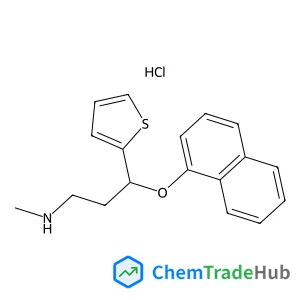
N-Methyl-3-(1-naphthyloxy)-3-(2-thienyl)-1-propanamine hydrochloride (1:1)
CAS番号:
1188266-11-6
分子式:
C18H20ClNOS
おすすめサプライヤー





免責事項
このページに表示される学術雑誌情報は、参考および研究目的のみを目的としています。当社は雑誌出版社とは提携しておらず、投稿の取り扱いも行っておりません。出版に関するお問い合わせは、各雑誌出版社に直接ご連絡ください。
表示されている情報に誤りがある場合は、support@chemtradehub.com までご連絡ください。迅速に確認し、対応いたします。