


High-efficiency solution-processed green thermally activated delayed fluorescence OLEDs using a polymer-small molecule mixed host
文献情報
出版日
2022-02-25
DOI
10.1039/D1PY01700D
インパクトファクター
5.582
著者
Seunguk Cho, Na Yeon Kwon, Chai Won Kim, Hyoseong Lee, Jung Min Ha, Hyung Jong Kim, Han Young Woo, Sungnam Park, Min Ju Cho, Dong Hoon Choi
原文を見る
要旨
The development of suitable host materials for application to an emitter is of significant importance for high-efficiency organic light-emitting diodes (OLEDs). In this study, we successfully synthesized poly(9,9-diphenyl-10-(4-vinylbenzyl)-9,10-dihydroacridine) (P(Bn-DPAc)) as a polymer donor and 2-(4′-(tert-butyl)-[1,1′-biphenyl]-4-yl)-4,6-diphenyl-1,3,5-triazine (tPTRZ) as a small-molecule acceptor. A blend of P(Bn-DPAc) and tPTRZ was used as the host material in solution-processed green thermally activated delayed fluorescence OLEDs (TADF-OLEDs). The P(Bn-DPAc)–tPTRZ blend showed a new red-shifted peak in the photoluminescence spectrum, suggesting the possibility of exciplex formation. The polymer-mixed host film showed a fine surface morphology, a well-formed exciplex in the bulk state, and good charge balance. The OLED fabricated with the as-prepared mixed host (P(Bn-DPAc) : tPTRZ = 1 : 1 wt ratio) and 2,4,5,6-tetra(3,6-di-tert-butylcarbazol-9-yl)-1,3-dicyanobenzene (t4CzIPN) emitter exhibited a high current efficiency of 107.3 cd A−1 and a maximum external quantum efficiency (EQE) of 31.2%. The OLED fabricated with the mixed host demonstrated better performance compared to the device with a unipolar host P(Bn-DPAc).
おすすめジャーナル

Russian Journal of Bioorganic Chemistry

Current Opinion in Solid State & Materials Science

Nature Medicine

Russian Journal of Applied Chemistry

Chemistry Education Research and Practice

Russian Journal of Coordination Chemistry

Russian Chemical Bulletin

Chemical Communications

Russian Journal of Organic Chemistry

Organic Process Research & Development
関連文献
X-ray-induced sample damage at the Mn L-edge: a case study for soft X-ray spectroscopy of transition metal complexes in solution
Markus Kubin, Jan Kern, Meiyuan Guo, Erik Källman, Rolf Mitzner, Vittal K. Yachandra, Marcus Lundberg, Junko Yano, Philippe Wernet
2018-06-04
Paper
DOI: 10.1039/C8CP03094D
Intrinsic structure of pentapeptide Leu-enkephalin: geometry optimization and validation by comparison of VSCF-PT2 calculations with cold ion spectroscopy
Tapta Kanchan Roy, Vladimir Kopysov, Aleksandr Pereverzev, Jiří Šebek, R. Benny Gerber, Oleg V. Boyarkin
2018-09-07
Paper
DOI: 10.1039/C8CP03989E
Insight into the local near-infrared photothermal dynamics of graphene oxide functionalized polymers through optical microfibers
Yunyun Huang, Chaoyan Chen, Hongtao Li, Aoxiang Xiao, Tuan Guo, Bai-Ou Guan
2018-01-20
Paper
DOI: 10.1039/C7CP07915J
Disorder in the hydrogen-atoms uninvolved in hydrogen bonds in a metal–organic framework
2018-09-19
Communication
DOI: 10.1039/C8CP03709D
Anion-encapsulating fullerenes behave as large anions: a DFT study
2018-09-04
Paper
DOI: 10.1039/C8CP03615B
The interfacial electrostatic potential modulates the insertion of cell-penetrating peptides into lipid bilayers
Natalia Wilke, Luis S. Mayorga
2018-01-26
Paper
DOI: 10.1039/C7CP07243K
Revisiting absorption and electronic circular dichroism spectra of cholesterol in solution: a joint experimental and theoretical study
Andrea Bonvicini, Laure Guilhaudis, Vincent Tognetti, Didier Desmaële, Nathalie Sauvonnet, Hassan Oulyadi, Laurent Joubert
2018-02-06
Paper
DOI: 10.1039/C7CP07713K
Comment on “Spectroscopic properties and location of the Ce3+ energy levels in Y3Al2Ga3O12 and Y3Ga5O12 at ambient and high hydrostatic pressure” by S. Mahlik, A. Lazarowska, J. Ueda, S. Tanabe and M. Grinberg, Phys. Chem. Chem. Phys., 2016, 18, 6683
Yongjie Wang, M. Głowacki, M. Berkowski, A. Kamińska
2018-12-14
Comment
DOI: 10.1039/C8CP06154H
Entropy drives the insertion of ibuprofen into model membranes
Natalia Rojas-Valencia, Marcela Manrique-Moreno, C. Z. Hadad, Albeiro Restrepo
2018-09-05
Paper
DOI: 10.1039/C8CP04674C
Super-resolution optical microscopy resolves network morphology of smart colloidal microgels
Stephan Bergmann, Oliver Wrede, Thomas Huser, Thomas Hellweg
2018-01-26
Paper
DOI: 10.1039/C7CP07648G
こちらもおすすめ
化合物よくある質問
2-ヒドロキシ-5-ニトロベンジンブロモイドの代替品はありますか?
2-ヒドロキシ-5-ニトロベンジンブロモイドは特定の化学反応に適しているため、代替品は限られています。しかし、同様の構造を持つ2-ヒドロキシ-4-ニトロベンジン...
772-33-82-(Bromomethyl)-4-ni...
化合物よくある質問
N-(2-ブロモフェニル)-1-チロール-3-オキソ-3-(ピペリジニル)プロペン-2-イル)ベンゼンアミドを取り扱う際の実験室安全事項は何ですか?
N-(2-ブロモフェニル)-1-チロール-3-オキソ-3-(ピペリジニル)プロペン-2-イル)ベンゼンアミドは有毒で、皮膚や粘膜に刺激を与える可能性があります。...
1800044-77-2N-[(1Z)-1-(2-Bromoph...
化合物よくある質問
1,3プロパンジオール,2-[2-(2アミノ-6クロロ-9Hピリミジン-9-イル)エチル-1,1,2,2-D4]-2,3-ジアセタートの市場動向や研究トレンドはどうですか?
この化合物は、新規治療薬の開発に注目されています。市場では、その有効性と安全性が評価され、研究分野では、分子生物学と医薬化学の新たな発見が期待されています。
1020718-81-31,3-Propanediol, 2-[...
579-44-2Ethanone, 2-hydroxy-...
化合物よくある質問
Succinimidyl-alanyl-phenylalanyl-prolyl-phenylalanine 4-nitroanilide はどの業界で使用されていますか?
Succinimidyl-alanyl-phenylalanyl-prolyl-phenylalanine 4-nitroanilide は主に医薬品開発やポ...
128802-73-3succinimidyl-alanyl-...
化合物よくある質問
メチル6-アミノ-5-クロロピリジン-2-カーボイル酸について、適用される法規ガイドラインは何ですか?
メチル6-アミノ-5-クロロピリジン-2-カーボイル酸(CAS番号: 1256794-05-4)の使用には、GHS( Globally Harmonized S...
1256794-05-4Methyl 6-amino-5-chl...
化合物よくある質問
エチル4-(シクロ Pentagonyl)アミノ-2-メチル硫化基ピリミジン-5-カルボキシレートを取り扱う際の実験室安全事項は何ですか?
取り扱いには、耐薬品性の容器を使用し、通気性の良い場所で操作することを推奨します。漏れ時は、SDS(安全データシート)を参照して適切な措置を取ること。手洗いと洗...
211245-62-4ethyl 4-(cyclopentyl...
化合物よくある質問
(S)-3-ベンZYルピペリジン塩酸塩とは何ですか?
(S)-3-ベンZYルピペリジン塩酸塩は、CAS番号1258940-00-9で表される化合物です。これは、(S)-3-苯基哌啶的盐酸盐であり、主に医薬品の原料と...
1258940-00-9(S)-3-Phenylpiperidi...
化合物よくある質問
3,5-二甲基金剛胺の主な用途は何ですか?
3,5-二甲基金剛胺は、主に医薬品の原料として使用され、また抗うつ薬や抗アルツハイマー薬の開発に利用されます。さらに、化粧品や食品添加物の製造でも重要な役割を果...
19988-45-52-(2,3-Dihydroxyphen...
化合物よくある質問
ビス(4-メチル-2-ペンチル)フェニルカルボン酸エステルの代替品はありますか?
ビス(4-メチル-2-ペンチル)フェニルカルボン酸エステル (CAS番号: 1398066-13-1) の代替品には、ビス(2-エチルヘキシル)フェノールカルボ...
1398066-13-1Bis(4-methyl-2-penty...
掲載誌
Polymer Chemistry

CiteScore:
8.6
自己引用率:
7.3%
年間論文数:
457
Polymer Chemistry welcomes submissions in all areas of polymer science that have a strong focus on macromolecular chemistry. Manuscripts may cover a broad range of fields, yet no direct application focus is required.
おすすめ化合物
![2,6-Bis({(2R)-2-[hydroxy(diphenyl)methyl]-1-pyrrolidinyl}methyl)-4-methylphenol structure](https://static.chemtradehub.com/structs/877/877395-58-9-70bf.webp "2,6-Bis({(2R)-2-[hydroxy(diphenyl)methyl]-1-pyrrolidinyl}methyl)-4-methylphenol structure")
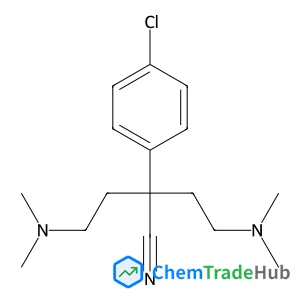
2-(4-Chlorophenyl)-4-(dimethylamino)-2-(2-(dimethylamino)ethyl)butanenitrile
CAS番号:
1246816-57-8
分子式:
C16H24ClN3
おすすめサプライヤー



免責事項
このページに表示される学術雑誌情報は、参考および研究目的のみを目的としています。当社は雑誌出版社とは提携しておらず、投稿の取り扱いも行っておりません。出版に関するお問い合わせは、各雑誌出版社に直接ご連絡ください。
表示されている情報に誤りがある場合は、support@chemtradehub.com までご連絡ください。迅速に確認し、対応いたします。