



Effect of radical copolymerization of the (oxa)norbornene end-group of RAFT-prepared macromonomers on bottlebrush copolymer synthesis via ROMP
文献情報
出版日
2022-02-02
DOI
10.1039/D1PY01599K
インパクトファクター
5.582
著者
Daniel J. Keddie
原文を見る
要旨
Bottlebrush polymers are attractive for use in a variety of different applications. Here we report the synthesis of two novel trithiocarbonate RAFT agents bearing either an oxanorbornenyl or norbornenyl moiety for bottlebrush synthesis via ROMP grafting-through polymerization. RAFT polymerization kinetics was evaluated as a function of the monomer type, number-average degree of polymerization (Xn) and RAFT agent structure. The correlation between the oxa/norbornenyl moiety and the type of RAFT monomer (methyl acrylate, n-butyl acrylate, and styrene) has been investigated. The reactivity of the oxa/norbornenyl group of the RAFT agent towards the radical propagating species during RAFT polymerization influences the molar mass, molar mass distribution and the residual olefinic end-group functionality of the resulting polymeric macromonomers. The RAFT synthesized macromonomers (MMs) are subjected to “grafting-through” ROMP using a Grubbs 3rd generation catalyst, resulting in bottlebrush polymers. The ‘defects’ in the MM structures have been found to be responsible for the higher amount of MM residue after the ROMP process and hence affect the microstructures of the synthesized bottlebrush polymers.
おすすめジャーナル

Drug Discovery Today

Organic Process Research & Development

Russian Journal of Coordination Chemistry

Journal of Saudi Chemical Society

Current Opinion in Colloid & Interface Science

Russian Journal of Bioorganic Chemistry

Russian Journal of General Chemistry

Saudi Pharmaceutical Journal

Russian Chemical Bulletin

Russian Journal of Organic Chemistry
関連文献
Structural stability and electronic properties of alkaline-earth metal induced Si(111)-(3 × 2) surfaces
Li-Fang Xu
2018-09-10
Paper
DOI: 10.1039/C8CP04323J
Ab initio kinetic Monte Carlo simulation of seeded emulsion polymerizations of styrene
Marco Drache, Katrin Brandl, Rebecca Reinhardt, Sabine Beuermann
2018-01-31
Paper
DOI: 10.1039/C7CP07768H
Towards a full quantitative description of single-molecule reaction kinetics in biological cells
Denis S. Grebenkov, Ralf Metzler, Gleb Oshanin
2018-05-21
Paper
DOI: 10.1039/C8CP02043D
Water desalination using graphene nanopores: influence of the water models used in simulations
Vishnu Prasad K., Remco Hartkamp, Sarith P. Sathian
2018-05-21
Paper
DOI: 10.1039/C8CP00919H
X-ray absorption near edge structure and first-principles spectral investigations of cationic disorder in MgAl2O4 induced by swift heavy ions
S. Yoshioka, K. Tsuruta, T. Yamamoto, K. Yasuda, S. Matsumura, N. Ishikawa, E. Kobayashi
2018-02-01
Paper
DOI: 10.1039/C7CP07591J
Zn-Porphyrin propped with hydantoin anchor: synthesis, photophysics and electron injection/recombination dynamics
Poomani Ram Kumar, Ebrahim M. Mothi, Mohan Ramesh, Arunkumar Kathiravan
2018-01-18
Paper
DOI: 10.1039/C7CP07326G
Structural definition of the BIL and DL: a new universal methodology to rationalize non-linear χ(2)(ω) SFG signals at charged interfaces, including χ(3)(ω) contributions
Simone Pezzotti, Daria Ruth Galimberti, Y. Ron Shen, Marie-Pierre Gaigeot
2018-01-23
Paper
DOI: 10.1039/C7CP06110B
Mineralization of phosphorylated cellulose: crucial role of surface structure and monovalent ions for optimizing calcium content
Natalia V. Lukasheva, Dmitry A. Tolmachev
2018-11-27
Paper
DOI: 10.1039/C8CP05767B
Identifying the acceptor state in NiO hole collection layers: direct observation of exciton dissociation and interfacial hole transfer across a Fe2O3/NiO heterojunction
Somnath Biswas, Jakub Husek, Stephen Londo, Elizabeth A. Fugate, L. Robert Baker
2018-09-05
Paper
DOI: 10.1039/C8CP04502J
Understanding water interactions with organic surfaces: environmental molecular beam and molecular dynamics studies of the water–butanol system
Sofia M. Johansson, Xiangrui Kong, Erik S. Thomson, Stéphane Briquez, Céline Toubin, Jan B. C. Pettersson
2018-12-20
Paper
DOI: 10.1039/C8CP04151B
こちらもおすすめ
化合物よくある質問
2-ヒドロキシ-5-ニトロベンジンブロモイドの代替品はありますか?
2-ヒドロキシ-5-ニトロベンジンブロモイドは特定の化学反応に適しているため、代替品は限られています。しかし、同様の構造を持つ2-ヒドロキシ-4-ニトロベンジン...
772-33-82-(Bromomethyl)-4-ni...
化合物よくある質問
N-(2-ブロモフェニル)-1-チロール-3-オキソ-3-(ピペリジニル)プロペン-2-イル)ベンゼンアミドを取り扱う際の実験室安全事項は何ですか?
N-(2-ブロモフェニル)-1-チロール-3-オキソ-3-(ピペリジニル)プロペン-2-イル)ベンゼンアミドは有毒で、皮膚や粘膜に刺激を与える可能性があります。...
1800044-77-2N-[(1Z)-1-(2-Bromoph...
化合物よくある質問
1,3プロパンジオール,2-[2-(2アミノ-6クロロ-9Hピリミジン-9-イル)エチル-1,1,2,2-D4]-2,3-ジアセタートの市場動向や研究トレンドはどうですか?
この化合物は、新規治療薬の開発に注目されています。市場では、その有効性と安全性が評価され、研究分野では、分子生物学と医薬化学の新たな発見が期待されています。
1020718-81-31,3-Propanediol, 2-[...
579-44-2Ethanone, 2-hydroxy-...
化合物よくある質問
Succinimidyl-alanyl-phenylalanyl-prolyl-phenylalanine 4-nitroanilide はどの業界で使用されていますか?
Succinimidyl-alanyl-phenylalanyl-prolyl-phenylalanine 4-nitroanilide は主に医薬品開発やポ...
128802-73-3succinimidyl-alanyl-...
化合物よくある質問
メチル6-アミノ-5-クロロピリジン-2-カーボイル酸について、適用される法規ガイドラインは何ですか?
メチル6-アミノ-5-クロロピリジン-2-カーボイル酸(CAS番号: 1256794-05-4)の使用には、GHS( Globally Harmonized S...
1256794-05-4Methyl 6-amino-5-chl...
化合物よくある質問
エチル4-(シクロ Pentagonyl)アミノ-2-メチル硫化基ピリミジン-5-カルボキシレートを取り扱う際の実験室安全事項は何ですか?
取り扱いには、耐薬品性の容器を使用し、通気性の良い場所で操作することを推奨します。漏れ時は、SDS(安全データシート)を参照して適切な措置を取ること。手洗いと洗...
211245-62-4ethyl 4-(cyclopentyl...
化合物よくある質問
(S)-3-ベンZYルピペリジン塩酸塩とは何ですか?
(S)-3-ベンZYルピペリジン塩酸塩は、CAS番号1258940-00-9で表される化合物です。これは、(S)-3-苯基哌啶的盐酸盐であり、主に医薬品の原料と...
1258940-00-9(S)-3-Phenylpiperidi...
化合物よくある質問
3,5-二甲基金剛胺の主な用途は何ですか?
3,5-二甲基金剛胺は、主に医薬品の原料として使用され、また抗うつ薬や抗アルツハイマー薬の開発に利用されます。さらに、化粧品や食品添加物の製造でも重要な役割を果...
19988-45-52-(2,3-Dihydroxyphen...
化合物よくある質問
ビス(4-メチル-2-ペンチル)フェニルカルボン酸エステルの代替品はありますか?
ビス(4-メチル-2-ペンチル)フェニルカルボン酸エステル (CAS番号: 1398066-13-1) の代替品には、ビス(2-エチルヘキシル)フェノールカルボ...
1398066-13-1Bis(4-methyl-2-penty...
掲載誌
Polymer Chemistry

CiteScore:
8.6
自己引用率:
7.3%
年間論文数:
457
Polymer Chemistry welcomes submissions in all areas of polymer science that have a strong focus on macromolecular chemistry. Manuscripts may cover a broad range of fields, yet no direct application focus is required.
おすすめ化合物

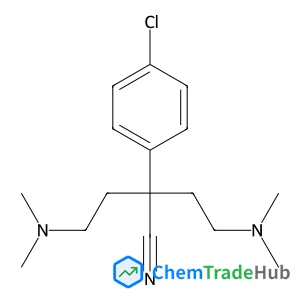
2-(4-Chlorophenyl)-4-(dimethylamino)-2-(2-(dimethylamino)ethyl)butanenitrile
CAS番号:
1246816-57-8
分子式:
C16H24ClN3

おすすめサプライヤー


免責事項
このページに表示される学術雑誌情報は、参考および研究目的のみを目的としています。当社は雑誌出版社とは提携しておらず、投稿の取り扱いも行っておりません。出版に関するお問い合わせは、各雑誌出版社に直接ご連絡ください。
表示されている情報に誤りがある場合は、support@chemtradehub.com までご連絡ください。迅速に確認し、対応いたします。