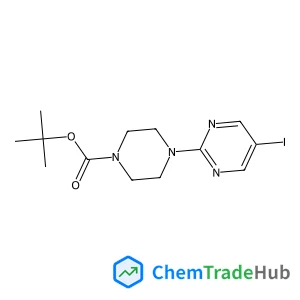
2-Methyl-2-propanyl 4-(5-iodo-2-pyrimidinyl)-1-piperazinecarboxylate
CAS番号:
1027616-32-5
分子式:
C13H19IN4O2
Susanne Müller, Suzanne Ackloo, Arij Al Chawaf, Hartmut Beck, Shaunna Beedie, Ulrich A. K. Betz, Gustavo Arruda Bezerra, Paul E. Brennan, David Brown, Peter J. Brown, Alex N. Bullock, Adrian J. Carter, Apirat Chaikuad, Mathilde Chaineau, Alessio Ciulli, Ian Collins, Jan Dreher, Kristina Edfeldt, Aled M. Edwards, Ursula Egner, Stephen M. Fuchs, Matthew D. Hall, Ingo V. Hartung, Alexander Hillisch, Stephen H. Hitchcock, Evert Homan, Natarajan Kannan, James R. Kiefer, Stefan Knapp, Milka Kostic, Stefan Kubicek, Andrew R. Leach, Sven Lindemann, Hisanori Matsui, Jordan L. Meier, Maurice Michel, Maxwell R. Morgan, Anke Mueller-Fahrnow, Dafydd R. Owen, Benjamin G. Perry, Saul H. Rosenberg, Kumar Singh Saikatendu, Cora Scholten, Sujata Sharma, Anton Simeonov, Michael Sundström, Matthew H. Todd, Claudia Tredup, Timothy M. Willson, Georg E. Winter
Twenty years after the publication of the first draft of the human genome, our knowledge of the human proteome is still fragmented. The challenge of translating the wealth of new knowledge from genomics into new medicines is that proteins, and not genes, are the primary executers of biological function. Therefore, much of how biology works in health and disease must be understood through the lens of protein function. Accordingly, a subset of human proteins has been at the heart of research interests of scientists over the centuries, and we have accumulated varying degrees of knowledge about approximately 65% of the human proteome. Nevertheless, a large proportion of proteins in the human proteome (∼35%) remains uncharacterized, and less than 5% of the human proteome has been successfully targeted for drug discovery. This highlights the profound disconnect between our abilities to obtain genetic information and subsequent development of effective medicines. Target 2035 is an international federation of biomedical scientists from the public and private sectors, which aims to address this gap by developing and applying new technologies to create by year 2035 chemogenomic libraries, chemical probes, and/or biological probes for the entire human proteome.
Minghao Ren, Linfang Wang, Xin Lv, Yuanqiang Sun, Hu Chen, Keyuan Zhang, Qi Wu, Yurong Bai, Wei Guo
DOI: 10.1039/C9AN01852B
Hamid Abdollahi, Paul J. Gemperline
DOI: 10.1039/C8AN00615F
Wen Yang, Jianniao Tian, Lijun Wang, Shui Fu, Hongyun Huang, Yanchun Zhao, Shulin Zhao
DOI: 10.1039/C6AN00184J
Xiaohu Liu, Peng Chen, Nhung Thi Tran, Jinling Zhang, Wei Sheng Chia, Bo Liedberg
DOI: 10.1039/C5AN02508G
Luca Guerrini
DOI: 10.1039/C9AN02040C
Xiao Fan, Qiaoli Yue, Yanyan Li, Yingya Liu, Lu-Lu Qu, Yingnan Cao
DOI: 10.1039/C5AN02543E
Claire V. Crowther, Viola Sanderlin, Mark A. Hayes, Gillian H. Gile
DOI: 10.1039/C9AN01186B
Yu Zong Chen
DOI: 10.1039/C6AN00678G
Areti Strati, Martha Zavridou, Evangelos Bournakis, Sophia Mastoraki, Evi Lianidou
DOI: 10.1039/C9AN00999J
Han Zhao, Ying Yan, Mingjian Chen, Tingting Hu, Kefeng Wu, Haisheng Liu, Changbei Ma
DOI: 10.1039/C9AN01659G
カルボニル基が付いた5-氰基-1-{[(2-メチル-2-プロpanyl)オキシ]カーボンイル}1H-吲哚-2-イリド-2-ボリン酸は、直射日光を避けて室温(15...
この化合物は合成化学分野において、特にピリジン化合物の合成や改良に用いられます。最近の研究では、ピリジン化合物の新規合成法や特性の改良が注目されています。市場動...
聚二季戊四醇六丙烯酸酯は、医薬品、ポリマー、センサー、半導体などの業界で広く使用されています。特にポリマー業界では硬化剤として、医薬分野では医療機器の製造に使用...
1-氯-5-硝基异喹啉は、薬理学や合成化学の研究分野で注目されています。市場動向としては、その生物学的な活性や合成可能性を評価する研究が増えています。また、代替...
2-チロール-5-メチルスルフェニル-3-trifルオルメチルベンゼンは、トリフルオロメチル化反応と硫化反応を経て合成されます。通常、トリフルオロメチル化剤と硫...
p-トールイルマグネシウムブロミドのCAS番号は4294-57-9です。この化合物は白色の結晶性粉末で、分子量は204.32です。溶剤中で良好に溶解しますが、水...
1-(5-甲基-2-硫化素基)プロパン-1-酮の市場動向は、化学産業全体の需要に影響を受けますが、最近では pharmaceutical 分野での応用が注目され...
十一碳烯酰甘氨酸は吸入や皮膚から吸収されることがあり、取り扱う際には防塵マスクと手袋を使用してください。ドラフトチャンバーを用いて漏洩を処理し、適切なSDS(S...
この化合物は吸入や皮膚吸収による毒性があるため、防塵マスク、ゴーグル、防護手袋を使用する必要があります。ドラフトチャンバーでの操作が必要です。漏洩時には即座に換...
安全性は化合物の使用方法によります。直接的な毒性は報告されていませんが、吸入や皮膚接触には注意が必要です。適切な防護服を着用し、換気を図ることを推奨します。
![Benzo[b]naphtho[2,1-d]thiophene structure](https://static.chemtradehub.com/structs/239/239-35-0-ff90.webp "Benzo[b]naphtho[2,1-d]thiophene structure")
![(3-{[4-(Aminomethyl)-6-(trifluoromethyl)-2-pyridinyl]oxy}phenyl)[(3R,4R)-3-fluoro-4-hydroxy-1-pyrrolidinyl]methanone structure](https://static.chemtradehub.com/structs/200/2007885-39-2-affc.webp "(3-{[4-(Aminomethyl)-6-(trifluoromethyl)-2-pyridinyl]oxy}phenyl)[(3R,4R)-3-fluoro-4-hydroxy-1-pyrrolidinyl]methanone structure")