


SF5- and SCF3-substituted tetrahydroquinoline compounds as potent bactericidal agents against multidrug-resistant persister Gram-positive bacteria
文献情報
出版日
2021-08-10
DOI
10.1039/D1MD00211B
インパクトファクター
0
著者
Neetu Dayal
原文を見る
要旨
Bacteria persister cells are immune to most antibiotics and hence compounds that are active against persister bacteria are needed. We screened a chemical library of SF5- and SCF3-substituted tetrahydroquinoline compounds, synthesized via the Povarov reaction, for antibacterial activity and identified active compounds that displayed good activities against many Gram-positive bacteria, including persisters. The most potent of these compounds, HSD1835, inhibited the growth of drug-resistant Gram-positive bacterial pathogens (including clinical strains) at concentrations ranging from 1 μg mL−1 to 4 μg mL−1. Several of the SCF3- and SF5-containing compounds were active against methicillin-resistant Staphylococcus aureus (MRSA) and against the two most fatal strains of vancomycin-resistant Enterococcus (VRE), VRE faecalis and VRE faecium. The compounds showed bactericidal activity against stationary phase persister MRSA in time-kill assays. Mechanistic studies showed that HSD1835 acts by disrupting bacterial membranes. Scanning electron microscopy (SEM) was used to confirm bacterial membrane disruption. Interestingly, in a 30 day serial exposure experiment, MRSA remained susceptible to low-dose HSD1835 whilst resistance to ciprofloxacin and mupirocin emerged by day 10. Analogs of HSD1835, which did not bear the SF5 or SCF3 moieties, were inactive against bacteria. Recent reports (G. A. Naclerio, N. S. Abutaleb, K. I. Onyedibe, M. N. Seleem and H. O. Sintim, RSC Med. Chem. 2020, 11, 102–110 and G. A. Naclerio, N. S. Abutaleb, D. Li, M. N. Seleem and H. O. Sintim, J. Med. Chem. 2020, 63(20), 11934–11944) also demonstrated that adding the SF5 or SCF3 groups to a different scaffold (oxadiazoles) enhanced the antibacterial properties of the compounds, so it appears that these groups are privileged moieties that enhance the antimicrobial activities of compounds.
おすすめジャーナル

Journal of Saudi Chemical Society

Russian Journal of General Chemistry

Journal of Natural Medicines

Current Opinion in Solid State & Materials Science

Current Opinion in Colloid & Interface Science

Russian Journal of Organic Chemistry

New Journal of Chemistry

Russian Journal of Bioorganic Chemistry

Crystallography Reports

Saudi Pharmaceutical Journal
関連文献
Short peptide-regulated aggregation of porphyrins for photoelectric conversion
Shengjie Wang, Dongxiu Zhang, Xiao Zhang, Daoyong Yu, Xiaofeng Jiang, Zhenyang Wang, Meiwen Cao, Yongqing Xia, Heyuan Liu
2018-12-27
Paper
DOI: 10.1039/C8SE00523K
Ultrahigh stability of high-power nanofibrillar PEDOT supercapacitors
Shinjita Acharya, Luciano M. Santino, Yang Lu, Hari Anandarajah, Aly Wayne
2017-03-27
Paper
DOI: 10.1039/C7SE00057J
The improved ion clustering and conductivity of a di-quaternized poly(arylene ether ketone sulfone)-based alkaline fuel cell membrane
2017-04-11
Paper
DOI: 10.1039/C7SE00097A
Study of the enhancement on photogalvanics: solar energy conversion and storage in EDTA–safranine O–NaLS system
Prerna Gangotri, Pooran Koli
2017-03-28
Paper
DOI: 10.1039/C7SE00083A
A surfactant-assisted strategy to tailor Li-ion charge transfer interfacial resistance for scalable all-solid-state Li batteries
Chengtian Zhou, Alfred Junio Samson, Kyle Hofstetter, Venkataraman Thangadurai
2018-07-18
Communication
DOI: 10.1039/C8SE00234G
Liquid flow-induced electricity in carbon nanomaterials
Junxian Pei, Jun Huang, Zhi Huang, Kang Liu
2019-01-30
Review Article
DOI: 10.1039/C8SE00604K
Renewable high density fuels containing tricyclic sesquiterpanes and alkyl diamondoids
Kale W. Harrison, Benjamin G. Harvey
2017-02-03
Paper
DOI: 10.1039/C6SE00108D
Phenol–TiO2 complex photocatalysis: visible light-driven selective oxidation of amines into imines in air
Ji-Long Shi, Huimin Hao
2018-12-07
Paper
DOI: 10.1039/C8SE00527C
こちらもおすすめ
化合物よくある質問
カルボニル基が付いた5-氰基-1-{[(2-メチル-2-プロpanyl)オキシ]カーボンイル}1H-吲哚-2-イリド-2-ボリン酸はどのように保存すればよいですか?
カルボニル基が付いた5-氰基-1-{[(2-メチル-2-プロpanyl)オキシ]カーボンイル}1H-吲哚-2-イリド-2-ボリン酸は、直射日光を避けて室温(15...
475102-15-9(5-Cyano-1-{[(2-meth...
化合物よくある質問
tert-ブチル2-クロロメチルピリジン-3-基炭酸エステルの市場動向や研究トレンドはどうですか?
この化合物は合成化学分野において、特にピリジン化合物の合成や改良に用いられます。最近の研究では、ピリジン化合物の新規合成法や特性の改良が注目されています。市場動...
1203498-98-9tert-Butyl 2-chloro-...
化合物よくある質問
聚二季戊四醇六丙烯酸酯はどの業界で使用されていますか?
聚二季戊四醇六丙烯酸酯は、医薬品、ポリマー、センサー、半導体などの業界で広く使用されています。特にポリマー業界では硬化剤として、医薬分野では医療機器の製造に使用...
29570-58-93-(Acryloyloxy)-2-({...
化合物よくある質問
1-氯-5-硝基异喹啉の市場動向や研究トレンドはどうですか?
1-氯-5-硝基异喹啉は、薬理学や合成化学の研究分野で注目されています。市場動向としては、その生物学的な活性や合成可能性を評価する研究が増えています。また、代替...
58142-97-51-Chloro-5-nitroisoq...
化合物よくある質問
2-チロール-5-メチルスルフェニル-3-trifルオルメチルベンゼンはどのように合成されますか?
2-チロール-5-メチルスルフェニル-3-trifルオルメチルベンゼンは、トリフルオロメチル化反応と硫化反応を経て合成されます。通常、トリフルオロメチル化剤と硫...
957066-04-51-Chloro-4-(methylsu...
化合物よくある質問
p-トールイルマグネシウムブロミドの物理化学的性質は何ですか?
p-トールイルマグネシウムブロミドのCAS番号は4294-57-9です。この化合物は白色の結晶性粉末で、分子量は204.32です。溶剤中で良好に溶解しますが、水...
4294-57-9p-Tolylmagnesium bro...
化合物よくある質問
1-(5-甲基-2-硫化素基)プロパン-1-酮の市場動向や研究トレンドはどうですか?
1-(5-甲基-2-硫化素基)プロパン-1-酮の市場動向は、化学産業全体の需要に影響を受けますが、最近では pharmaceutical 分野での応用が注目され...
59303-13-81-(5-Methyl-2-thieny...
化合物よくある質問
十一碳烯酰甘氨酸を取り扱う際の実験室安全事項は何ですか?
十一碳烯酰甘氨酸は吸入や皮膚から吸収されることがあり、取り扱う際には防塵マスクと手袋を使用してください。ドラフトチャンバーを用いて漏洩を処理し、適切なSDS(S...
54301-26-7N-10-Undecenoylglyci...
化合物よくある質問
1H,1H-全氟-3,6-二氧杂葵-1-醇を取り扱う際の実験室安全事項は何ですか?
この化合物は吸入や皮膚吸収による毒性があるため、防塵マスク、ゴーグル、防護手袋を使用する必要があります。ドラフトチャンバーでの操作が必要です。漏洩時には即座に換...
152914-73-32,2-Difluoro-2-[1,1,...
化合物よくある質問
3-(4-(フルオロメチルオキシ)フェニル)-1,2,4-オキサジアゾール-5-カルボハイドライドは安全ですか?
安全性は化合物の使用方法によります。直接的な毒性は報告されていませんが、吸入や皮膚接触には注意が必要です。適切な防護服を着用し、換気を図ることを推奨します。
883028-82-83-(4-(Trifluorometho...
掲載誌
おすすめ化合物
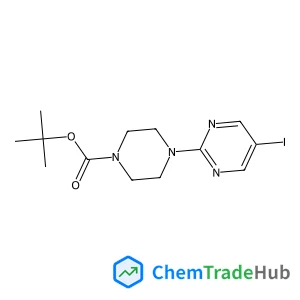
2-Methyl-2-propanyl 4-(5-iodo-2-pyrimidinyl)-1-piperazinecarboxylate
CAS番号:
1027616-32-5
分子式:
C13H19IN4O2
おすすめサプライヤー




免責事項
このページに表示される学術雑誌情報は、参考および研究目的のみを目的としています。当社は雑誌出版社とは提携しておらず、投稿の取り扱いも行っておりません。出版に関するお問い合わせは、各雑誌出版社に直接ご連絡ください。
表示されている情報に誤りがある場合は、support@chemtradehub.com までご連絡ください。迅速に確認し、対応いたします。