












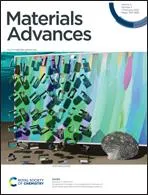
Organolead halide perovskites beyond solar cells: self-powered devices and the associated progress and challenges
文献情報
出版日
2021-06-30
DOI
10.1039/D1MA00377A
インパクトファクター
0
著者
Avi Mathur, Hua Fan, Vivek Maheshwari
原文を見る
要旨
Conventional electronic devices powered by lithium-ion batteries or supercapacitors face the challenge of offering long-term and self-sustaining operations. Self-powered devices based on emerging energy harvesting technologies can help of the development of long-lasting transducers with a small form factor. Organolead halide perovskites due to their excellent electro-optical properties are promising photosensitive materials for the development of such self-powered devices. The following review aims at summarizing recent developments made in the field of organolead halide perovskite based self-powered applications. The underlying mechanism driving the self-powered operation in electronic devices such as photodetectors, tactile sensors, and gas sensors is discussed in detail. Finally, the current challenges and prospects of these perovskite based optoelectronic applications are highlighted.
関連文献
Structural and reorientational dynamics of tetrahydroborate (BH4−) and tetrahydrofuran (THF) in a Mg(BH4)2·3THF adduct: neutron-scattering characterization
Marina Chong, Mark E. Bowden, Hui Wu, Wei Zhou, Iffat Nayyar, Bojana Ginovska, Thomas Gennett, Tom Autrey, Craig M. Jensen, Terrence J. Udovic
2019-11-20
Paper
DOI: 10.1039/C9CP03311D
The dual-defective SnS2 monolayers: promising 2D photocatalysts for overall water splitting
2019-11-08
Paper
DOI: 10.1039/C9CP04649F
Atomic arrangement in CuZr-based metallic glass composites under tensile deformation
Huali Hao, Wenzhao Zhou
2019-11-22
Paper
DOI: 10.1039/C9CP04914B
3-D bond-paths of QTAIM and the stress tensor in neutral lithium clusters, Lim (m = 2–5), presented on the Ehrenfest force molecular graph
Alireza Azizi, Roya Momen, Steven R. Kirk, Samantha Jenkins
2019-12-10
Paper
DOI: 10.1039/C9CP05066C
Quantitative determination of the phosphorus environment in lithium aluminosilicate glasses using solid-state NMR techniques
Monique Comte, Lionel Montagne, Bertrand Doumert, Laurent Cormier
2019-07-31
Paper
DOI: 10.1039/C9CP03181B
Comment on “Penicillin’s catalytic mechanism revealed by inelastic neutrons and quantum chemical theory” by Z. Mucsi, G. A. Chass, P. Ábrányi-Balogh, B. Jójárt, D.-C. Fang, A. J. Ramirez-Cuesta, B. Viskolczc and I. G. Csizmadia, Phys. Chem. Chem. Phys., 2013, 15, 20447
2019-07-31
Comment
DOI: 10.1039/C8CP02413H
Electronic structure modifications induced by increased molecular complexity: from triphenylamine to m-MTDATA
C. Grazioli, A. Guarnaccio, F. O. L. Johansson, M. Coreno, M. de Simone, A. Santagata, B. Brena, C. Puglia
2019-07-26
Paper
DOI: 10.1039/C9CP02423A
Sublimation thermodynamics of nucleobases derived from fast scanning calorimetry
A. V. Buzyurov
2019-12-10
Paper
DOI: 10.1039/C9CP04761A
Ionic liquid based battery electrolytes using lithium and sodium pseudo-delocalized pyridinium anion salts
Elham Hosseini-Bab-Anari, Adriana M. Navarro-Suárez, Kasper Moth-Poulsen
2019-08-07
Paper
DOI: 10.1039/C9CP03445E
こちらもおすすめ
化合物よくある質問
4-アミノフェノール酸ナトリウム水和物とは何ですか?
4-アミノフェノール酸ナトリウム水和物は、CAS番号206557-08-6の化合物で、4-アミノフェノールとナトリウムが結合した塩と水和物です。この化合物は、白...
206557-08-64-Aminobenzoic acid ...
化合物よくある質問
Methyl 3-methyl-N-{[(2-methyl-2-propanyl)oxy]carbonyl}-L-histidinateの代替品はありますか?
この化合物は特定の合成プロセスに使用される可能性がありますが、代替品として、他の类似的な化合物、例えばMethyl 3-methyl-N-{[(2-methyl...
72212-51-2Methyl 3-methyl-N-{[...
化合物よくある質問
4-Boc-2-哌嗪甲酸の市場動向や研究トレンドはどうですか?
4-Boc-2-哌嗪甲酸は、薬品開発や合成化学分野で広く使用されており、その需要は継続的に推移しています。特に、新薬開発における合成化学分野での需要が高まってい...
192330-11-3(2R)-4-[(tert-butoxy...
化合物よくある質問
4,4'-二羟甲基联苯の物理化学的性質は何ですか?
4,4'-二羟甲基联苯のCAS番号は1667-12-5です。この化合物は白色の結晶粉末で、分子量は154.20です。水にわずかに溶けますが、アルコールや有機溶媒...
1667-12-54,4'-Biphenyldiyldim...
化合物よくある質問
5-甲硫基戊腈はどの業界で使用されていますか?
5-甲硫基戊腈は医薬品産業で使用される可能性があります。また、ポリマー合成の触媒として、センサー製造の一部として、半導体製造のプロセス改善に使用される可能性があ...
59121-25-45-(Methylsulfanyl)pe...
化合物よくある質問
CAS番号1311961-50-8の化合物はどのように合成されますか?
この化合物は、1-abieta-8,11,13-trien-19-イルと6'-メトキシシンコナナン-9-基を含有する窒素含有化合物から合成されます。一般的な合成...
1311961-50-81-Abieta-8,11,13-tri...
化合物よくある質問
6-ブロモベンジジミダゾール-2-カルビルデオキシドはどのように保存すればよいですか?
6-ブロモベンジジミダゾール-2-カルビルデオキシドは、避光・乾燥した容器(密閉容器)で-20℃~4℃の低温で保存してください。高温や直射日光、湿気は避けてくだ...
885280-26-25-Bromo-1H-benzimida...
化合物よくある質問
Boc-N-甲基氨甲环酸とは何ですか?
621-65-8のCAS番号を持つBoc-N-甲基氨甲环酸は、化学式C7H13NO5を有する化合物です。この化合物は白色の結晶性粉末で、吸湿性があります。
621-65-83-Hydroxy-1,2-propan...
化合物よくある質問
乙基三氟硼酸钾はどのように合成されますか?
乙基三氟硼酸钾は、トリフLUオール酸カリウムとエチルブロミドを反応させて合成されます。この反応は高い選択性と収率を持ち、触媒を用いることで効率的に進行します。
882871-21-8Potassium ethyltrifl...
化合物よくある質問
2-フロウロ-5-クロロ-4-アミノフェノールはどのように保存すればよいですか?
2-フロウロ-5-クロロ-4-アミノフェノールは、直射日光を避けて冷却された暗所で保存し、密閉容器に保管してください。温度は常温か低温が適しています。
847872-10-04-Amino-5-chloro-2-f...
掲載誌
おすすめ化合物
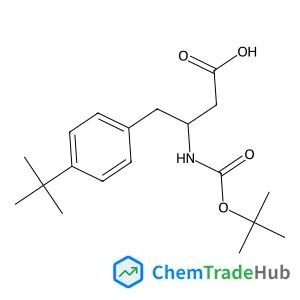
(S)-3-((tert-Butoxycarbonyl)amino)-4-(4-(tert-butyl)phenyl)butanoic acid
CAS番号:
403661-85-8
分子式:
C19H29NO4
おすすめサプライヤー





免責事項
このページに表示される学術雑誌情報は、参考および研究目的のみを目的としています。当社は雑誌出版社とは提携しておらず、投稿の取り扱いも行っておりません。出版に関するお問い合わせは、各雑誌出版社に直接ご連絡ください。
表示されている情報に誤りがある場合は、support@chemtradehub.com までご連絡ください。迅速に確認し、対応いたします。