



Azobenzene isomerization in condensed matter: lessons for the design of efficient light-responsive soft-matter systems
文献情報
出版日
2021-06-03
DOI
10.1039/D1MA00340B
インパクトファクター
0
著者
Luke W. Giles, Charl F. J. Faul, Rico F. Tabor
原文を見る
要旨
Azobenzene-based materials have found applications in a wide variety of systems as a convenient method to induce photo-responsive behaviour through facile trans (E) to cis (Z) isomerization. Of particular interest are condensed matter systems, for which diverse assemblies have been applied in myriad ways to produce optical materials, controllable assemblies and functional surfaces. However, isomerization of azobenzene faces unique challenges in condensed systems when compared with dilute states (molecular solution and gas phase) where isomerization is best understood. In the present work, we explore recent studies looking at these challenges experienced in condensed matter phases, some solutions proposed to improve isomerization efficiency, and further give these issues wider context for the future development of light-responsive soft-matter systems.
おすすめジャーナル

Planta Medica

European Journal of Wood and Wood Products

Israel Journal of Chemistry

Journal of Heterocyclic Chemistry

Journal of Physics and Chemistry of Solids

Science

Russian Chemical Reviews

Fibre Chemistry

Proceedings of the National Academy of Sciences of the United States of America

Journal of Organometallic Chemistry
関連文献
Dipole reorientation and local density of optical states influence the emission of light-emitting electrochemical cells
Alberto Jiménez-Solano, Laura Martínez-Sarti, Antonio Pertegás, Gabriel Lozano, Henk J. Bolink, Hernán Míguez
2019-11-05
Paper
DOI: 10.1039/C9CP05505C
Polyphosphates can stabilize but also aggregate colloids
Rayssa Jossanea Brasileiro Motta, Ana Zélia Falcão Almeida, Bruna Luiza Batista de Lima, Ricardo Schneider, Rosangela de Carvalho Balaban, Jeroen Sebastiaan van Duijneveldt, Rodrigo José de Oliveira
2019-11-29
Communication
DOI: 10.1039/C9CP05225A
The pH dependent mechanisms of non-enzymatic peptide bond cleavage reactions
2019-11-22
Paper
DOI: 10.1039/C9CP05240B
p-Type conductivity mechanism and defect structure of nitrogen-doped LiNbO3 from first-principles calculations
Weiwei Wang, Yang Zhong, Dahuai Zheng, Hongde Liu, Lixin Zhang
2019-10-25
Paper
DOI: 10.1039/C9CP05019A
Comment on “Penicillin’s catalytic mechanism revealed by inelastic neutrons and quantum chemical theory” by Z. Mucsi, G. A. Chass, P. Ábrányi-Balogh, B. Jójárt, D.-C. Fang, A. J. Ramirez-Cuesta, B. Viskolczc and I. G. Csizmadia, Phys. Chem. Chem. Phys., 2013, 15, 20447
2019-07-31
Comment
DOI: 10.1039/C8CP02413H
A new strategy to generate super and hyper acids with simple organic molecules exploiting σ-hole interaction
Anusuya Saha
2019-07-19
Paper
DOI: 10.1039/C9CP03881G
Polypyrrole derivatives for optoelectronic applications: a DFT study on the influence of side groups
Alex Pifer Coleone, Leonardo Gois Lascane
2019-07-23
Paper
DOI: 10.1039/C9CP02638J
Prototypical cyclohexane dimers: spectroscopic evidence for σ stacking at low temperatures
N. Ramanathan, Shubhra Sarkar, K. Sundararajan
2019-12-02
Paper
DOI: 10.1039/C9CP05237B
こちらもおすすめ
化合物よくある質問
4-アミノフェノール酸ナトリウム水和物とは何ですか?
4-アミノフェノール酸ナトリウム水和物は、CAS番号206557-08-6の化合物で、4-アミノフェノールとナトリウムが結合した塩と水和物です。この化合物は、白...
206557-08-64-Aminobenzoic acid ...
化合物よくある質問
Methyl 3-methyl-N-{[(2-methyl-2-propanyl)oxy]carbonyl}-L-histidinateの代替品はありますか?
この化合物は特定の合成プロセスに使用される可能性がありますが、代替品として、他の类似的な化合物、例えばMethyl 3-methyl-N-{[(2-methyl...
72212-51-2Methyl 3-methyl-N-{[...
化合物よくある質問
4-Boc-2-哌嗪甲酸の市場動向や研究トレンドはどうですか?
4-Boc-2-哌嗪甲酸は、薬品開発や合成化学分野で広く使用されており、その需要は継続的に推移しています。特に、新薬開発における合成化学分野での需要が高まってい...
192330-11-3(2R)-4-[(tert-butoxy...
化合物よくある質問
4,4'-二羟甲基联苯の物理化学的性質は何ですか?
4,4'-二羟甲基联苯のCAS番号は1667-12-5です。この化合物は白色の結晶粉末で、分子量は154.20です。水にわずかに溶けますが、アルコールや有機溶媒...
1667-12-54,4'-Biphenyldiyldim...
化合物よくある質問
5-甲硫基戊腈はどの業界で使用されていますか?
5-甲硫基戊腈は医薬品産業で使用される可能性があります。また、ポリマー合成の触媒として、センサー製造の一部として、半導体製造のプロセス改善に使用される可能性があ...
59121-25-45-(Methylsulfanyl)pe...
化合物よくある質問
CAS番号1311961-50-8の化合物はどのように合成されますか?
この化合物は、1-abieta-8,11,13-trien-19-イルと6'-メトキシシンコナナン-9-基を含有する窒素含有化合物から合成されます。一般的な合成...
1311961-50-81-Abieta-8,11,13-tri...
化合物よくある質問
6-ブロモベンジジミダゾール-2-カルビルデオキシドはどのように保存すればよいですか?
6-ブロモベンジジミダゾール-2-カルビルデオキシドは、避光・乾燥した容器(密閉容器)で-20℃~4℃の低温で保存してください。高温や直射日光、湿気は避けてくだ...
885280-26-25-Bromo-1H-benzimida...
化合物よくある質問
Boc-N-甲基氨甲环酸とは何ですか?
621-65-8のCAS番号を持つBoc-N-甲基氨甲环酸は、化学式C7H13NO5を有する化合物です。この化合物は白色の結晶性粉末で、吸湿性があります。
621-65-83-Hydroxy-1,2-propan...
化合物よくある質問
乙基三氟硼酸钾はどのように合成されますか?
乙基三氟硼酸钾は、トリフLUオール酸カリウムとエチルブロミドを反応させて合成されます。この反応は高い選択性と収率を持ち、触媒を用いることで効率的に進行します。
882871-21-8Potassium ethyltrifl...
化合物よくある質問
2-フロウロ-5-クロロ-4-アミノフェノールはどのように保存すればよいですか?
2-フロウロ-5-クロロ-4-アミノフェノールは、直射日光を避けて冷却された暗所で保存し、密閉容器に保管してください。温度は常温か低温が適しています。
847872-10-04-Amino-5-chloro-2-f...
掲載誌
おすすめ化合物
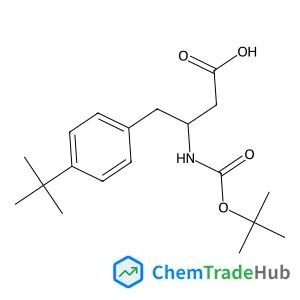
(S)-3-((tert-Butoxycarbonyl)amino)-4-(4-(tert-butyl)phenyl)butanoic acid
CAS番号:
403661-85-8
分子式:
C19H29NO4
![[3-(2,6-Dichlorophenyl)-5-isopropyl-1,2-oxazol-4-yl]methanol structure](https://static.chemtradehub.com/structs/278/278597-30-1-5c79.webp "[3-(2,6-Dichlorophenyl)-5-isopropyl-1,2-oxazol-4-yl]methanol structure")
おすすめサプライヤー





免責事項
このページに表示される学術雑誌情報は、参考および研究目的のみを目的としています。当社は雑誌出版社とは提携しておらず、投稿の取り扱いも行っておりません。出版に関するお問い合わせは、各雑誌出版社に直接ご連絡ください。
表示されている情報に誤りがある場合は、support@chemtradehub.com までご連絡ください。迅速に確認し、対応いたします。