


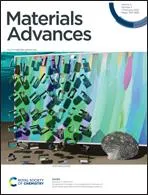
Thermal decarboxylation for the generation of hierarchical porosity in isostructural metal–organic frameworks containing open metal sites
文献情報
出版日
2021-07-14
DOI
10.1039/D1MA00163A
インパクトファクター
0
著者
Zhifeng Xiao, Shaik Waseem Vali, Wenmiao Chen, Qi Wang, Yutao Huang, Tian-Hao Yan, Jason E. Kuszynski, Paul A. Lindahl, Matthew R. Ryder
原文を見る
要旨
The effect of metal-cluster redox identity on the thermal decarboxylation of a series of isostructural metal–organic frameworks (MOFs) with tetracarboxylate-based ligands and trinuclear μ3-oxo clusters was investigated. The PCN-250 series of MOFs can consist of various metal combinations (Fe3, Fe/Ni, Fe/Mn, Fe/Co, Fe/Zn, Al3, In3, and Sc3). The Fe-based system can undergo a thermally induced reductive decarboxylation, producing a mixed valence cluster with decarboxylated ligand fragments subsequently eliminated to form uniform mesopores. We have extended the analysis to alternative monometallic and bimetallic PCN-250 systems to observe the cluster's effect on the decarboxylation process. Our results suggest that the propensity to undergo decarboxylation is directly related to the cluster redox accessibility, with poorly reducible metals, such as Al, In, and Sc, unable to thermally reduce at the readily accessible temperatures of the Fe-containing system. In contrast, the mixed-metal variants are all reducible. We report improvements in gas adsorption behavior, significantly the uniform increase in the heat of adsorption going from the microporous to hierarchically induced decarboxylated samples. This, along with Fe oxidation state changes from 57Fe Mössbauer spectroscopy, suggests that reduction occurs at the clusters and is essential for mesopore formation. These results provide insight into the thermal behavior of redox-active MOFs and suggest a potential future avenue for generating mesoporosity using controlled cluster redox chemistry.
おすすめジャーナル

Journal of Physics and Chemistry of Solids

Russian Chemical Reviews

Journal of Medicinal Chemistry

Pure and Applied Chemistry

Pharmacological Reviews

Proceedings of the National Academy of Sciences of the United States of America

Journal of Organometallic Chemistry

Kinetics and Catalysis

Israel Journal of Chemistry

Science Progress
関連文献
p-Type conductivity mechanism and defect structure of nitrogen-doped LiNbO3 from first-principles calculations
Weiwei Wang, Yang Zhong, Dahuai Zheng, Hongde Liu, Lixin Zhang
2019-10-25
Paper
DOI: 10.1039/C9CP05019A
Ab initio study of a 2D h-BAs monolayer: a promising anode material for alkali-metal ion batteries
Amitava Banerjee, Younes Benhouria
2019-07-23
Paper
DOI: 10.1039/C9CP03242H
Interface-induced perpendicular magnetic anisotropy in Co2FeAl/NiFe2O4 superlattice: first-principles study
Fangfang Li, Jianmin Zhang, Xiufeng Han, Yu Yan
2019-12-03
Paper
DOI: 10.1039/C9CP05703J
3-D bond-paths of QTAIM and the stress tensor in neutral lithium clusters, Lim (m = 2–5), presented on the Ehrenfest force molecular graph
Alireza Azizi, Roya Momen, Steven R. Kirk, Samantha Jenkins
2019-12-10
Paper
DOI: 10.1039/C9CP05066C
Spontaneous proton transfer in a series of amphoteric molecules under hydrostatic pressure
Binhong Yu, Yi Wang, Lingrui Wang, Xiao Tan, Yu-Mo Zhang, Minjie Li, Bo Zou, Sean Xiao-An Zhang
2019-07-17
Paper
DOI: 10.1039/C9CP02445J
Understanding deep dehydrogenation and cracking of n-butane on Ni(111) by a DFT study
Li Wang, Zhourong Xiao, Guozhu Li, Lichang Wang
2019-11-22
Paper
DOI: 10.1039/C9CP05022A
The effect of CO2 loading on alkanolamine absorbents in aqueous solutions
Sergey M. Melnikov, Matthias Stein
2019-08-08
Paper
DOI: 10.1039/C9CP03976G
The effect of grain size on the hydration of BaZr0.9Y0.1O3−δ proton conductor studied by ambient pressure X-ray photoelectron spectroscopy
Gregory S. Jackson, Ethan J. Crumlin, Bryan Eichhorn, Sandrine Ricote
2019-12-03
Paper
DOI: 10.1039/C9CP04335G
こちらもおすすめ
化合物よくある質問
4-アミノフェノール酸ナトリウム水和物とは何ですか?
4-アミノフェノール酸ナトリウム水和物は、CAS番号206557-08-6の化合物で、4-アミノフェノールとナトリウムが結合した塩と水和物です。この化合物は、白...
206557-08-64-Aminobenzoic acid ...
化合物よくある質問
Methyl 3-methyl-N-{[(2-methyl-2-propanyl)oxy]carbonyl}-L-histidinateの代替品はありますか?
この化合物は特定の合成プロセスに使用される可能性がありますが、代替品として、他の类似的な化合物、例えばMethyl 3-methyl-N-{[(2-methyl...
72212-51-2Methyl 3-methyl-N-{[...
化合物よくある質問
4-Boc-2-哌嗪甲酸の市場動向や研究トレンドはどうですか?
4-Boc-2-哌嗪甲酸は、薬品開発や合成化学分野で広く使用されており、その需要は継続的に推移しています。特に、新薬開発における合成化学分野での需要が高まってい...
192330-11-3(2R)-4-[(tert-butoxy...
化合物よくある質問
4,4'-二羟甲基联苯の物理化学的性質は何ですか?
4,4'-二羟甲基联苯のCAS番号は1667-12-5です。この化合物は白色の結晶粉末で、分子量は154.20です。水にわずかに溶けますが、アルコールや有機溶媒...
1667-12-54,4'-Biphenyldiyldim...
化合物よくある質問
5-甲硫基戊腈はどの業界で使用されていますか?
5-甲硫基戊腈は医薬品産業で使用される可能性があります。また、ポリマー合成の触媒として、センサー製造の一部として、半導体製造のプロセス改善に使用される可能性があ...
59121-25-45-(Methylsulfanyl)pe...
化合物よくある質問
CAS番号1311961-50-8の化合物はどのように合成されますか?
この化合物は、1-abieta-8,11,13-trien-19-イルと6'-メトキシシンコナナン-9-基を含有する窒素含有化合物から合成されます。一般的な合成...
1311961-50-81-Abieta-8,11,13-tri...
化合物よくある質問
6-ブロモベンジジミダゾール-2-カルビルデオキシドはどのように保存すればよいですか?
6-ブロモベンジジミダゾール-2-カルビルデオキシドは、避光・乾燥した容器(密閉容器)で-20℃~4℃の低温で保存してください。高温や直射日光、湿気は避けてくだ...
885280-26-25-Bromo-1H-benzimida...
化合物よくある質問
Boc-N-甲基氨甲环酸とは何ですか?
621-65-8のCAS番号を持つBoc-N-甲基氨甲环酸は、化学式C7H13NO5を有する化合物です。この化合物は白色の結晶性粉末で、吸湿性があります。
621-65-83-Hydroxy-1,2-propan...
化合物よくある質問
乙基三氟硼酸钾はどのように合成されますか?
乙基三氟硼酸钾は、トリフLUオール酸カリウムとエチルブロミドを反応させて合成されます。この反応は高い選択性と収率を持ち、触媒を用いることで効率的に進行します。
882871-21-8Potassium ethyltrifl...
化合物よくある質問
2-フロウロ-5-クロロ-4-アミノフェノールはどのように保存すればよいですか?
2-フロウロ-5-クロロ-4-アミノフェノールは、直射日光を避けて冷却された暗所で保存し、密閉容器に保管してください。温度は常温か低温が適しています。
847872-10-04-Amino-5-chloro-2-f...
掲載誌
おすすめ化合物
![Imidazo[1,2-c]pyrimidine structure](https://static.chemtradehub.com/structs/274/274-78-2-8b4c.webp "Imidazo[1,2-c]pyrimidine structure")
![[3-(2,6-Dichlorophenyl)-5-isopropyl-1,2-oxazol-4-yl]methanol structure](https://static.chemtradehub.com/structs/278/278597-30-1-5c79.webp "[3-(2,6-Dichlorophenyl)-5-isopropyl-1,2-oxazol-4-yl]methanol structure")
おすすめサプライヤー




免責事項
このページに表示される学術雑誌情報は、参考および研究目的のみを目的としています。当社は雑誌出版社とは提携しておらず、投稿の取り扱いも行っておりません。出版に関するお問い合わせは、各雑誌出版社に直接ご連絡ください。
表示されている情報に誤りがある場合は、support@chemtradehub.com までご連絡ください。迅速に確認し、対応いたします。