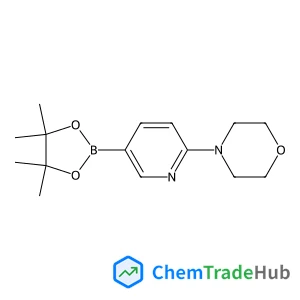
4-(5-(4,4,5,5-tetramethyl-1,3,2-dioxaborolan-2-yl)pyridin-2-yl)morpholine
CAS番号:
485799-04-0
分子式:
C15H23BN2O3
Min Chen, Fan Fu, Hongwei Zhu, Thomas Feurer, Wenming Tian, Chao Zhu, Ke Zhou, Shengye Jin, Shaik Mohammed Zakeeruddin, Ayodhya N. Tiwari, Nitin P. Padture, Michael Grätzel, Yantao Shi
Carbon-based perovskite solar cells (C-PSCs) are recognized as low-cost stable photovoltaics. However, currently most highly efficient C-PSCs are optically opaque, which means that they can only utilize direct illumination but cannot efficiently utilize the reflected irradiance. Here we propose bifacial C-PSCs incorporating transparent carbon-nanotube (CNT) network films in the rear electrode to efficiently utilize the reflected irradiation. By systematically optimizing the type and size of representative CNTs (including MWCNTs and SWCNTs), we find that the SWCNT-PSCs show a monofacial-power-conversion-efficiency (monofacial-PCE) of up to 21.4%, whereas the SWCNT-PSCs reach a bifacial power output of 24.0 mW cm−2 in natural reflecting surroundings (20% of AM 1.5 G irradiance) and 34.1 mW cm−2 in artificial reflecting surroundings (100% of AM 1.5 G irradiance). The bifacial SWCNT-PSCs also show high operational stability with a loss of 5% under 1000 h full sun continuous illumination. Moreover, we achieved a PCE of 27.1% by using our bifacial device as a top cell together with a CIS bottom cell in a 4-T tandem. These findings point to a promising direction for improving the output power per unit area of PSCs.

Russian Journal of Organic Chemistry

Current Opinion in Solid State & Materials Science

Russian Journal of Bioorganic Chemistry

Journal of Peptide Science

Current Opinion in Colloid & Interface Science

Chemical Communications

New Journal of Chemistry

Chemistry Education Research and Practice

Nature Medicine

Organic Process Research & Development
Zheng Wang, Margareta L. Larsson, Mattias Grahn, Allan Holmgren, Jonas Hedlund
DOI: 10.1039/B410314A
Seung Uk Son, Youngjin Jang, Ki Youl Yoon, Changhua An, Yosun Hwang, Je-Geun Park, Han-Jin Noh, Jae-Young Kim, Jae-Hoon Park, Taeghwan Hyeon
DOI: 10.1039/B411656A
Muhammad Nawaz Tahir, Patrick Théato, Werner E. G. Müller, Heinz C. Schröder, Andreas Janshoff, Jian Zhang, Joachim Huth, Wolfgang Tremel
DOI: 10.1039/B410283E
Alan Armstrong, James N. Scutt
DOI: 10.1039/B316142K
Moonhyun Oh, Charlotte L. Stern, Chad A. Mirkin
DOI: 10.1039/B408084J
Mizuki Tada, Toshiaki Taniike, Lakshmi M. Kantam, Yasuhiro Iwasawa
DOI: 10.1039/B410307F
V. Ajay Mallia, Nobuyuki Tamaoki
DOI: 10.1039/B410902C
Varinder K. Aggarwal, Mike Butters, Paul W. Davies
DOI: 10.1039/B300719G
Paula Alvarez-Bercedo, Andrew D. Bond, Robert Haigh, Alexander D. Hopkins, Gavin T. Lawson, Mary McPartlin, David Moncrieff, Marta E. Gonzalez Mosquera, Jeremy M. Rawson, Anthony D. Woods, Dominic S. Wright
DOI: 10.1039/B300522D
Marc Lafrance, Nicole Blaquière, Keith Fagnou
DOI: 10.1039/B410394G
環戊烷-1,3-二甲酸甲酯は、環戊烷と塩酸によるヒンデンブルク反応を経由して合成されます。この反応では、環戊烷が塩酸と作用し、1,3-ジカルボキシ基が導入されま...
4-メトキシ-1,2,3-スチアゼ-3,5-ジオンは、CAS番号107843-77-6の化合物で、(E)-ベンジル3-(3,4-ジヒドロキシフェニル) acry...
プロスタグランジンA2 (CAS番号: 41691-92-3) は、化学物質の安全管理に関する規制として、GHS (危険物質の国際的ハザード分類・ラベル付けシス...
4-アミノ-1-ナフタレン sulfonic 酸のCAS番号は84-86-6です。この化合物は結晶性で、分子量は212.15 g/molです。アルコールや水など...
N-GlcNAc-生物素は吸収性があり、皮膚や目への接触を避けることが重要です。PPE(個体保護具)は使用し、ドラフトチャンバーは必要に応じて使用します。漏洩時...
CAS番号1209781-11-2の3-アミノメチルフローラノピペリジン-1-カルボニル酸テルブチルエステルは、有機化合物の一種で、化学式はC10H17FNO3...
6- bromo-1-methyl-1H-benzotriazoleは、ブロモフリオリンと1-メチル-1H-ベンゾ[d][1,2,3]三氮唑の反応により合成され...
4-硫代尿苷は、尿素とD-リボシルヒドロキシアルデヒドを用いてスルホン化反応を経て合成されます。通常は塩酸ヒドロキシチオニルスルホン酸などの触媒を使用し、選択性...
ブレインナトリユリックペプチド32ラット(CAS番号: 133448-20-1)は、心臓で作られるホルモンの一つで、心不全の診断や予後評価に使用されます。
CAS番号810680-60-5の1-(3-氮杂啶)-4-羟基哌啶双盐酸盐は、白色の結晶性粉末である。分子量は360.84 g/molで、水に溶けやすい。反応活...
Energy & Environmental Science is an international journal dedicated to publishing exceptionally important and high quality, agenda-setting research tackling the key global and societal challenges of ensuring the provision of energy and protecting our environment for the future. The scope is intentionally broad and the journal recognises the complexity of issues and challenges relating to energy conversion and storage, alternative fuel technologies and environmental science. For work to be published it must be linked to the energy-environment nexus and be of significant general interest to our community-spanning readership. All scales of studies and analysis, from impactful fundamental advances, to interdisciplinary research across the (bio)chemical, (bio/geo)physical sciences and chemical engineering disciplines are welcomed. Topics include, but are not limited to, the following: Solar energy conversion and photovoltaics Solar fuels and artificial photosynthesis Fuel cells Hydrogen storage and (bio) hydrogen production Materials for energy systems Capture, storage and fate of CO2, including chemicals and fuels from CO2 Catalysis for a variety of feedstocks (for example, oil, gas, coal, biomass and synthesis gas) Biofuels and biorefineries Materials in extreme environments Environmental impacts of energy technologies Global atmospheric chemistry and climate change as related to energy systems Water-energy nexus Energy systems and networks Globally applicable principles of energy policy and techno-economics