













![5-Acetyl-2,3-dihydrobenzo[b]furan structure](https://static.chemtradehub.com/structs/908/90843-31-5-eea4.webp "5-Acetyl-2,3-dihydrobenzo[b]furan structure")
What's all the phos about? Insights into the phosphorylation state of the RNA polymerase II C-terminal domain via mass spectrometry
文献情報
出版日
2021-06-03
DOI
10.1039/D1CB00083G
インパクトファクター
0
著者
Blase M. LeBlanc, R. Yvette Moreno, Edwin E. Escobar, Mukesh Kumar Venkat Ramani, Jennifer S. Brodbelt
原文を見る
要旨
RNA polymerase II (RNAP II) is one of the primary enzymes responsible for expressing protein-encoding genes and some small nuclear RNAs. The enigmatic carboxy-terminal domain (CTD) of RNAP II and its phosphorylation state are critically important in regulating transcription in vivo. Early methods of identifying phosphorylation on the CTD heptad were plagued by issues of low specificity and ambiguous signals. However, advancements in the field of mass spectrometry (MS) have presented the opportunity to gain new insights into well-studied processes as well as explore new frontiers in transcription. By using MS, residues which are modified within the CTD heptad and across repeats are now able to be pinpointed. Likewise, identification of kinase and phosphatase specificity towards residues of the CTD has reached a new level of accuracy. Now, MS is being used to investigate the crosstalk between modified residues of the CTD and may be a critical technique for understanding how phosphorylation plays a role in the new LLPS model of transcription. Herein, we discuss the development of various MS techniques and evaluate their capabilities. By highlighting the pros and cons of each technique, we aim to provide future investigators with a comprehensive overview of how MS can be used to investigate the complexities of RNAP-II mediated transcription.
関連文献
Multichromophoric hybrid species made of perylene bisimide derivatives and Ru(ii) and Os(ii) polypyridine subunits
Francesco Nastasi, Giuseppina La Ganga, Sebastiano Campagna, Zois Syrgiannis, Francesco Rigodanza, Stefania Vitale, Antonino Licciardello
2017-05-03
Paper
DOI: 10.1039/C7CP01597F
Identification of the smallest peptide with a zwitterion as the global minimum: a first-principles study on arginine-containing peptides
Hongbao Li, Jun Jiang
2017-04-06
Paper
DOI: 10.1039/C7CP01380A
A theoretical study of complexes formed between cations and curved aromatic systems: electrostatics does not always control cation–π interaction
Jorge A. Carrazana-García, Enrique M. Cabaleiro-Lago, Jesús Rodríguez-Otero
2017-03-24
Paper
DOI: 10.1039/C7CP01491K
A thermodynamic model to predict electron mobility in superfluid helium
Frédéric Aitken, Ferdinand Volino, Luis Guillermo Mendoza-Luna, Klaus von Haeften, Jussi Eloranta
2017-05-23
Paper
DOI: 10.1039/C7CP03067C
A theoretical study on hot charge-transfer states and dimensional effects of organic photocells based on an ideal diode model
2017-04-19
Paper
DOI: 10.1039/C7CP01455D
Current–voltage characteristics influenced by the nanochannel diameter and surface charge density in a fluidic field-effect-transistor
Chunlei Guo
2017-05-19
Paper
DOI: 10.1039/C7CP02457F
On exo-cyclic aromaticity
Tamal Goswami, Manoswita Homray, Satadal Paul, Debojit Bhattacharya, Anirban Misra
2017-04-18
Communication
DOI: 10.1039/C7CP02031G
Atomistic non-adiabatic dynamics of the LH2 complex with a GPU-accelerated ab initio exciton model
Clem Stross, Simon McIntosh-Smith, Edward G. Hohenstein, Fred R. Manby
2017-03-28
Paper
DOI: 10.1039/C7CP00492C
Reduction and oxidation of Au adatoms on the CeO2(111) surface – DFT+U versus hybrid functionals
Christopher Penschke, Joachim Paier
2017-04-24
Paper
DOI: 10.1039/C7CP01785E
Exploiting hydrogen bonding interactions to probe smaller linear and cyclic diamines binding to G-quadruplexes: a DFT and molecular dynamics study
Anik Sen
2017-04-07
Paper
DOI: 10.1039/C7CP00472A
こちらもおすすめ
化合物よくある質問
2-メトキシ-4-(メチルスルフィニル)アミンの主な用途は何ですか?
2-メトキシ-4-(メチルスルフィニル)アミンは、主に医薬品および農薬の製造に使用されます。また、合成化学の一部として研究用材料としても利用されます。
41608-73-52-Methoxy-4-(methyls...
118684-13-24-(Bromomethyl)-3-me...
化合物よくある質問
4,6-二氯-N-甲基ピラミジンアミンの代替品はありますか?
代替品としては、4,6-二クロロピラミジンアミンや他のピラミジン系化合物が考えられます。ただし、目的と用途によって最適な代替品は異なります。
10397-15-64,6-Dichloro-N-methy...
化合物よくある質問
6-氯-4-甲基-1H-吲哚を含む廃棄物はどのように処理すべきですか?
6-氯-4-甲基-1H-吲哚の廃棄物は、適切な容器に収集し、密閉して保管します。温度は常温、湿度は低く、直射日光を避けて保管することを推奨します。廃棄処理は専門...
885520-84-36-chloro-4-methyl-1H...
化合物よくある質問
2-フローユロ-4-(トリフルオロメチル)ベンゾイドについて「に適用される法規ガイドラインは何ですか」
2-フローユロ-4-(トリフルオロメチル)ベンゾイドのCAS番号は207974-08-1です。この化合物はGHS分類で毒性物質と有害な反応物質として分類されます...
207974-08-1[2-Fluoro-4-(trifluo...
化合物よくある質問
4-ニトロフェニルN-[(ベンゼルオキシルカーボンイル]グリシングリシングリシン酸はどのように保存すればよいですか?
4-ニトロフェニルN-[(ベンゼルオキシルカーボンイル]グリシングリシングリシン酸は、室温で暗所に保管し、乾燥した環境で保存することを推奨します。容器は密閉性の...
19811-64-44-Nitrophenyl N-[(be...
化合物よくある質問
イソデスロラタドリンの代替品はありますか?
イソデスロラタドリンの代替品としては、デスロラタドリンや他の抗ヒスタミン薬が挙げられます。具体的には、デスロラタドリン、ラセカミド、フェルタドリンなどが、症状や...
183198-49-4Iso Desloratadine
化合物よくある質問
5-甲氧基-1,2,3,4-四氢异喹啉盐酸盐はどのように合成されますか?
5-甲氧基-1,2,3,4-四氢异喹啉盐酸盐の一般的な合成方法は、メタノール中で5-メトキシ-1,2,3,4-四ヒュドロイソキシンを塩酸で塩化します。この反応で...
103030-69-95-Methoxy-1,2,3,4-te...
化合物よくある質問
4-アミノ-5-メトキシ-2-トルエンサルホニック酸についての法規ガイドラインは何ですか?
CAS番号6471-78-9の4-アミノ-5-メトキシ-2-トルエンサルホニック酸は、GHS分類では corrosive(腐食性)と識別されます。EUのREAC...
6471-78-94-Amino-5-Methoxy-2-...
化合物よくある質問
甲基孕酮を取り扱う際の実験室安全事項は何ですか?
甲基孕酮の取り扱いは、PPE(個人保護具)の使用が必要な重要な安全事項を伴います。防塵マスク、ゴーグル、手袋を着用することが推奨されます。ドラフトチャンバーを使...
204063-33-22-[(Diphenylmethyl)a...
掲載誌
おすすめ化合物
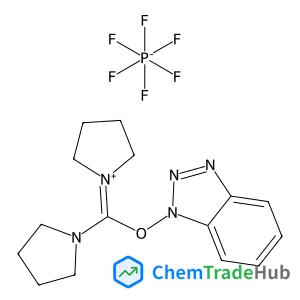
(1H-Benzotriazol-1-yloxy)(di-1-pyrrolidinyl)methylium hexafluorophosphate
CAS番号:
105379-24-6
分子式:
C15H21F6N5OP
おすすめサプライヤー





免責事項
このページに表示される学術雑誌情報は、参考および研究目的のみを目的としています。当社は雑誌出版社とは提携しておらず、投稿の取り扱いも行っておりません。出版に関するお問い合わせは、各雑誌出版社に直接ご連絡ください。
表示されている情報に誤りがある場合は、support@chemtradehub.com までご連絡ください。迅速に確認し、対応いたします。