













Substrate strain engineering: an efficient strategy to enhance the catalytic activity of SACs on waved graphene for e-NRR
文献情報
出版日
2020-05-14
DOI
10.1039/D0SE00518E
インパクトファクター
6.367
著者
Di Liu, Haoqiang Ai, Wan Tong Lou, Feifei Li, Kin Ho Lo
原文を見る
要旨
Ammonia is an important chemical in both industry and agriculture. The production of ammonia in a green way is challenging. The electrochemical nitrogen reduction reaction (e-NRR) has been proposed for this purpose. However, this technology is still far from practical applications due to low production, which is mainly because of inefficient electrocatalysts. In this work, we have designed a series of single-atom catalysts (SACs) anchored on waved graphene (wG) for efficient e-NRR and systematically investigated the effect of curvature on the catalytic performance based on first-principles calculations. Eight SACs (V, Cr, Mn, Fe, Co, Ni, Cu, and Pt) anchored on waved graphene with various curvatures (0–50%) have been studied. We found that the curvature strongly affected the formation, catalytic activity, and selectivity of SACs for e-NRR: (1) the formation possibility of SACs on wG was considerably enhanced on increasing the curvature. (2) The free energies for the rate-determining steps of SAC-V-wG, SAC-Mn-wG, and SAC-Cr-wG were less than 1.0 eV, leading to high catalytic activity for e-NRR. In particular, SAC-Mn-wG exhibited higher activity for e-NRR than SAC-Mn on flat graphene. (3) The three systems had higher selectivity for e-NRR than for HER, which could be further improved by compression. Thus, we conclude that SAC-Mn-wG is the best SAC on wG for e-NRR because of its easy fabrication, good catalytic performance and high selectivity. We believe that our findings can provide new insights in reported experimental results and guidance for the design of novel SACs with high performance for e-NRR.
関連文献
Organic–inorganic nanohybrids based on an AIE luminogen-functional polymer and CdTe/ZnS QDs: morphologies, optical properties, and applications
Bingfeng Shi, Jianhua Lü, Ying Liu, Yang Xiao, Changli Lü
2021-06-02
Paper
DOI: 10.1039/D1PY00308A
Correction: Synthesis and structural characterization of bio-based bis(cyclic carbonate)s for the preparation of non-isocyanate polyurethanes
Kamila Błażek, Hynek Beneš, Zuzana Walterová, Sabina Abbrent, Arantxa Eceiza, Tamara Calvo-Correas, Janusz Datta
2021-03-31
Correction
DOI: 10.1039/D1PY90040D
Amphiphilic poly(ether urethanes) carrying associative terpyridine side groups with controlled spacing
Katharina Breul, Sebastian Seiffert
2021-03-23
Paper
DOI: 10.1039/D1PY00121C
The synthesis of thermoresponsive POSS-based eight-arm star poly(N-isopropylacrylamide): A comparison between Z-RAFT and R-RAFT strategies
Bo Pang, Rui Liu, Guang Han, Wei Wang
2021-03-02
Paper
DOI: 10.1039/D1PY00087J
Nucleobase-monofunctionalized supramolecular poly(l-lactide): controlled synthesis, competitive crystallization, and structural organization
Xing Li, Lingling Ni, Chenxuan Sun, Wenqing Xu
2021-05-26
Paper
DOI: 10.1039/D1PY00288K
Polymerizability of exomethylene monomers based on adamantyl frameworks
Raita Goseki, Shogo Miyai, Satoshi Uchida, Takashi Ishizone
2021-06-02
Paper
DOI: 10.1039/D1PY00500F
Towards scalable, low dispersity, and dimensionally tunable 2D platelets using living crystallization-driven self-assembly
Charlotte E. Ellis, Tomoya Fukui, Cristina Cordoba, Arthur Blackburn, Ian Manners
2021-05-27
Paper
DOI: 10.1039/D1PY00571E
こちらもおすすめ
化合物よくある質問
環戊烷-1,3-二甲酸甲酯はどのように合成されますか?
環戊烷-1,3-二甲酸甲酯は、環戊烷と塩酸によるヒンデンブルク反応を経由して合成されます。この反応では、環戊烷が塩酸と作用し、1,3-ジカルボキシ基が導入されま...
2435-36-1Dimethyl 1,3-cyclope...
化合物よくある質問
4-メトキシ-1,2,3-スチアゼ-3,5-ジオンとは何ですか?
4-メトキシ-1,2,3-スチアゼ-3,5-ジオンは、CAS番号107843-77-6の化合物で、(E)-ベンジル3-(3,4-ジヒドロキシフェニル) acry...
107843-77-6(E)-Benzyl 3-(3,4-di...
化合物よくある質問
プロスタグランジンA2について「に適用される法規ガイドラインは何ですか?'
プロスタグランジンA2 (CAS番号: 41691-92-3) は、化学物質の安全管理に関する規制として、GHS (危険物質の国際的ハザード分類・ラベル付けシス...
41691-92-316,16-DIMETHYL PROST...
化合物よくある質問
4-アミノ-1-ナフタレン sulfonic 酸についての物理化学的性質は何ですか?
4-アミノ-1-ナフタレン sulfonic 酸のCAS番号は84-86-6です。この化合物は結晶性で、分子量は212.15 g/molです。アルコールや水など...
84-86-64-Amino-1-naphthalen...
化合物よくある質問
N-GlcNAc-生物素を取り扱う際の実験室安全事項は何ですか?
N-GlcNAc-生物素は吸収性があり、皮膚や目への接触を避けることが重要です。PPE(個体保護具)は使用し、ドラフトチャンバーは必要に応じて使用します。漏洩時...
1272755-69-72-Acetamido-2-deoxy-...
化合物よくある質問
3-アミノメチルフローラノピペリジン-1-カルボニル酸テルブチルエステルとは何ですか?
CAS番号1209781-11-2の3-アミノメチルフローラノピペリジン-1-カルボニル酸テルブチルエステルは、有機化合物の一種で、化学式はC10H17FNO3...
1209781-11-22-Methyl-2-propanyl ...
化合物よくある質問
6-溴-1-甲基-1H-ベンゾ[d][1,2,3]三氮唑はどのように合成されますか?
6- bromo-1-methyl-1H-benzotriazoleは、ブロモフリオリンと1-メチル-1H-ベンゾ[d][1,2,3]三氮唑の反応により合成され...
944718-32-56-Bromo-1-methyl-1H-...
化合物よくある質問
4-硫代尿苷はどのように合成されますか?
4-硫代尿苷は、尿素とD-リボシルヒドロキシアルデヒドを用いてスルホン化反応を経て合成されます。通常は塩酸ヒドロキシチオニルスルホン酸などの触媒を使用し、選択性...
6741-73-71-(4-thio-beta-D-rib...
化合物よくある質問
ブレインナトリユリックペプチド32ラットとは何ですか?
ブレインナトリユリックペプチド32ラット(CAS番号: 133448-20-1)は、心臓で作られるホルモンの一つで、心不全の診断や予後評価に使用されます。
133448-20-1Brain Natriuretic Pe...
化合物よくある質問
1-(3-氮杂啶)-4-羟基哌啶双盐酸盐の物理化学的性質は何ですか?
CAS番号810680-60-5の1-(3-氮杂啶)-4-羟基哌啶双盐酸盐は、白色の結晶性粉末である。分子量は360.84 g/molで、水に溶けやすい。反応活...
810680-60-51-(3-Azetidinyl)-4-p...
掲載誌
おすすめ化合物
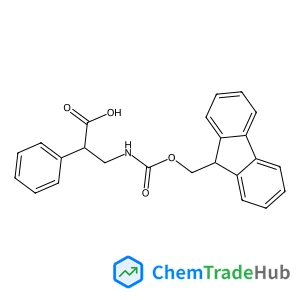
(S)-3-((((9H-Fluoren-9-yl)methoxy)carbonyl)amino)-2-phenylpropanoic acid
CAS番号:
1217663-60-9
分子式:
C24H21NO4
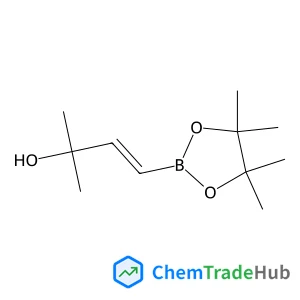
(E)-2-methyl-4-(4,4,5,5-tetramethyl-1,3,2-dioxaborolan-2-yl)but-3-en-2-ol
CAS番号:
581802-26-8
分子式:
C11H21BO3
おすすめサプライヤー




免責事項
このページに表示される学術雑誌情報は、参考および研究目的のみを目的としています。当社は雑誌出版社とは提携しておらず、投稿の取り扱いも行っておりません。出版に関するお問い合わせは、各雑誌出版社に直接ご連絡ください。
表示されている情報に誤りがある場合は、support@chemtradehub.com までご連絡ください。迅速に確認し、対応いたします。