













Amino-functionalized MOF derived porous Fe3O4/N-doped C encapsulated within a graphene network by self-assembling for enhanced Li-ion storage
文献情報
出版日
2020-04-30
DOI
10.1039/D0SE00112K
インパクトファクター
6.367
著者
Weijuan Wang, Daming Chen, Hui Xu, Genxi Yu, Shangqi Sun, Wei Zhang, Jian Chen
原文を見る
要旨
Fe3O4 is regarded as one of the most promising anode materials for next generation lithium ion batteries. The main issues of the Fe3O4 anodes are the severe pulverization and instability of the solid-electrolyte interphase (SEI) layer caused by the large volume change during the charge/discharge processes, as well as poor electrical conductivity. In this study, graphene-wrapped porous Fe3O4/N-doped C frameworks that were synthesized by a facial MOF-derived strategy coupled with an electrostatic interaction induced self-assembly process are reported for enhanced lithium ion storage. In the resulting architecture, integrating porous Fe3O4/N-doped C frameworks into graphene with an encapsulated structure effectively prevents the structural degradation and facilitates the formation of a stable SEI layer during the cycles. Moreover, benefiting from the highly conductive continuous graphene network and hierarchical porous structure, the electron conduction and lithium ion diffusion of the electrode are greatly enhanced. In virtue of the unique structure engineering, the as-built electrode exhibits high reversible capacity (764 mA h g−1 after 100 cycles at 0.2 A g−1), excellent rate capability (370 mA h g−1 at 8.0 A g−1) and enhanced cycling stability (441 mA h g−1 after 800 cycles at 2.0 A g−1).
関連文献
Toughened PLA-b-PCL-b-PLA triblock copolymer based biomaterials: effect of self-assembled nanostructure and stereocomplexation on the mechanical properties
Neha Mulchandani, Kazunari Masutani, Sachin Kumar, Hideki Yamane, Yoshiharu Kimura, Vimal Katiyar
2021-06-18
Paper
DOI: 10.1039/D1PY00429H
RAFT polymerisation of trifluoroethylene: the importance of understanding reverse additions
Marc Guerre, Cédric Totée, Gilles Silly, Olinda Gimello, Bruno Améduri, Jean-François Tahon, Rinaldo Poli, Sophie Barrau, Vincent Ladmiral
2021-03-15
Paper
DOI: 10.1039/D0PY01754J
Modeling ultrasound-induced molecular weight decrease of polymers with multiple scissile azo-mechanophores
Mathieu A. Ayer, Cheyenne H. Liu, Christoph Weder
2021-06-22
Paper
DOI: 10.1039/D1PY00420D
Homo- and co-polymerisation of di(propylene glycol) methyl ether methacrylate – a new monomer
Anna P. Constantinou, Georgios Patias, Birsen Somuncuoğlu, Toby Brock, Daniel W. Lester, David M. Haddleton, Theoni K. Georgiou
2021-05-12
Paper
DOI: 10.1039/D1PY00444A
The synergistic effect of rigid and flexible substituents on insertion polymerization with α-diimine nickel and palladium catalysts
Zijuan Hai, Zhou Lu, Shuaikang Li, Zhong-Yan Cao, Shengyu Dai
2021-07-30
Paper
DOI: 10.1039/D1PY00812A
A pillar[5]arene-based 3D polymer network for efficient iodine capture in aqueous solution
Jiajun Cao, Huangtianzhi Zhu, Liqing Shangguan, Yuezhou Liu, Peiren Liu, Qi Li, Yitao Wu
2021-05-27
Communication
DOI: 10.1039/D1PY00535A
こちらもおすすめ
化合物よくある質問
環戊烷-1,3-二甲酸甲酯はどのように合成されますか?
環戊烷-1,3-二甲酸甲酯は、環戊烷と塩酸によるヒンデンブルク反応を経由して合成されます。この反応では、環戊烷が塩酸と作用し、1,3-ジカルボキシ基が導入されま...
2435-36-1Dimethyl 1,3-cyclope...
化合物よくある質問
4-メトキシ-1,2,3-スチアゼ-3,5-ジオンとは何ですか?
4-メトキシ-1,2,3-スチアゼ-3,5-ジオンは、CAS番号107843-77-6の化合物で、(E)-ベンジル3-(3,4-ジヒドロキシフェニル) acry...
107843-77-6(E)-Benzyl 3-(3,4-di...
化合物よくある質問
プロスタグランジンA2について「に適用される法規ガイドラインは何ですか?'
プロスタグランジンA2 (CAS番号: 41691-92-3) は、化学物質の安全管理に関する規制として、GHS (危険物質の国際的ハザード分類・ラベル付けシス...
41691-92-316,16-DIMETHYL PROST...
化合物よくある質問
4-アミノ-1-ナフタレン sulfonic 酸についての物理化学的性質は何ですか?
4-アミノ-1-ナフタレン sulfonic 酸のCAS番号は84-86-6です。この化合物は結晶性で、分子量は212.15 g/molです。アルコールや水など...
84-86-64-Amino-1-naphthalen...
化合物よくある質問
N-GlcNAc-生物素を取り扱う際の実験室安全事項は何ですか?
N-GlcNAc-生物素は吸収性があり、皮膚や目への接触を避けることが重要です。PPE(個体保護具)は使用し、ドラフトチャンバーは必要に応じて使用します。漏洩時...
1272755-69-72-Acetamido-2-deoxy-...
化合物よくある質問
3-アミノメチルフローラノピペリジン-1-カルボニル酸テルブチルエステルとは何ですか?
CAS番号1209781-11-2の3-アミノメチルフローラノピペリジン-1-カルボニル酸テルブチルエステルは、有機化合物の一種で、化学式はC10H17FNO3...
1209781-11-22-Methyl-2-propanyl ...
化合物よくある質問
6-溴-1-甲基-1H-ベンゾ[d][1,2,3]三氮唑はどのように合成されますか?
6- bromo-1-methyl-1H-benzotriazoleは、ブロモフリオリンと1-メチル-1H-ベンゾ[d][1,2,3]三氮唑の反応により合成され...
944718-32-56-Bromo-1-methyl-1H-...
化合物よくある質問
4-硫代尿苷はどのように合成されますか?
4-硫代尿苷は、尿素とD-リボシルヒドロキシアルデヒドを用いてスルホン化反応を経て合成されます。通常は塩酸ヒドロキシチオニルスルホン酸などの触媒を使用し、選択性...
6741-73-71-(4-thio-beta-D-rib...
化合物よくある質問
ブレインナトリユリックペプチド32ラットとは何ですか?
ブレインナトリユリックペプチド32ラット(CAS番号: 133448-20-1)は、心臓で作られるホルモンの一つで、心不全の診断や予後評価に使用されます。
133448-20-1Brain Natriuretic Pe...
化合物よくある質問
1-(3-氮杂啶)-4-羟基哌啶双盐酸盐の物理化学的性質は何ですか?
CAS番号810680-60-5の1-(3-氮杂啶)-4-羟基哌啶双盐酸盐は、白色の結晶性粉末である。分子量は360.84 g/molで、水に溶けやすい。反応活...
810680-60-51-(3-Azetidinyl)-4-p...
掲載誌
おすすめ化合物
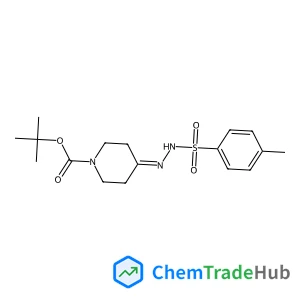
tert-Butyl 4-(2-(p-Tolylsulfonyl)hydrazono)piperidine-1-carboxylate
CAS番号:
1046478-89-0
分子式:
C17H25N3O4S
![(2S)-2-{[(9H-Fluoren-9-ylmethoxy)carbonyl]amino}-4-(methylselanyl)butanoic acid structure](https://static.chemtradehub.com/structs/121/1217852-49-7-f252.webp "(2S)-2-{[(9H-Fluoren-9-ylmethoxy)carbonyl]amino}-4-(methylselanyl)butanoic acid structure")
(2S)-2-{[(9H-Fluoren-9-ylmethoxy)carbonyl]amino}-4-(methylselanyl)butanoic acid
CAS番号:
1217852-49-7
分子式:
C20H21NO4Se
おすすめサプライヤー




免責事項
このページに表示される学術雑誌情報は、参考および研究目的のみを目的としています。当社は雑誌出版社とは提携しておらず、投稿の取り扱いも行っておりません。出版に関するお問い合わせは、各雑誌出版社に直接ご連絡ください。
表示されている情報に誤りがある場合は、support@chemtradehub.com までご連絡ください。迅速に確認し、対応いたします。