













Cavity-based applications of metallo-supramolecular coordination cages (MSCCs)
文献情報
出版日
2020-07-20
DOI
10.1039/D0QO00681E
インパクトファクター
5.281
著者
Sarita Yadav, Palanisamy Kannan, Guanyinsheng Qiu
原文を見る
要旨
The microenvironment within self-assembled supramolecular coordination cages (SCCs) inaugurates a new phase of chemistry other than the conventional solid, liquid and gaseous phases. The rational design and ease of synthesis of self-assembled architectures have received tremendous attention mainly in the field of supramolecular chemistry. The structural transition from 2-D metallacycles to 3-D metallacages has led to better encapsulation and enhanced cavity effects, like restricted substrate motion, desolvation of the substrate and covalent binding of the transition state etc. Metal-mediated self-assemblies, principally known as metallo-supramolecular coordination cages (MSCCs), form a separate class of SCCs with unique chemical phenomena inside the cavities. The aesthetic structural diversity of MSCCs obtained from the rational choice of metal knots and organic linkers renders designable and programmable architectures. This review presents cavity-based applications of these MSCCs, such as molecular recognition and separation, stabilization of reactive species by encapsulation, as drug-delivery systems and as “molecular flasks” to foster reactions with unprecedented results. The objective of this review is to inspire and pave the way for researchers working in this field to design more advanced MSCCs and gain deep insight into cavity effects.
関連文献
What will freestanding borophene nanoribbons look like? An analysis of their possible structures, magnetism and transport properties
A. García-Fuente, J. Carrete, A. Vega, L. J. Gallego
2016-11-29
Paper
DOI: 10.1039/C6CP07432D
Comment on “trans-1,2-Disiloxybenzocyclobutene, an adequate partner for the auto-oxidation: EPR/spin trapping and theoretical studies” by J. Drujon et al., Phys. Chem. Chem. Phys., 2014, 16, 7513
Hans-Gert Korth, Peter Mulder, Thomas Paul
2016-12-21
Comment
DOI: 10.1039/C6CP04187F
Observation of partial reduction of manganese in the lithium rich layered oxides, 0.4Li2MnO3–0.6LiNi1/3Co1/3Mn1/3O2, during the first charge
Hyung Cheoul Shim, Donghan Kim, Dongwook Shin, Seungmin Hyun, Chang-Su Woo, Taehwan Yu, Jae-Pyoung Ahn
2016-12-02
Paper
DOI: 10.1039/C6CP07574F
Dynamic phase change and local structures in IL-containing mixtures: classical MD simulations and experiments
Yang Wu, Xia Wang, Qiaozhen Liu, Dawei Fang, Xuefei Jiang, Wei Guan
2016-12-16
Paper
DOI: 10.1039/C6CP06300D
Gold-supported two-dimensional cobalt oxyhydroxide (CoOOH) and multilayer cobalt oxide islands
Jakob Fester, Alex Walton, Zheshen Li, Jeppe V. Lauritsen
2016-12-21
Paper
DOI: 10.1039/C6CP07901F
Water-tunable solvatochromic and nanoaggregate fluorescence: dual colour visualisation and quantification of trace water in tetrahydrofuran
Masaru Tanioka, Atsuya Muranaka, Yoshinao Shirasaki, Yousuke Ooyama, Masashi Ueda
2016-11-11
Paper
DOI: 10.1039/C6CP06808A
Stability of 2′,3′ and 3′,5′ cyclic nucleotides in formamide and in water: a theoretical insight into the factors controlling the accumulation of nucleic acid building blocks in a prebiotic pool
Giuseppe Cassone, Franz Saija, Ernesto Di Mauro, A. Marco Saitta, Judit E. Šponer
2016-12-05
Paper
DOI: 10.1039/C6CP07993H
Luminophores of tunable colors from ternary Ag–In–S and quaternary Ag–In–Zn–S nanocrystals covering the visible to near-infrared spectral range
Grzegorz Gabka, Piotr Bujak, Kamil Kotwica, Andrzej Ostrowski, Wojciech Lisowski, Janusz W. Sobczak, Adam Pron
2016-12-02
Paper
DOI: 10.1039/C6CP07008F
Molecular qubits based on potentially nuclear-spin-free nickel ions
K. Bader, S. H. Schlindwein, D. Gudat
2016-12-21
Paper
DOI: 10.1039/C6CP08161D
Freestanding MoO2/Mo2C imbedded carbon fibers for Li-ion batteries
Hongqin Li, Haijun Ye, Zheng Xu, Chuanyi Wang, Jiao Yin
2016-12-15
Paper
DOI: 10.1039/C6CP07569J
こちらもおすすめ
化合物よくある質問
4'-ブロモビフェニル-3-メトークシーディ.ActionBarはどのように保存すればよいですか?
4'-ブロモビフェニル-3-メトークシーディ.ActionBarは、冷暗所で、直射日光を避け、密栓の容器に保存し、遠隔場所に保管してください。温度は常温(0〜2...
149506-25-24'-Bromo-biphenyl-3-...
2947-60-6(3-Methylphenyl)acet...
化合物よくある質問
2-異丙基フェニルヒドラジン塩酸塩とは何ですか?
2-異丙基フェニルヒドラジン塩酸塩は、CAS番号58928-82-8を有する化合物で、構造式はC11H14N2HClです。これは塩基性化合物であり、水に溶けやす...
58928-82-8(2-Isopropylphenyl)h...
化合物よくある質問
5-(4-クロロフェニル)-4H-1,2,4-三氮唑-3-アミンを取り扱う際の実験室安全事項は何ですか?
5-(4-クロロフェニル)-4H-1,2,4-三氮唑-3-アミンは取り扱いに注意が必要です。PPEとして防塵マスク、ゴーグル、手袋を使用し、ドラフトチャンバーを...
98554-00-85-(4-Chlorophenyl)-1...
化合物よくある質問
去甲基雷贝拉唑硫醚はどのように合成されますか?
去甲基雷贝拉唑硫醚は、ベンジミダゾール硫化物と3-メチル-4-ピリジノールの反応によって合成されます。具体的には、2-チオキシドベンジミダゾールと3-メチル-4...
117976-91-73-({2-[(1H-Benzimida...
化合物よくある質問
2-ブロモ-5-フロロ-N-(2-フェノールメチル)ベンゼンウレアは安全ですか?
2-ブロモ-5-フロロ-N-(2-フェノールメチル)ベンゼンウレアは、毒性や刺激性の実験データに基づき、適切な取扱いと防護措置を講じることで安全に使用できます。...
923722-86-52-Bromo-5-fluoro-N-(...
化合物よくある質問
対甲苯磺酸酯-四聚乙二醇-四氢吡喃醚の物理化学的性質は何ですか?
対甲苯磺酸酯-四聚乙二醇-四氢吡喃醚のCAS番号は86259-89-4です。この化合物は無色の液体で、分子量は約724.8です。高濃度では溶血性が報告されており...
86259-89-42-(2-{2-[2-(Tetrahyd...
化合物よくある質問
2-(3-(二氟甲基)-4-氟苯基)-4,4,5,5-四甲基-1,3,2-二噁硼戊環はどのように保存すればよいですか?
2-(3-(二氟甲基)-4-氟苯基)-4,4,5,5-四甲基-1,3,2-二噁硼戊環は、室温で暗い場所に保管し、直射日光から遠ざけ、容器は密閉状態で保存してくだ...
445303-65-12-[3-(difluoromethyl...
化合物よくある質問
6-アミノ-5-クロロ-2-シクロプロピルピリミジンカルボン酸の代替品はありますか?
この化合物の代替品には、ピロリミジン酸やその類似物、またピロリミジンカルボン酸の他の異性体があります。これらの代替品は、特定の化学反応や目的に応じて選択すること...
858956-08-86-Amino-5-chloro-2-c...
化合物よくある質問
5-クロロベンゾ[1,3]二オキセイン-4-アミンに適用される法規ガイドラインは何ですか?
5-クロロベンゾ[1,3]二オキセイン-4-アミンはCAS番号379228-45-2に該当します。この化合物はGHS分類でH314(接触により急性毒性がある)と...
379228-45-25-Chloro-1,3-benzodi...
掲載誌
Organic Chemistry Frontiers

CiteScore:
7.8
自己引用率:
8.7%
年間論文数:
724
Organic Chemistry Frontiers publishes high-quality research from across organic chemistry. Emphases are placed on studies that make significant contributions to the field of organic chemistry by reporting either new or significantly improved protocols or methodologies. Topics include, but are not limited to the following: Organic synthesis Development of synthetic methodologies Catalysis Natural products Functional organic materials Supramolecular and macromolecular chemistry Physical and computational organic chemistry
おすすめ化合物
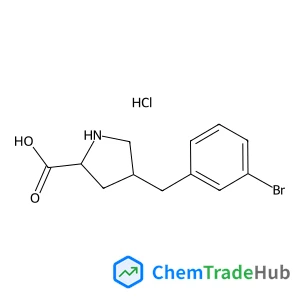
(2S,4R)-4-(3-Bromobenzyl)pyrrolidine-2-carboxylic acid hydrochloride
CAS番号:
1049734-10-2
分子式:
C12H15BrClNO2
おすすめサプライヤー




免責事項
このページに表示される学術雑誌情報は、参考および研究目的のみを目的としています。当社は雑誌出版社とは提携しておらず、投稿の取り扱いも行っておりません。出版に関するお問い合わせは、各雑誌出版社に直接ご連絡ください。
表示されている情報に誤りがある場合は、support@chemtradehub.com までご連絡ください。迅速に確認し、対応いたします。