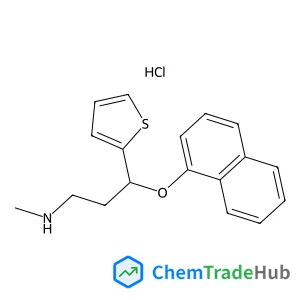
N-Methyl-3-(1-naphthyloxy)-3-(2-thienyl)-1-propanamine hydrochloride (1:1)
CAS番号:
1188266-11-6
分子式:
C18H20ClNOS
Jens C. Markwart, Alexander Battig, Tobias Urbaniak, Katharina Haag, Katharina Koschek, Bernhard Schartel, Frederik R. Wurm
Recycling of crosslinked fiber-reinforced polymers is difficult. Moreover, as they are often based on flammable resins, additional additives are needed. So-called “vitrimers” open the possibility of recycling and reprocessing and repairing with dynamically crosslinked chemistries. To date, vitrimer-based composites still need flame retardant additives, such as organophosphates. An additive-free vitrimer composite has not been reported. Herein, we synthesized an intrinsic flame-retardant vitrimer, relying on vinylogous polyurethanes containing covalently installed phosphonates as flame-retardant units and prepared glass-fiber-reinforced composites. We studied recycling and flame retardant properties and compared the data to phosphorus-free vitrimers and conventional epoxy resins (with and without additive flame retardant). Our phosphonate-based vitrimer proved in first tests, a flame retardant effect comparable to commercial flame retardant resins. The bending strength and bending modulus for the phosphorus-vitrimer glass fiber composites were comparable to glass fiber composites with permanently cross-linked epoxies. In summary, we were able to prove that the covalent installation of phosphonates into vitrimers allows the preparation of recyclable and intrinsic flame retardant composites that do not need flame retardant additives. We believe this concept can be expanded to other polymer networks and additives to generate recyclable and sustainable high-performance materials.
Guang Li, Liping Bai, Farong Tao, Aixia Deng, Liping Wang
DOI: 10.1039/C8AN01130C
Ya-Fei Tian, Cui-Fang Ning, Fang He, Bin-Cheng Yin
DOI: 10.1039/C8AN01041B
Ghazal Azarfar, Ebrahim Aboualizadeh, Nicholas M. Walter, Simona Ratti, Camilla Olivieri, Alessandra Norici, Michael Nasse, Achim Kohler, Mario Giordano
DOI: 10.1039/C8AN00093J
Arash Hanifi, Uday Palukuru, Cushla McGoverin, Michael Shockley, Eliot Frank, Alan Grodzinsky, Richard G. Spencer, Nancy Pleshko
DOI: 10.1039/C6AN02167K
Shuai-Liang Yang, Jiu-Nan Lu, Sai-Jun Zhang
DOI: 10.1039/C8AN00701B
Daojin Li, Zijun Bie, Fangfang Wang, Enhui Guo
DOI: 10.1039/C8AN01044G
G. R. Lloyd, J. Nallala, M. Isabelle, L. M. Almond, N. A. Shepherd, C. A. Kendall, A. C. Shore, N. Stone
DOI: 10.1039/C6AN01871H
Shaiju S. Nazeer, Rarinthorn Samrid, David Perez-Guaita, Parichat Prachaney, Kowit Chaisiwamongkol, Poungrat Pakdeechote, Bayden R. Wood
DOI: 10.1039/C6AN02074G
B. Bird, J. Rowlette
DOI: 10.1039/C6AN01916A
M. R. Siddique, A. V. Rutter, K. Wehbe, G. Cinque, G. Bellisola
DOI: 10.1039/C6AN01914E
3-イチチルビフェニルは、ビフェニルとイチプロピオニトリルを回収率約90%で反応させて合成されます。触媒は通常、亜リチウムホウ素を用います。
8-溴-5-三氟甲基喹啉は、5-トリフルオロメチル-2-メチル-1,3-ベンゼンジオールをブロモエタノールと反応させて生成します。この反応は塩基性条件下で行われ...
ジメチル4-(4,4,5,5-テトラメチル-1,3,2-ドioxaborolan-2-基)-2,6-ピリジンジカルボイル酸フェニルアミニドの代替品としては、4-...
N-(3,5-ヘキサクロロ-4-ピリドインイル)-8-メチオキシ-5-キノリンカーボン酸の市場動向は、主に産業用途での需要により影響を受けます。研究トレンドとし...
イソステアロイルグリセリルは一般的に安全性が高いとされていますが、過度な使用や個人差により皮�owsん炎などの反応が起こる可能性があります。使用前に医師に相談す...
1-(二苯甲基)-3,3-二氟-氮杂环丁烷の市場動向は、医薬品や合成化学の研究分野で注目を集めています。新興研究は、該当化合物の合成改良と生体内での作用メカニズ...
3-チオフェンスチオールのCAS番号は7774-73-4です。結晶性の白色粉末で、分子量は122.17です。この化合物は水に微溶解し、エタノールやジクロロメタン...
2-Methyl-2-propanyl (2S)-2-(aminomethyl)-1-piperidinecarboxylateは一定の安全性基準を満たしていま...
CAS番号1316822-90-8の化合物は安全性に関しては評価が不足していますが、一般的には生物学的に活性な物質であり、取り扱いには適切な安全防護措置が必要で...
Tert-butyl 2-(2-羟基乙基)哌嗪-1-羧酸は、冷暗所で保存し、直射日光から遠ざけてください。容器は密閉し、高湿度や高温を避けて保管してください。

Polymer Chemistry welcomes submissions in all areas of polymer science that have a strong focus on macromolecular chemistry. Manuscripts may cover a broad range of fields, yet no direct application focus is required.
![1-[6-(1H-Imidazol-1-yl)-3-pyridinyl]methanamine structure](https://static.chemtradehub.com/structs/914/914637-08-4-8825.webp "1-[6-(1H-Imidazol-1-yl)-3-pyridinyl]methanamine structure")
![1-oxaspiro[4.4]nonan-6-one structure](https://static.chemtradehub.com/structs/134/134179-01-4-e051.webp "1-oxaspiro[4.4]nonan-6-one structure")