![[2',6'-bis(propan-2-yloxy)-[1,1'-biphenyl]-3-yl]dicyclohexylphosphane structure](https://static.chemtradehub.com/structs/787/787618-22-8-dda2.webp "[2',6'-bis(propan-2-yloxy)-[1,1'-biphenyl]-3-yl]dicyclohexylphosphane structure")
[2',6'-bis(propan-2-yloxy)-[1,1'-biphenyl]-3-yl]dicyclohexylphosphane
CAS番号:
787618-22-8
分子式:
C30H43O2P
A graphical abstract is available for this content
Rongjin Huang, Wei Wang, Zheshuai Lin, Jiangtao Li, Laifeng Li
DOI: 10.1039/C6CP03221D
Mattanjah S. de Vries
DOI: 10.1039/C6CP90169G
Chao-Ching Chiang, Chien-You Su, An-Chih Yang, Ting-Yu Wang, Wen-Ya Lee, Chi-Chung Hua, Dun-Yen Kang
DOI: 10.1039/C6CP04166C
B. J. Cafferty, S. C. Karunakaran, G. B. Schuster, N. V. Hud
DOI: 10.1039/C6CP03047E
Luca Belmonte, Daniele Rossetto, Michele Forlin, Simone Scintilla, Claudia Bonfio, Sheref S. Mansy
DOI: 10.1039/C6CP00608F
B. Carlotti, E. Benassi, A. Cesaretti, C. G. Fortuna, A. Spalletti, V. Barone, F. Elisei
DOI: 10.1039/C5CP03207E
Jing Chen, Songmei Li, Juan Du, Bo Wang, Shiming Meng, Jianhua Liu, Mei Yu
DOI: 10.1039/C6CP02302A
Bolong Huang, Jianfu Li, Zhenyi Jiang, Bo Wang, Zhigang Wang, Rui-Qin Zhang
DOI: 10.1039/C5CP02598B
Annette F. Taylor, Mark R. Tinsley, Kenneth Showalter
DOI: 10.1039/C5CP01964H
この化合物はCAS番号1142209-81-1であり、GHS分類では corrosive (腐食性物質) と classified (分類物質) として指定され...
2,2-二氟-1,3-ベンゾジオキサン-5-カルボキシlic酸は、CAS番号656-46-2の化合物で、化学式はC8H4F2O4です。この化合物は白色の結晶性粉...
8-氯-4-色原酮(CAS番号: 49701-11-3)の代替品には、他の色原酮類似物や、構造が似ている化合物があります。例えば、8-メチル-4-色原酮や、他の...
エチル6,6-ジメチル-4,5,6,7-テトラヒドロ-1H-インドアゼー-3-カルボキシレートは、CAS番号1233243-56-5を有する化合物です。これは有...
4-叔丁基-6-氯-嘧啶はCAS番号3435-24-3で、GHS分類では毒性物質とみなし、GHSの危険性分類が適用されます。REACH規則では登録が必要で、Eu...
維库溴铵杂质Bは、アンドロステンデンから始まり、一連の合成反応、包括的な選択性と高い収率で合成されます。具体的には、ブロミド化、酸化、ジマーゼ反応、アミド化など...
CAS番号350017-04-8の2-(4-氟苄基)-吡咯烷は、結晶性の白色粉末です。分子量は199.17 g/molで、水に溶けにくいです。化学反応では比較的...
3-喹啉甲醛(2-チロール-8-エチル)は一定の毒性を持つため、取扱には注意が必要です。使用する際は適切な防護具を着用し、密閉容器で保管・搬送し、直接的な接触を...
エチル3-(ヒドロキシメチル)-1H-ピロール-2-カルボキシレートは、室温(25℃)以下で保存し、直射日光を避け、乾燥した環境で保管することが推奨されます。ま...
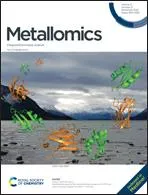
Metallomics publishes cutting-edge investigations aimed at elucidating the identification, distribution, dynamics, role and impact of metals and metalloids in biological systems. Studies that address the “what, where, when, how and why” of these inorganic elements in cells, tissues, organisms, and various environmental niches are welcome, especially those employing multidisciplinary approaches drawn from the analytical, bioinorganic, medicinal, environmental, biophysical, cell biology, plant biology and chemical biology communities. We are particularly interested in articles that enhance our chemical and/or physical understanding of the molecular mechanisms of metal-dependent life processes, and those that probe the common space between metallomics and other ‘omics approaches to uncover new insights into biological processes. Metallomics seeks to position itself at the forefront of those advances in analytical chemistry destined to clarify the enormous complexity of biological systems. As such, we particularly welcome those papers that outline cutting-edge analytical technologies, e.g., in the development and application of powerful new imaging, spectroscopic and mass spectrometric modalities. Work that describes new insights into metal speciation, trafficking and dynamics in complex systems or as a function of microenvironment are also strongly encouraged. Studies that examine the interconnectivity of metal-dependent processes with systems level responses relevant to organismal health or disease are also strongly encouraged, for example those that probe the effect of chemical exposure on metal homeostasis or the impact of metal-based drugs on cellular processes.