












![Benzyl 2-{[(tert-butoxy)carbonyl]amino}acetate structure](https://static.chemtradehub.com/structs/542/54244-69-8-6399.webp "Benzyl 2-{[(tert-butoxy)carbonyl]amino}acetate structure")
The modulatory role of sulfated and non-sulfated small molecule heparan sulfate-glycomimetics in endothelial dysfunction: absolute structural clarification, molecular docking and simulated dynamics, SAR analyses and ADMET studies
文献情報
出版日
2021-04-23
DOI
10.1039/D0MD00366B
インパクトファクター
0
著者
Daniel M. Gill, Sabrina A. Shamir, Fiona L. Wilkinson, M. Yvonne Alexander, Marinonio L. Cornelio, Alan M. Jones
原文を見る
要旨
The conceptual technology of small molecule glycomimetics, exemplified by compounds C1–4, has shown promising protective effects against lipid-induced endothelial dysfunction, restorative effects on diabetic endothelial colony forming cells, and preventative effects on downstream vascular calcification amongst other important in vitro and ex vivo studies. We report the optimised synthesis of an array of 17 small molecule glycomimetics, including the regio-, enantio- and diastereo-meric sulfated scaffolds of a hit structure along with novel desulfated examples. For the first time, the absolute stereochemical configurations of C1–4 have been clarified based on an identified and consistent anomaly with the Sharpless asymmetric dihydroxylation reaction. We have investigated the role and importance of sulfation pattern, location, regioisomers, and spatial orientation of distal sulfate groups on the modulation of endothelial dysfunction through their interaction with hepatocyte growth factor (HGF). In silico studies demonstrated the key interactions the persulfated glycomimetics make with HGF and revealed the importance of both sulfate density and positioning (both point chirality and vector) to biological activity. In vitro biological data of the most efficient binding motifs, along with desulfated comparators, support the modulatory effects of sulfated small molecule glycomimetics in the downstream signaling cascade of endothelial dysfunction. In vitro absorption, distribution, metabolism, elimination and toxicity (ADMET) data demonstrate the glycomimetic approach to be a promising approach for hit-to-lead studies.
関連文献
Competitive adsorption on gold nanoparticles for human papillomavirus 16 L1 protein detection by LDI-MS
Jing Han, Zhihua Wang, Lihui Yin, Wei Zhang, You Peng, Zongxiu Nie
2019-09-29
Paper
DOI: 10.1039/C9AN01612K
Styrylpyridine salts-based red emissive two-photon turn-on probe for imaging the plasma membrane in living cells and tissues
Lifang Guo, Ruoyao Zhang, Yuming Sun, Minggang Tian, Ge Zhang, Ruiqing Feng, Xuechen Li, Xiaoqiang Yu, Xiuquan He
2016-04-26
Communication
DOI: 10.1039/C6AN00147E
The origin of the band at around 730 cm−1 in the SERS spectra of bacteria: a stable isotope approach
Patrick Kubryk, Reinhard Niessner, Natalia P. Ivleva
2016-04-20
Communication
DOI: 10.1039/C6AN00306K
Rapid detection of synthetic cannabinoids in herbal highs using surface-enhanced Raman scattering produced by gold nanoparticle co-aggregation in a wet system
Hiroki Segawa, Takao Fukuoka, Tamitake Itoh, Yuichi Imai, Yuko T. Iwata, Tadashi Yamamuro, Kenji Kuwayama, Kenji Tsujikawa, Tatsuyuki Kanamori, Hiroyuki Inoue
2019-10-07
Paper
DOI: 10.1039/C9AN01512D
Green synthesis of up- and down-conversion photoluminescent carbon dots from coffee beans for Fe3+ detection and cell imaging
Wanyu Zhang, Lihua Jia, Rui Yang, Yu Zhang, Zhenlong Zhao
2019-10-28
Paper
DOI: 10.1039/C9AN01953G
Nano-analytical characterization of endogenous minerals in healthy placental tissue: mineral distribution, composition and ultrastructure
Elena Tsolaki, Louis Didierlaurent, Samuel Staubli, Robert Zboray, Antonia Neels, Dörthe Dietrich, Pius Manser, Lotus May Desbiolles, Sebastian Leschka, Simon Wildermuth, Sandro Lehner, Pascale Chavatte-Palmer, Wolfram Jochum, Peter Wick, Tina Bürki-Turnherr, Tina Fischer, René Hornung, Sergio Bertazzo
2019-10-02
Communication
DOI: 10.1039/C9AN01312A
A lysosome specific theranostic NO donor inhibits cancer cells by stimuli responsive molecular self-decomposition with an on-demand fluorescence pattern
Wuyang Hua, Xinyi Wang, Sinan Pei
2019-09-30
Paper
DOI: 10.1039/C9AN01746A
Enzymatic reaction-based nanopore detection of zinc ions
Golbarg Mohammadi Roozbahani, Youwen Zhang, Xiaohan Chen, Mona Hoseini Soflaee, Xiyun Guan
2019-10-18
Paper
DOI: 10.1039/C9AN01784D
Adaptive use of a personal glucose meter (PGM) for acute biotoxicity assessment based on the glucose consumption of microbes
Yuan Yu, Jie Shen, Jinfang Zhi
2016-03-23
Paper
DOI: 10.1039/C5AN02478A
Addressing the practicalities of anodic stripping voltammetry for heavy metal detection: a tutorial review
Julie V. Macpherson
2019-10-15
Tutorial Review
DOI: 10.1039/C9AN01437C
こちらもおすすめ
化合物よくある質問
カルボニル基が付いた5-氰基-1-{[(2-メチル-2-プロpanyl)オキシ]カーボンイル}1H-吲哚-2-イリド-2-ボリン酸はどのように保存すればよいですか?
カルボニル基が付いた5-氰基-1-{[(2-メチル-2-プロpanyl)オキシ]カーボンイル}1H-吲哚-2-イリド-2-ボリン酸は、直射日光を避けて室温(15...
475102-15-9(5-Cyano-1-{[(2-meth...
化合物よくある質問
tert-ブチル2-クロロメチルピリジン-3-基炭酸エステルの市場動向や研究トレンドはどうですか?
この化合物は合成化学分野において、特にピリジン化合物の合成や改良に用いられます。最近の研究では、ピリジン化合物の新規合成法や特性の改良が注目されています。市場動...
1203498-98-9tert-Butyl 2-chloro-...
化合物よくある質問
聚二季戊四醇六丙烯酸酯はどの業界で使用されていますか?
聚二季戊四醇六丙烯酸酯は、医薬品、ポリマー、センサー、半導体などの業界で広く使用されています。特にポリマー業界では硬化剤として、医薬分野では医療機器の製造に使用...
29570-58-93-(Acryloyloxy)-2-({...
化合物よくある質問
1-氯-5-硝基异喹啉の市場動向や研究トレンドはどうですか?
1-氯-5-硝基异喹啉は、薬理学や合成化学の研究分野で注目されています。市場動向としては、その生物学的な活性や合成可能性を評価する研究が増えています。また、代替...
58142-97-51-Chloro-5-nitroisoq...
化合物よくある質問
2-チロール-5-メチルスルフェニル-3-trifルオルメチルベンゼンはどのように合成されますか?
2-チロール-5-メチルスルフェニル-3-trifルオルメチルベンゼンは、トリフルオロメチル化反応と硫化反応を経て合成されます。通常、トリフルオロメチル化剤と硫...
957066-04-51-Chloro-4-(methylsu...
化合物よくある質問
p-トールイルマグネシウムブロミドの物理化学的性質は何ですか?
p-トールイルマグネシウムブロミドのCAS番号は4294-57-9です。この化合物は白色の結晶性粉末で、分子量は204.32です。溶剤中で良好に溶解しますが、水...
4294-57-9p-Tolylmagnesium bro...
化合物よくある質問
1-(5-甲基-2-硫化素基)プロパン-1-酮の市場動向や研究トレンドはどうですか?
1-(5-甲基-2-硫化素基)プロパン-1-酮の市場動向は、化学産業全体の需要に影響を受けますが、最近では pharmaceutical 分野での応用が注目され...
59303-13-81-(5-Methyl-2-thieny...
化合物よくある質問
十一碳烯酰甘氨酸を取り扱う際の実験室安全事項は何ですか?
十一碳烯酰甘氨酸は吸入や皮膚から吸収されることがあり、取り扱う際には防塵マスクと手袋を使用してください。ドラフトチャンバーを用いて漏洩を処理し、適切なSDS(S...
54301-26-7N-10-Undecenoylglyci...
化合物よくある質問
1H,1H-全氟-3,6-二氧杂葵-1-醇を取り扱う際の実験室安全事項は何ですか?
この化合物は吸入や皮膚吸収による毒性があるため、防塵マスク、ゴーグル、防護手袋を使用する必要があります。ドラフトチャンバーでの操作が必要です。漏洩時には即座に換...
152914-73-32,2-Difluoro-2-[1,1,...
化合物よくある質問
3-(4-(フルオロメチルオキシ)フェニル)-1,2,4-オキサジアゾール-5-カルボハイドライドは安全ですか?
安全性は化合物の使用方法によります。直接的な毒性は報告されていませんが、吸入や皮膚接触には注意が必要です。適切な防護服を着用し、換気を図ることを推奨します。
883028-82-83-(4-(Trifluorometho...
掲載誌
おすすめ化合物
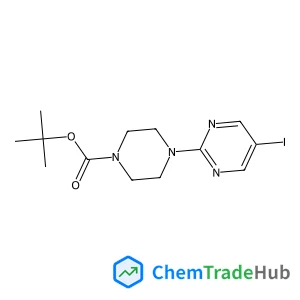
2-Methyl-2-propanyl 4-(5-iodo-2-pyrimidinyl)-1-piperazinecarboxylate
CAS番号:
1027616-32-5
分子式:
C13H19IN4O2
![2-Methyl-2-propanyl (2E)-5-chloro-2-[3-methoxy-4-(4-methyl-1H-imidazol-1-yl)benzylidene]pentanoate structure](https://static.chemtradehub.com/structs/122/1225232-42-7-ee03.webp "2-Methyl-2-propanyl (2E)-5-chloro-2-[3-methoxy-4-(4-methyl-1H-imidazol-1-yl)benzylidene]pentanoate structure")
おすすめサプライヤー




免責事項
このページに表示される学術雑誌情報は、参考および研究目的のみを目的としています。当社は雑誌出版社とは提携しておらず、投稿の取り扱いも行っておりません。出版に関するお問い合わせは、各雑誌出版社に直接ご連絡ください。
表示されている情報に誤りがある場合は、support@chemtradehub.com までご連絡ください。迅速に確認し、対応いたします。