












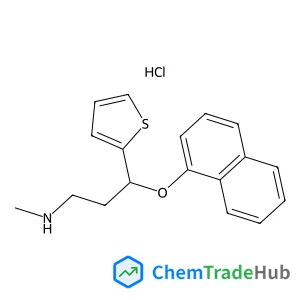
N-Methyl-3-(1-naphthyloxy)-3-(2-thienyl)-1-propanamine hydrochloride (1:1)
CAS番号:
1188266-11-6
分子式:
C18H20ClNOS
Christian Schwieger
How does a small change in the structure of a phospholipid affect its supramolecular assembly? In aqueous suspensions, the substitution of one ester linkage in DPPC (1,2-dipalmitoyl-sn-glycero-3-phosphocholine) by an ether linkage alters its phase behaviour completely. To unravel the effect of replacing a phospholipid's ester linkage by an ether linkage in lipid monolayers, we characterized pure monolayers of the model lipid DPPC and its sn-2 ether analogue PHPC (1-palmitoyl-2-O-hexadecyl-sn-glycero-3-phosphocholine) as well as mixtures of both by measurements of surface pressure–molecular area (π–Amol) isotherms. In addition, we used infrared reflection absorption spectroscopy (IRRAS) to study lipid condensation, lipid chain orientation, headgroup hydration, and lipid miscibility in all samples. Mixed monolayers consisting of DPPC and PHPC were studied further using epifluorescence microscopy. Our results indicate a strong influence of the sn-2 ether linkage on headgroup hydration and ordering effects in the regions of the apolar chains and the headgroups. Both effects could originate from changes in glycerol conformation. Furthermore, we observed a second plateau in the π–Amol isotherms of DPPC/PHPC mixtures and analysis of the mixed π–Amol isotherms reveals a non-ideal mixing behaviour of both lipids which may be caused by conformational differences in their headgroups.
Samiran Garain, Shrabanee Sen, Dipankar Mandal
DOI: 10.1039/C5CP01820J
Michael I. Cotterell, Bernard J. Mason, Thomas C. Preston, Andrew J. Orr-Ewing, Jonathan P. Reid
DOI: 10.1039/C5CP00252D
Richard J. Cooper, Sven Heiles, Evan R. Williams
DOI: 10.1039/C5CP01859E
Bikash Mandal, Pranab Sarkar
DOI: 10.1039/C5CP01359C
Youngil Park, Cheng-Yu Kuo, Young-Shin Park, Hsinhan Tsai, Jennifer S. Martinez, Andrew P. Shreve, Hsing-Lin Wang
DOI: 10.1039/C5CP01309G
Martin Wessig, Martin Spitzbarth, Malte Drescher, Rainer Winter, Sebastian Polarz
DOI: 10.1039/C5CP01369K
Yan Qian, Shaohua Lu, Erjun Kan, Ruifeng Lu, Kaiming Deng, Hui Wang, Yanming Ma
DOI: 10.1039/C5CP01601K
カルボニル基が付いた5-氰基-1-{[(2-メチル-2-プロpanyl)オキシ]カーボンイル}1H-吲哚-2-イリド-2-ボリン酸は、直射日光を避けて室温(15...
この化合物は合成化学分野において、特にピリジン化合物の合成や改良に用いられます。最近の研究では、ピリジン化合物の新規合成法や特性の改良が注目されています。市場動...
聚二季戊四醇六丙烯酸酯は、医薬品、ポリマー、センサー、半導体などの業界で広く使用されています。特にポリマー業界では硬化剤として、医薬分野では医療機器の製造に使用...
1-氯-5-硝基异喹啉は、薬理学や合成化学の研究分野で注目されています。市場動向としては、その生物学的な活性や合成可能性を評価する研究が増えています。また、代替...
2-チロール-5-メチルスルフェニル-3-trifルオルメチルベンゼンは、トリフルオロメチル化反応と硫化反応を経て合成されます。通常、トリフルオロメチル化剤と硫...
p-トールイルマグネシウムブロミドのCAS番号は4294-57-9です。この化合物は白色の結晶性粉末で、分子量は204.32です。溶剤中で良好に溶解しますが、水...
1-(5-甲基-2-硫化素基)プロパン-1-酮の市場動向は、化学産業全体の需要に影響を受けますが、最近では pharmaceutical 分野での応用が注目され...
十一碳烯酰甘氨酸は吸入や皮膚から吸収されることがあり、取り扱う際には防塵マスクと手袋を使用してください。ドラフトチャンバーを用いて漏洩を処理し、適切なSDS(S...
この化合物は吸入や皮膚吸収による毒性があるため、防塵マスク、ゴーグル、防護手袋を使用する必要があります。ドラフトチャンバーでの操作が必要です。漏洩時には即座に換...
安全性は化合物の使用方法によります。直接的な毒性は報告されていませんが、吸入や皮膚接触には注意が必要です。適切な防護服を着用し、換気を図ることを推奨します。

Physical Chemistry Chemical Physics (PCCP) is an international journal co-owned by 19 physical chemistry and physics societies from around the world. This journal publishes original, cutting-edge research in physical chemistry, chemical physics and biophysical chemistry. To be suitable for publication in PCCP, articles must include significant innovation and/or insight into physical chemistry; this is the most important criterion that reviewers and Editors will judge against when evaluating submissions. The journal has a broad scope and welcomes contributions spanning experiment, theory, computation and data science. Topical coverage includes spectroscopy, dynamics, kinetics, statistical mechanics, thermodynamics, electrochemistry, catalysis, surface science, quantum mechanics, quantum computing and machine learning. Interdisciplinary research areas such as polymers and soft matter, materials, nanoscience, energy, surfaces/interfaces, and biophysical chemistry are welcomed if they demonstrate significant innovation and/or insight into physical chemistry. Joined experimental/theoretical studies are particularly appreciated when complementary and based on up-to-date approaches.
![(2R,6S)-6-[(Benzyloxy)methyl]-4-{[(2-methyl-2-propanyl)oxy]carbonyl}-2-morpholinecarboxylic acid structure](https://static.chemtradehub.com/structs/109/1093085-91-6-3382.webp "(2R,6S)-6-[(Benzyloxy)methyl]-4-{[(2-methyl-2-propanyl)oxy]carbonyl}-2-morpholinecarboxylic acid structure")
![N-{15-[(2,5-Dioxo-1-pyrrolidinyl)oxy]-15-oxo-3,6,9,12-tetraoxapentadec-1-yl}-2-(2-propyn-1-yloxy)acetamide structure](https://static.chemtradehub.com/structs/210/2101206-92-0-2eb5.webp "N-{15-[(2,5-Dioxo-1-pyrrolidinyl)oxy]-15-oxo-3,6,9,12-tetraoxapentadec-1-yl}-2-(2-propyn-1-yloxy)acetamide structure")
![1-[6-(1H-Imidazol-1-yl)-3-pyridinyl]methanamine structure](https://static.chemtradehub.com/structs/914/914637-08-4-8825.webp "1-[6-(1H-Imidazol-1-yl)-3-pyridinyl]methanamine structure")




