












Theoretical study of the Coriolis effect in LiNa, LiK, and LiRb molecules
文献情報
出版日
2021-02-12
DOI
10.1039/D0CP06487D
インパクトファクター
3.676
著者
I. Majewska, R. Moszynski
原文を見る
要旨
The non-adiabatic electronic matrix elements, LΠΣ(R), that arise from the spin-conserving electron-rotational interactions between all mΣ+ and mΠ states, where multiplicity m = 1, 3, converging to the lowest three dissociation limits of Li-containing alkali diatomics, LiM (M = Na, K, Rb), were calculated ab initio up to large internuclear distances, R. The required electronic wavefunctions were obtained within the framework of the multi-reference configuration interaction treatment of the two-valence-electron problem constructed using small-core scalar-relativistic effective core potentials and l-independent core-polarization potentials. A least squares analysis of the ab initio functions at large internuclear distances in conjunction with long-range perturbation theory (LRPT) revealed three different asymptotic behaviors of the LΠΣ(R → +∞)-functions: const. + β[n]/Rn, characterized by n = −1, 3 and 6. The asymptotic coefficients β[n], extracted from the point-wise ab initio data, were found to be in agreement with their LRPT counterparts, which were evaluated analytically using the relevant atomic parameters. The mass dependence of the LΠΣ matrix elements was investigated analytically and numerically. To confirm the reliability of the LΠΣ(R)-functions and interatomic potentials at small and intermediate distances, the empirical q-factors available for the D1Π-states of all LiM molecules studied were compared with their theoretical counterparts derived from the present ab initio data.
関連文献
Experimental and first-principles study of guanine adsorption on ZnO clusters
V. L. Chandraboss, B. Karthikeyan, S. Senthilvelan
2014-09-22
Paper
DOI: 10.1039/C4CP03274H
Polymorphic transformations and optical properties of graphene-based Ag-doped titania nanostructures
Anand Kumar Tripathi, Promod Kumar, Balasubramaniyan R., Manish Kumar Singh, Jin Suk Chung, Seung Hyun Hur, Arvind Agarwal
2014-09-17
Paper
DOI: 10.1039/C4CP02982H
Quasi-perpetual discharge behaviour in p-type Ge–air batteries
Joey D. Ocon, Jin Won Kim, Graniel Harne A. Abrenica, Jae Kwang Lee
2014-06-20
Paper
DOI: 10.1039/C4CP02134G
Seaurchin-like hierarchical NiCo2O4@NiMoO4 core–shell nanomaterials for high performance supercapacitors
Qiang Zhang, Yanghua Deng, Zhonghua Hu, Yafei Liu, Mingming Yao, Peipei Liu
2014-09-12
Paper
DOI: 10.1039/C4CP02928C
Ab initio Kinetic Monte Carlo simulations of dissolution at the NaCl–water interface
Peter Spijker, Nico Holmberg, Adam S. Foster
2014-09-11
Paper
DOI: 10.1039/C4CP02375G
Gaussian analysis of Raman spectroscopy of acetic acid reveals a significant amount of monomers that effectively cooperate with hydrogen bonded linear chains
2014-09-11
Communication
DOI: 10.1039/C4CP03999H
Photochemistry of aldehyde clusters: cross-molecular versus unimolecular reaction dynamics
Dorit Shemesh, Sandra L. Blair, Sergey A. Nizkorodov
2014-09-16
Paper
DOI: 10.1039/C4CP03130J
Fast carbon dioxide recycling by reaction with γ-Mg(BH4)2
Jenny G. Vitillo, Elena Groppo, Elisa Gil Bardají, Marcello Baricco, Silvia Bordiga
2014-09-05
Communication
DOI: 10.1039/C4CP03300K
High performance n-type and ambipolar small organic semiconductors for organic thin film transistors
Huanli Dong, Hao-li Zhang, Wenping Hu
2014-06-26
Perspective
DOI: 10.1039/C4CP01700E
Photoelectrochemical reduction of aqueous protons with a CuO|CuBi2O4 heterojunction under visible light irradiation
Hyun S. Park, Chong-Yong Lee, Erwin Reisner
2014-09-05
Communication
DOI: 10.1039/C4CP03883E
こちらもおすすめ
化合物よくある質問
3-イチチルビフェニルはどのように合成されますか?
3-イチチルビフェニルは、ビフェニルとイチプロピオニトリルを回収率約90%で反応させて合成されます。触媒は通常、亜リチウムホウ素を用います。
5668-93-93-Ethylbiphenyl
化合物よくある質問
8-溴-5-三氟甲基喹啉はどのように合成されますか?
8-溴-5-三氟甲基喹啉は、5-トリフルオロメチル-2-メチル-1,3-ベンゼンジオールをブロモエタノールと反応させて生成します。この反応は塩基性条件下で行われ...
917251-92-48-Bromo-5-(trifluoro...
化合物よくある質問
ジメチル4-(4,4,5,5-テトラメチル-1,3,2-ドioxaborolan-2-基)-2,6-ピリジンジカルボイル酸フェニルアミニドの代替品はありますか?
ジメチル4-(4,4,5,5-テトラメチル-1,3,2-ドioxaborolan-2-基)-2,6-ピリジンジカルボイル酸フェニルアミニドの代替品としては、4-...
741709-66-0Dimethyl 4-(4,4,5,5-...
化合物よくある質問
N-(3,5-ヘキサクロロ-4-ピリドインイル)-8-メチオキシ-5-キノリンカーボン酸の市場動向や研究トレンドはどのようなものでしょうか?
N-(3,5-ヘキサクロロ-4-ピリドインイル)-8-メチオキシ-5-キノリンカーボン酸の市場動向は、主に産業用途での需要により影響を受けます。研究トレンドとし...
199871-63-1N-(3,5-Dichloro-4-py...
化合物よくある質問
イソステアロイルグリセリルは安全ですか?
イソステアロイルグリセリルは一般的に安全性が高いとされていますが、過度な使用や個人差により皮�owsん炎などの反応が起こる可能性があります。使用前に医師に相談す...
222723-55-92-[(5Z,8Z,11Z,14Z)-5...
化合物よくある質問
1-(二苯甲基)-3,3-二氟-氮杂环丁烷の市場動向や研究トレンドはどうですか?
1-(二苯甲基)-3,3-二氟-氮杂环丁烷の市場動向は、医薬品や合成化学の研究分野で注目を集めています。新興研究は、該当化合物の合成改良と生体内での作用メカニズ...
288315-02-61-Benzhydryl-3,3-dif...
化合物よくある質問
3-チオフェンスチオールの物理化学的性質は何ですか?
3-チオフェンスチオールのCAS番号は7774-73-4です。結晶性の白色粉末で、分子量は122.17です。この化合物は水に微溶解し、エタノールやジクロロメタン...
7774-73-43-Thiophenethiol
化合物よくある質問
2-Methyl-2-propanyl (2S)-2-(aminomethyl)-1-piperidinecarboxylateは安全ですか?
2-Methyl-2-propanyl (2S)-2-(aminomethyl)-1-piperidinecarboxylateは一定の安全性基準を満たしていま...
475105-35-22-Methyl-2-propanyl ...
化合物よくある質問
CAS番号1316822-90-8の化合物は安全ですか?
CAS番号1316822-90-8の化合物は安全性に関しては評価が不足していますが、一般的には生物学的に活性な物質であり、取り扱いには適切な安全防護措置が必要で...
1316822-90-8Gal beta(1-3)[Neu5Ac...
化合物よくある質問
Tert-butyl 2-(2-羟基乙基)哌嗪-1-羧酸はどのように保存すればよいですか?
Tert-butyl 2-(2-羟基乙基)哌嗪-1-羧酸は、冷暗所で保存し、直射日光から遠ざけてください。容器は密閉し、高湿度や高温を避けて保管してください。
517866-79-4Tert-butyl 2-(2-hydr...
掲載誌
Physical Chemistry Chemical Physics

CiteScore:
5.5
自己引用率:
10.3%
年間論文数:
3036
Physical Chemistry Chemical Physics (PCCP) is an international journal co-owned by 19 physical chemistry and physics societies from around the world. This journal publishes original, cutting-edge research in physical chemistry, chemical physics and biophysical chemistry. To be suitable for publication in PCCP, articles must include significant innovation and/or insight into physical chemistry; this is the most important criterion that reviewers and Editors will judge against when evaluating submissions. The journal has a broad scope and welcomes contributions spanning experiment, theory, computation and data science. Topical coverage includes spectroscopy, dynamics, kinetics, statistical mechanics, thermodynamics, electrochemistry, catalysis, surface science, quantum mechanics, quantum computing and machine learning. Interdisciplinary research areas such as polymers and soft matter, materials, nanoscience, energy, surfaces/interfaces, and biophysical chemistry are welcomed if they demonstrate significant innovation and/or insight into physical chemistry. Joined experimental/theoretical studies are particularly appreciated when complementary and based on up-to-date approaches.
おすすめ化合物
![1-[6-(1H-Imidazol-1-yl)-3-pyridinyl]methanamine structure](https://static.chemtradehub.com/structs/914/914637-08-4-8825.webp "1-[6-(1H-Imidazol-1-yl)-3-pyridinyl]methanamine structure")
![1-oxaspiro[4.4]nonan-6-one structure](https://static.chemtradehub.com/structs/134/134179-01-4-e051.webp "1-oxaspiro[4.4]nonan-6-one structure")
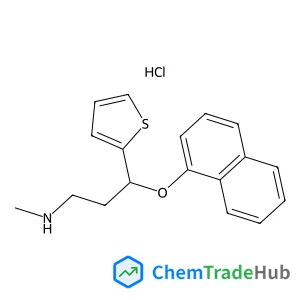
N-Methyl-3-(1-naphthyloxy)-3-(2-thienyl)-1-propanamine hydrochloride (1:1)
CAS番号:
1188266-11-6
分子式:
C18H20ClNOS
おすすめサプライヤー




免責事項
このページに表示される学術雑誌情報は、参考および研究目的のみを目的としています。当社は雑誌出版社とは提携しておらず、投稿の取り扱いも行っておりません。出版に関するお問い合わせは、各雑誌出版社に直接ご連絡ください。
表示されている情報に誤りがある場合は、support@chemtradehub.com までご連絡ください。迅速に確認し、対応いたします。